


* As the world's second-largest economy, China charts its course through medium- and long-term plans that clarify policy direction, development goals, and reform pathways, offering a degree of predictability that contrasts with governments fixated on short electoral cycles.
* The outline of the 15th Five-Year Plan (2026-2030) for national economic and social development sets a slew of goals, with high-quality development high on the agenda. Key indicators span areas including economic development, innovation, public well-being, green transition, and security.
* In an era of heightened geopolitical turbulence and rising economic uncertainty, China's consistent long-term development strategy has made the country a rare anchor of stability in the global economy.
BEIJING, March 12 (Xinhua) -- China's national lawmakers on Thursday approved a development blueprint for the 2026-2030 period, marking a pivotal step in the modernization drive of nearly one-fifth of the world's population.
As the world's second-largest economy, China charts its course through medium- and long-term plans that clarify policy direction, development goals, and reform pathways, offering a degree of predictability that contrasts with governments fixated on short electoral cycles.
"For us, the five-year plan is more than a macro blueprint," said Ginger Cheng, CEO of DBS China. "It serves as a 'metronome' for calibrating our strategic rhythm, ensuring our investment pulse remains synchronized with the key cycles of national development."
The outline of the 15th Five-Year Plan (2026-2030) for national economic and social development sets a slew of goals, with high-quality development high on the agenda. Key indicators span areas including economic development, innovation, public well-being, green transition, and security. Many of the indicators focus on people's livelihoods, sending a clear signal that development is ultimately meant to benefit the people.
Wu Fenggang, a national political advisor, noted that the 15th plan's wide-ranging indicators will push officials at all levels to move beyond GDP-centric thinking toward more balanced, accountable governance. It is a shift that aligns with the "correct view on governance performance" that became a buzzword at this year's "two sessions" -- the annual meetings of China's top legislature and top political advisory body.
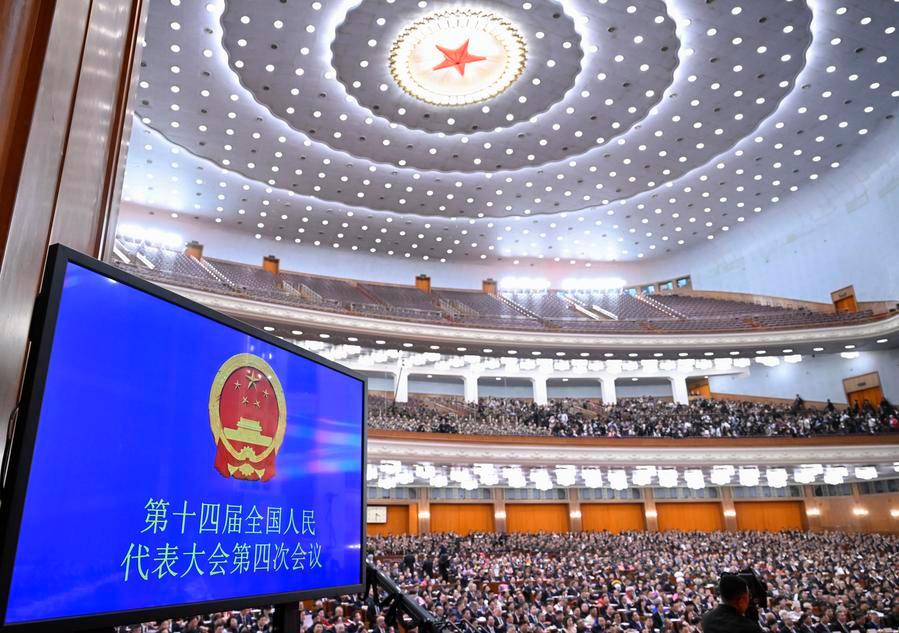
The closing meeting of the fourth session of the 14th National People's Congress (NPC) is held at the Great Hall of the People in Beijing, capital of China, March 12, 2026. (Xinhua/Shen Hong)
The dream of modernization has been a lasting aspiration of the Chinese people for centuries. After the Opium War of 1840, China was bullied by foreign powers and suffered from poverty and weakness. History bestowed upon the Communist Party of China (CPC) the momentous task of exploring a path to Chinese modernization.
In 2017, the CPC made a two-stage roadmap toward that goal. From 2020 to 2035, China aims to basically realize socialist modernization -- a process to be advanced through the 14th, 15th and 16th five-year plans.
From 2035 to the middle of this century, with another three five-year plans, the country will strive to build itself into a great modern socialist country that is prosperous, strong, democratic, culturally advanced, harmonious and beautiful.
The 15th Five-Year Plan period plays a pivotal connecting role. The targets set for 2026-2030 and the progress made during these five years will be decisive in determining whether China can basically achieve socialist modernization on schedule.
The plan maps out goals for "building up national strengths" across various sectors with manufacturing in spotlight. The value-added output of China's manufacturing sector has been the world's largest for 16 consecutive years.
Building a modern industrial system and strengthening the foundation of the real economy are high on the agenda. China will move to upgrade traditional sectors to the mid-to-high end of the value chain, nurture emerging industries, and make forward-looking plans for industries of the future.
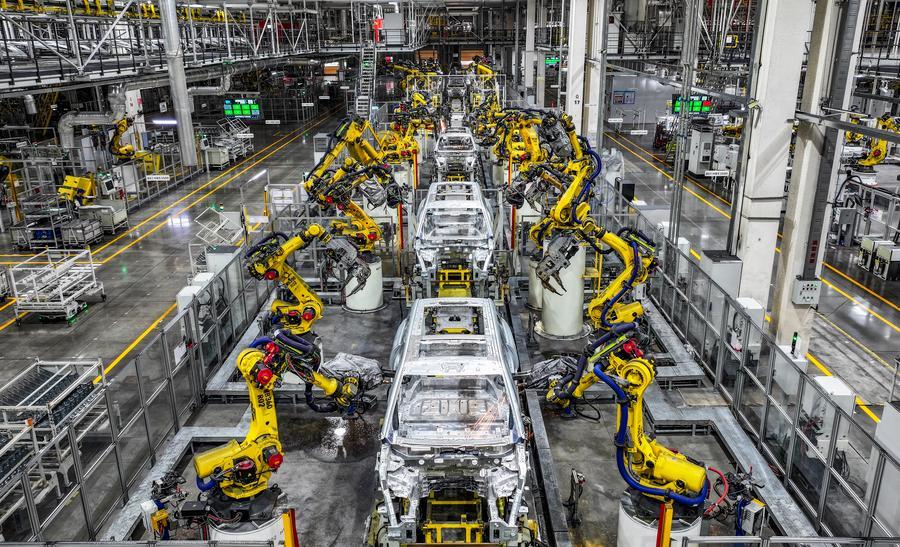
A drone photo shows the automated production at the Seres Super Factory in Liangjiang New Area, southwest China's Chongqing, Sept. 19, 2025. (Xinhua/Wang Quanchao)
Janice Hu, chairperson of UBS Securities Co. Ltd., said that Chinese companies are demonstrating dynamic innovation in artificial intelligence, high-end manufacturing, semiconductors, and new energy -- reshaping global investors' perception of Chinese assets.
"Chinese assets are no longer just a portfolio option. They are a strategic must-have," Hu told Xinhua.
At a time when some countries are turning to protectionism, China is proactively opening its vast market, transforming it into a source of global opportunity and cooperation. The country will promote the quality of foreign trade, according to the blueprint.
"Exports and imports are like the two wheels on a car. The more balanced they are, the more steadily it runs, and the farther it goes," said Minister of Commerce Wang Wentao at a press conference on the sidelines of the legislative session.

Farmers thresh the highland barley in their traditional way in Lhunzhub County, southwest China's Xizang Autonomous Region, Sept. 23, 2025. (Xinhua/Tenzin Nyida)
During the 14th Five-Year Plan period (2021-2025), China's economic performance was impressive. Total economic output crossed successive thresholds of 110 trillion yuan (about 15.95 trillion U.S. dollars), 120 trillion yuan, 130 trillion yuan, and 140 trillion yuan, with an average annual growth of 5.4 percent, well above the global average.
"The 15th Five-Year Plan's emphasis on high-quality development offers a source of certainty against a backdrop of mounting global uncertainty, and will help write a new chapter in China's twin miracles of rapid economic growth and long-term social stability," said Zhang Shuibo, a national lawmaker and professor with the College of Management and Economics at Tianjin University.
In an era of heightened geopolitical turbulence and rising economic uncertainty, China's consistent long-term development strategy has made the country a rare anchor of stability in the global economy, said Chen Zhanming, deputy head of the School of Applied Economics at Renmin University of China, in an interview with Xinhua.
Geostrategic analyst Imran Khalid wrote in a recent op-ed for Eurasia Review calling this year's two sessions a "watershed" moment. As the author noted, the roadmap laid out in the 15th Five-Year Plan shows a country that is clear-eyed about its future and ready to lead the development of industries in the 21st century.
In just a few decades, China completed a grand journey that took Western nations centuries -- rising from a country ravaged by poverty and foreign aggression to the world's second-largest economy. This historic achievement, forged through the concerted efforts of the Chinese people under the CPC's leadership, lends firm confidence to the nation's pursuit of the next milestone.
As emphasized by China's top leader Xi Jinping, "As long as we maintain strategic resolve, forge ahead step by step, and advance steadily from one stage to another, we will continue to turn small victories into great success in advancing the cause of the Party and the country, and our goals will surely be achieved."
(Video reporters: Huo Siying, Zeng Tao, Xu Jiatong, You Huiyuan, Dai He, Hua Hongli, Lin Guangyao, Nurdin Pallangyo, Zhang Jingyao, Yang Kai, Ahmad Kamal; video editors: Zhang Nan, Zhu Cong, Wang Han)
 A single purchase