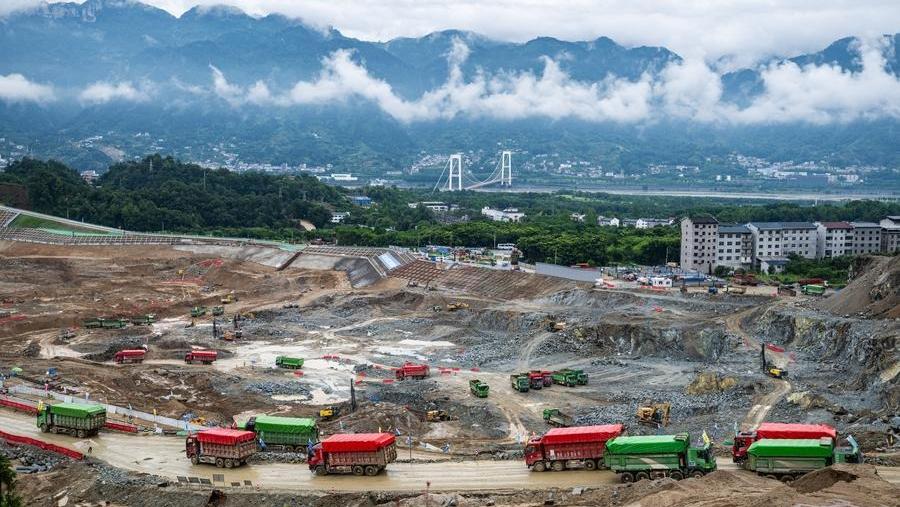



* China on Monday began construction of a mega waterway project on the Yangtze, the world's third-longest river.
* The 77.2-billion-yuan project will add a five-tier, dual-track ship lock north of the existing lock at the Three Gorges Dam and upgrade navigation facilities at a smaller downstream dam.
* It is the first major project to break ground during China's 15th Five-Year Plan period (2026-2030).
WUHAN, June 8 (Xinhua) -- China on Monday began construction of a mega waterway project, including what is expected to become the world's largest inland ship lock, in response to the rising shipping demand along the Yangtze, the world's third-longest river.
The 77.2-billion-yuan (about 11.3 billion U.S. dollars) project will add a five-tier, dual-track ship lock north of the existing lock at the Three Gorges Dam, the world's largest water conservancy project, and upgrade navigation facilities at a smaller downstream dam.
Once completed, it will almost double the annual throughput capacity at the Three Gorges to 336 million tonnes.

Chinese Vice Premier Ding Xuexiang, also a member of the Standing Committee of the Political Bureau of the Communist Party of China Central Committee, kicks off the construction of the Three Gorges new waterway project at a commencement ceremony in Yichang, central China's Hubei Province, on June 8, 2026. (Xinhua/Li Tao)
Chinese Vice Premier Ding Xuexiang, also a member of the Standing Committee of the Political Bureau of the Communist Party of China Central Committee, kicked off the construction of the Three Gorges new waterway project at a commencement ceremony in Yichang, central China's Hubei Province.
The ceremony was attended by officials from relevant central authorities and state-owned enterprises, as well as representatives from project consulting, design and construction organizations and local communities.
The project is expected to set world records for inland ship lock construction in navigable vessel dimensions, chamber size and earthwork excavation, said Niu Xinqiang, an academician of the Chinese Academy of Engineering.
The design emphasizes ecological protection by including dedicated fish passages and using construction methods that minimize impacts on fish and other aquatic species, Niu said.
For instance, to avoid affecting the spawning grounds of the Chinese sturgeon, China has revised the original design, a move that raised the cost of the project by 2 billion yuan, said Gao Peng, deputy chief engineer of the China Three Gorges Corporation.
It is the first major project to break ground during China's 15th Five-Year Plan period (2026-2030), a critical stage in the country's efforts to advance toward its goal of basically realizing socialist modernization by 2035.
"It echoes the development priorities set out for the next five years, including high-quality development and green growth of the Yangtze River Economic Belt," said Tang Pengfei, an economist from Hubei Academy of Social Sciences.
Spanning 11 provincial-level regions from the inland west to the eastern coast, the Yangtze River Economic Belt accounts for nearly half of national GDP. It hosts major industrial clusters covering metallurgy, electronics and automobiles, while newer sectors such as AI, biomedicine and new energy are rapidly taking shape.
The economic belt is also one of China's major hubs for foreign investment and trade, accounting for nearly half of the country's foreign trade.
River transport remains vital to China's economy, especially along the Yangtze, which stretches over 6,300 km and is known as the country's golden waterway.
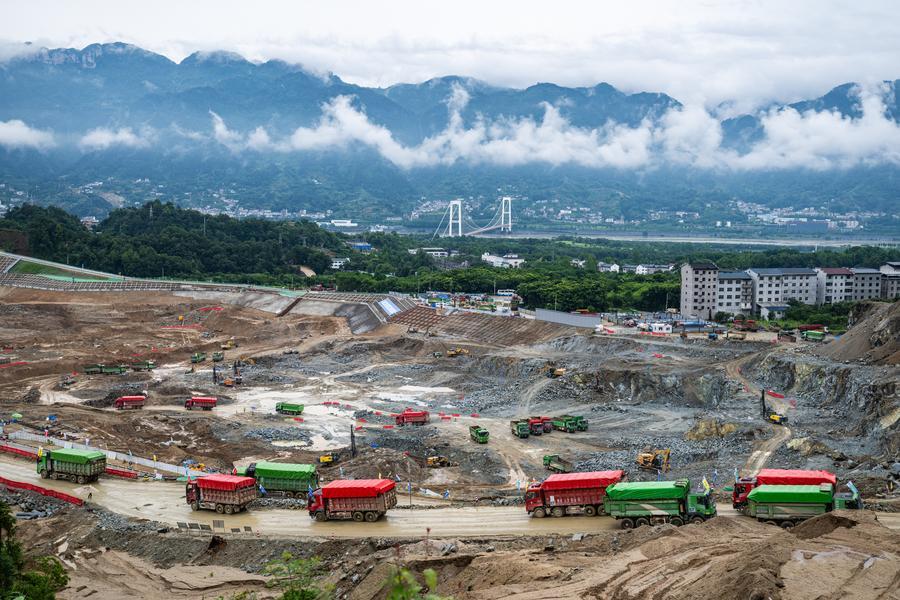
This photo taken on June 8, 2026 shows the construction site in an early-phase excavation zone of the Three Gorges new waterway project in Yichang, central China's Hubei Province. (Xinhua/Wu Zhizun)
However, rapid economic growth and soaring cargo transport demand have increased pressure on the existing Three Gorges ship lock, which in 2011 surpassed its designed capacity of 100 million tonnes of annual cargo throughput, 19 years ahead of schedule. Last year's figure exceeded 170 million tonnes.
Feasibility studies predicted that cargo demand through the Three Gorges ship locks would reach 220 million tonnes by 2035 and 250 million tonnes by 2050, Niu said.
The new ship lock and its approach channels, which together stretch about 6,680 meters, are expected to take over nine years to build, while the downstream dam upgrade is scheduled to be completed in about eight years.
The new waterway is expected to ease supply chain bottlenecks, cut trade costs and better connect inland regions with global markets, Tang said.
For those who work on the river, the project could mean both shorter waits and lower costs.
"With the new waterway, companies would spend less on delays, and we could get home earlier," said Jiang Zhongjin, captain of a container ship who has sailed along the Yangtze for two decades.
The Three Gorges, a 200-kilometer stretch of the Yangtze formed by the Qutang, Wuxia and Xiling gorges, has long been central to China's efforts to contain floods and improve navigation on the river.
Construction of the Three Gorges project began in 1994, and its reservoir began storing water in 2003. It has played a key role in flood control, power generation and navigation on the Yangtze River.
(Reporting by Cheng Lu, Wang Jian, Yue Wenwan, Yao Yuan, Zhang Xu, Dai Xiaohe, Li Siyuan and Fang Dong; Video reporters: Fang Yadong, Tian Zhongquan, Rao Rao and Wu Zhi; Video editors: Wu You, Zhang Mocheng and Liang Wanshan.)
 A single purchase