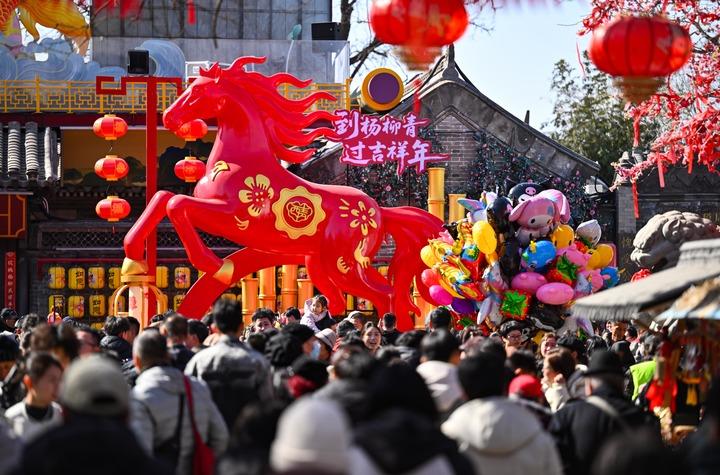



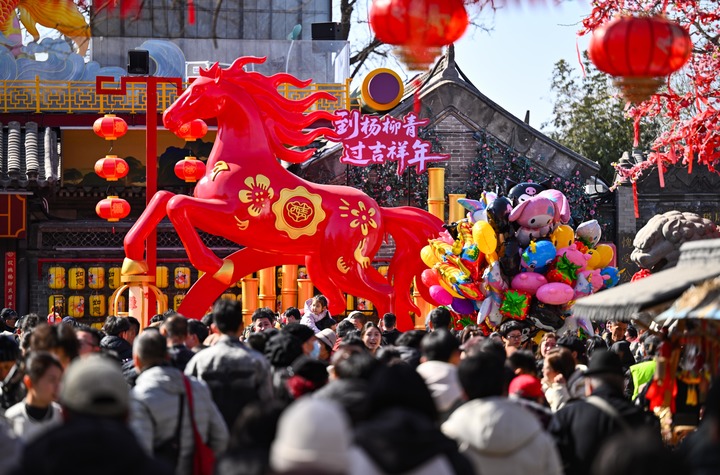
Visitors have fun at Yangliuqing ancient town in Tianjin, north China, Feb. 22, 2026. Yangliuqing ancient town launched a range of activities featuring folk customs, traditional culture and interactive experiences, offering visitors an immersive folk feast during this Spring Festival holiday. (Xinhua/Zhao Zishuo)
BEIJING, March 2 (Xinhua Silk Road) -- The Chinese New Year holiday had just passed. During the nine-day holiday from Feb. 15 to 23, China's domestic tourism and consumption markets saw remarkable growth, reflecting increasingly strong domestic demand momentum.
Regarded as the longest Chinese New Year holiday, also known as the Spring Festival holiday, this year's break saw a 5.7-percent increase in average daily sales of major retail and catering enterprises across the country compared with the 2025 new year holiday, more than 2.8 billion cross-regional trips nationwide, about 596 million domestic tourism trips, and a total domestic tourism spending of nearly 803.5 billion yuan.
The Spring Festival holiday is traditionally a peak consumption season in China and the optimization of the long-holiday system has further unleashed a "time bonus", which stimulates consumers' spending vitality.
-- Long holiday ignites cultural tourism market
A report jointly released by China Association of Travel Services and China's famous online travel platform Tuniu says that Tuniu users spent an average of 5.9 days on travel during the holiday, 1.1 days more than the figure last year. Data from another Chinese travel platform Mafengwo shows that orders for long-distance travel (more than five days) made up 59.6 percent of the total number of orders.
As this year's Spring Festival coinciding with the Winter Olympics, tourists' enthusiasm for ice-and-snow sports continued to rise. On the second day of the new year, at the Nantian Lake International Ski Resort in Fengdu, Chongqing, the winding ski slopes were crowded with people.
The extended holiday break has created unprecedented new opportunities for tourism, transportation, retail, and catering industries, especially for the cultural and tourism market, said Cai Muzi, a researcher at the Big Data Research Institute of China's tourism platform Qunar. Many people have chosen a segmented holiday model of "reunion first, vacation later", which has directly stimulated the growth of scenic spot tickets, accommodation and other related industries, Cai noted.
-- New consumption scenarios unlock further potentials
As one of the first batch of comprehensive pilot cities for "movie+" consumption, Changsha, the capital city of Hunan Province, launched an innovative consumption scenario of "movie + market" during the holiday, connecting thousands of stores and businesses with a single movie ticket and enriching the holiday experiences of citizens and tourists.
With the movie ticket stubs, Ms. Li, a Changsha resident, said that her family could buy various food and cultural creative products with discounts at stalls on a movie-related fair held in a shopping center in Changsha.
Various new consumption scenarios and businesses across the country have been created and further activated the potential of the festive consumption market. Robots performed lion dance at the 2026 Haidian New Year Science and Technology Temple Fair in Beijing; Hangzhou of Zhejiang launched a series of theme activities related to a recently popular TV series called The Year of Taiping; many places in Anhui have promoted cross-sector integration such as "old buildings + new formats" and "science and technology + folk customs".
-- Policy support enhances consumer benefits, market vitality
China has continued allocating consumption subsidies to various regions across the country in 2026. This year, the first batch of 62.5 billion yuan in consumer goods trade-in subsidies has been allocated nationwide, with increased subsidy distribution during the Spring Festival holiday. Local governments also arranged 2.05 billion yuan through consumption vouchers, subsidies, and digital red envelopes delivered directly to consumers during the holiday. Multiple departments introduced holiday gift packages, including trade-in programs, prize-winning invoices, and financial support to invigorate the festive consumption market with tangible incentives.
Data show that during the holiday, the foot traffic and business turnover of the 78 business districts under the key monitoring of the Ministry of Commerce increased by 6.7 percent and 7.5 percent, respectively, compared with the same period last year. The sales of key monitored catering enterprises increased by 5.2 percent compared with the Spring Festival holiday last year.
Meanwhile, sales of smart glasses and embodied smart robots on key platforms increased by 47.3 percent and 32.7 percent, respectively, compared with last year's Spring Festival break. The average daily sales revenue of consumption-related industries across the country increased by 13.7 percent compared with the last Spring Festival holiday.
On the first day of the Year of the Horse, China implemented a visa-free policy for ordinary passport holders from Canada and the United Kingdom, expanding its unilateral visa-free "circle of friends" to 50 countries.
The growing popularity of "Travel to China" and "Shop in China" has continued to drive domestic consumption. Data show that during the holiday, 460,000 inbound foreign visitors entered China under visa-free policy, representing a 28.5-percent increase in daily average compared with last year's Chines New Year holiday. Bookings for inbound tourism products increased by 18.4 percent year-on-year.
The vibrant scenes during the Spring Festival holiday provided a vivid reflection of economic vitality in China and showed that domestic potential had been effectively unleashed. (Edited by Li Xueqing with Xinhua Silk Road, lixueqing@xinhua.org)
 A single purchase