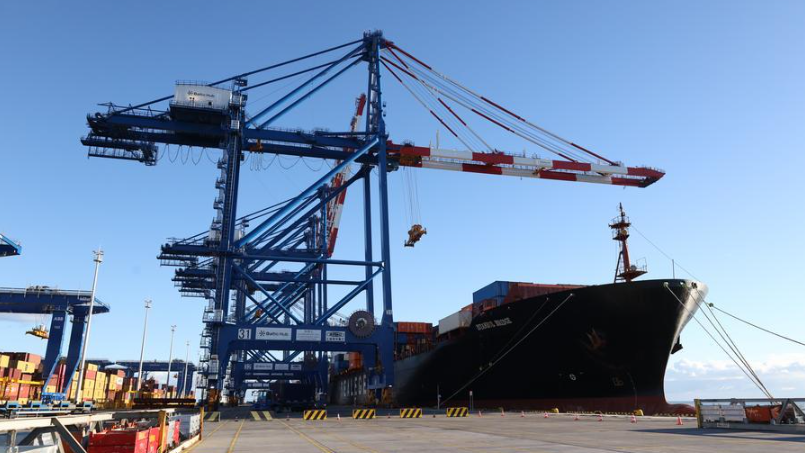



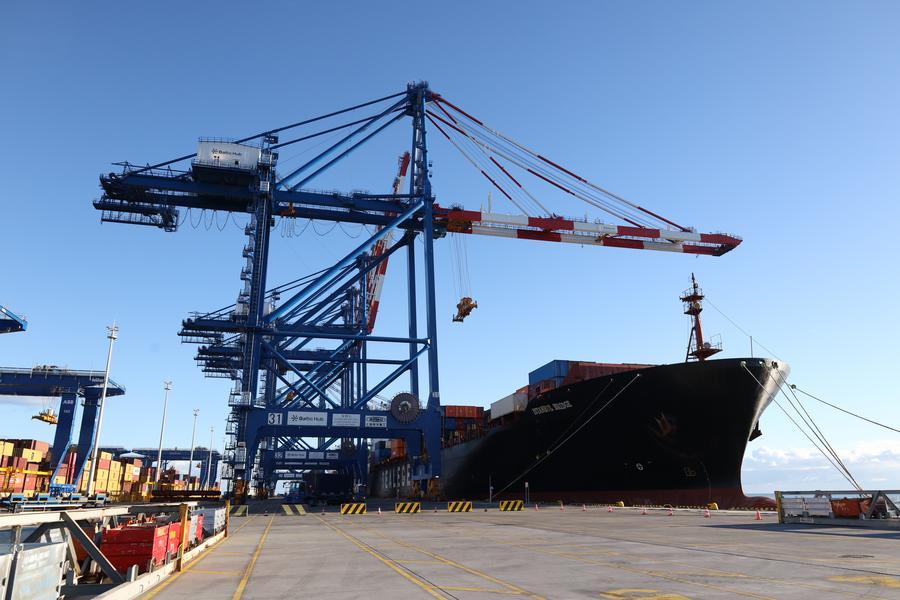
This photo taken on Oct. 19, 2025 shows the "Istanbul Bridge," the first vessel on the China-Europe Arctic container express route, berthing at the Port of Gdansk, Poland. (Xinhua/Cui Li)
Cooperation, innovation and shared business models will define the next phase of Britain-China economic relations, Stephen Perry said, reiterating that China's approach is based on building access and connections rather than closing markets.
LONDON, Dec. 30 (Xinhua) -- China's approach to globalization is about building networks and expanding access to markets rather than erecting barriers -- a method that is "more important in globalization than almost any other factor," Stephen Perry, president emeritus of Britain's 48 Group, told Xinhua in an interview.
Globalization is "a natural characteristic of the development of the economies of the world" rather than a deliberate political invention, Perry said, noting that many regions across Africa, Asia and South America were historically shaped by colonial transport systems designed to move resources from inland areas to ports, without fostering connections between countries.
In contrast, China has "helped all those three continents develop transportation systems that enabled them to do business with each other," Perry said.
At the outset of China's "going global" policy, Perry said, most of China's trade was concentrated in North America and Europe. This has changed, however, as China has expanded its trade with Asia, Africa and countries across the Global South.
Perry said the Belt and Road Initiative "immediately opened up a huge amount of trade between China and Europe," adding that China's rail and road corridors created trading routes that were previously considered impossible.
He described China as "the leader of globalization," noting that these routes are not limited to Chinese companies but accessible to the broader international community.
Perry said China does not seek expansion through military force, noting that the country "is not pointing missiles all over the world." Instead, it pursues a policy aimed at helping global development, "and with that process, China will grow as well."
On innovation, Perry said China will continue to innovate "in every area for the next 500 years," adding that China has restructured its education system to prepare for future technological needs, with a significant portion of China's university education shifting toward "new technology and the new era."
Disputes over electric vehicles and other advanced technologies could be eased through joint ventures and shared ownership between Chinese and European companies, Perry said.
European companies must rethink their business models, he added, warning that attempts to dominate markets in Asia or Africa would "lead to resistance."
He said the 48 Group is now focusing on technology, robotics and artificial intelligence, working to introduce new British companies to the Chinese market while encouraging Chinese companies to operate in Britain.
Perry said tariffs and trade barriers discourage long-term investment and disrupt supply chains, calling them "barriers to progress."
He added that younger generations are generally more interested in traveling, working and engaging globally rather than in "setting up barriers."
Cooperation, innovation and shared business models will define the next phase of Britain-China economic relations, Perry said, reiterating that China's approach is based on building access and connections rather than closing markets.
 A single purchase