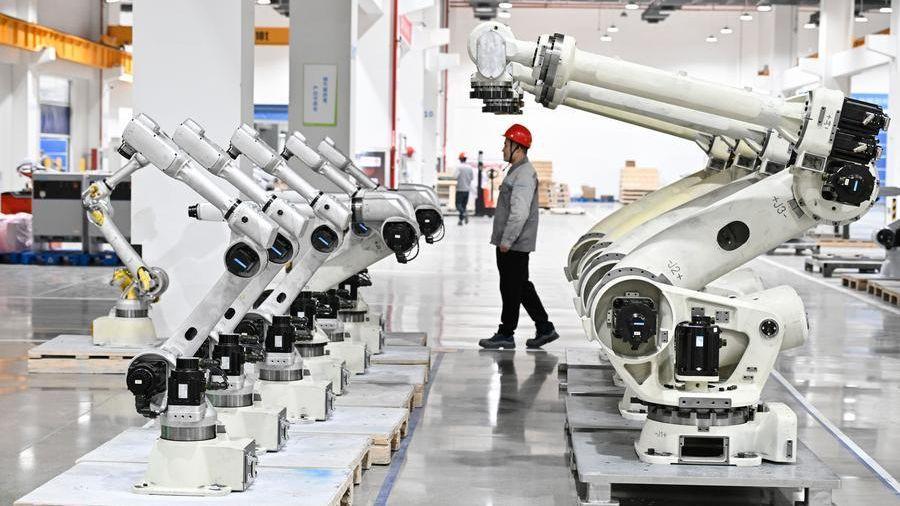



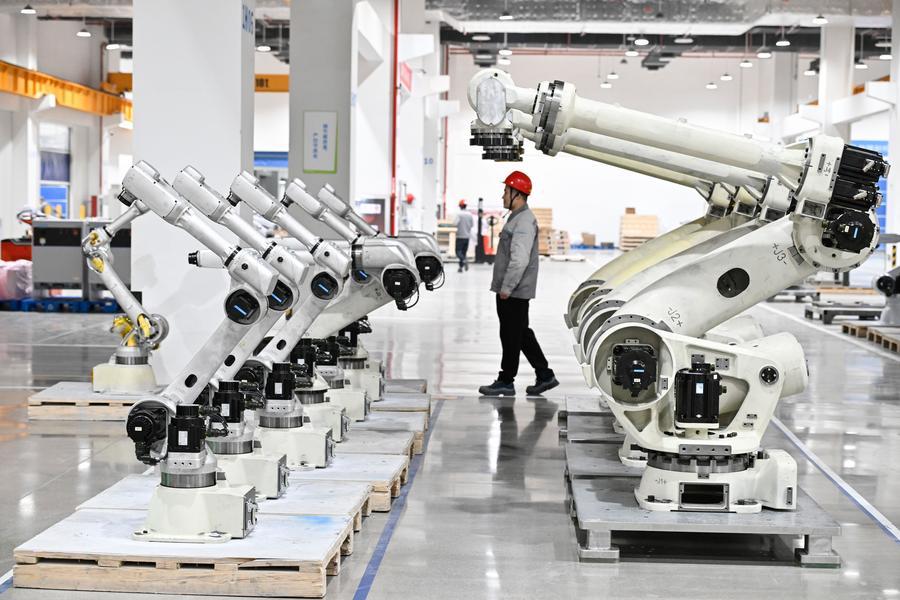
This photo taken on March 17, 2026, shows robots at a workshop of Inovance Group in Jiangning District of Nanjing, east China's Jiangsu Province. (Xinhua/Ji Chunpeng)
"The innovation pace in China is extremely strong. In China, AI is already widely applied across production stages, from workflow design to factory management in collaboration with human teams," said Bosch chairman.
by Xinhua writer Li Hanlin
HANNOVER, Germany, April 23 (Xinhua) -- China is becoming a key global driver of AI-powered smart manufacturing, said Stefan Hartung, chairman of the board of management of the Bosch Group, as the German technology supplier expands its industrial AI applications and deepens its local innovation footprint.
AI is rapidly transforming manufacturing from a supporting tool into an embedded decision-making layer, enabling closer human-machine collaboration, said Hartung in a recent interview with Xinhua at the Hannover Messe, Germany's flagship industrial trade fair.
Bosch is advancing its "agentic AI" concept, which integrates humans, machines and digital systems into a unified operational framework aimed at addressing labour shortages, rising complexity and cost pressures in industrial production, he noted.
Under this model, agentic AI systems can monitor production in real time, detect early deviations and trigger corrective actions before major failures occur. When faults do happen, workers can interact directly with AI systems via voice or chat interfaces.
The system can also retrieve manuals, analyse shift logs and provide step-by-step troubleshooting guidance, while automatically documenting incidents and sharing solutions across plants using similar equipment.
"AI agents can answer questions up to three times more accurately than isolated systems and reduce manual documentation and data reconciliation work by up to 50 percent," he said, adding that the impact is becoming increasingly evident at scale in large industrial environments.
He pointed to Bosch's smart factory in the eastern Chinese city of Suzhou as an example of how agentic AI is being applied in industrial settings.
At the plant, Bosch engineers have developed an AI agent-based platform for new product industrialisation, integrating nearly 30 AI models and multiple agents for quality inspection and production preparation.
The system reduces processes that previously took several weeks to around one to two weeks and is now being gradually rolled out to Bosch plants in Europe and North America, according to Hartung.
He said China plays a particularly important role in this transformation, given its large-scale manufacturing base, rapid adoption of new technologies and strong engineering talent pool.
"The innovation pace in China is extremely strong. In China, AI is already widely applied across production stages, from workflow design to factory management in collaboration with human teams," he said.
China remains Bosch's largest single automotive and industrial market in Asia, supporting the company's global growth trajectory.
In 2025, Bosch's sales in China reached 149.8 billion yuan (21.9 billion U.S. dollars), up 4.9 percent year-on-year. Hartung said China's scale and technological dynamism continue to underpin its strategic importance for the group.
Bosch's global manufacturing network includes more than 220 plants, of which 38 are in China, making the country not only a major production base but also an increasingly important source of industrial innovation, according to Hartung.
"We are seeing strong innovation momentum in China, supported by talent from universities and a very strong manufacturing ecosystem," he said.
Bosch employs around 57,000 people in China and has invested an average of around 6 billion yuan (879 million U.S. dollars) annually in recent years, driven by its market scale and technological change, he said.
"This makes it a long-term strategic investment for us," he added. "We will continue to increase investment and deepen local innovation and industrial cooperation."
 A single purchase