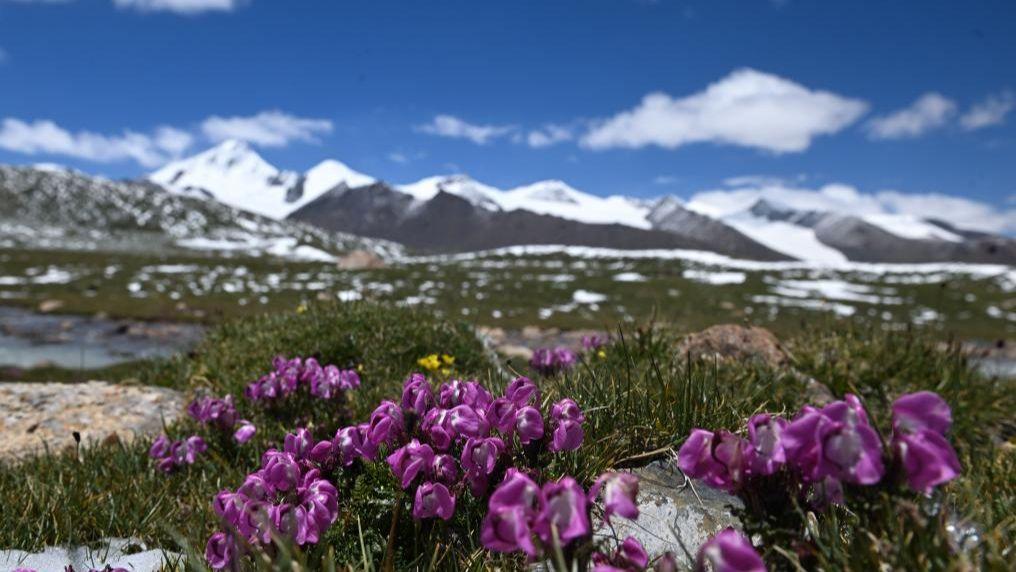



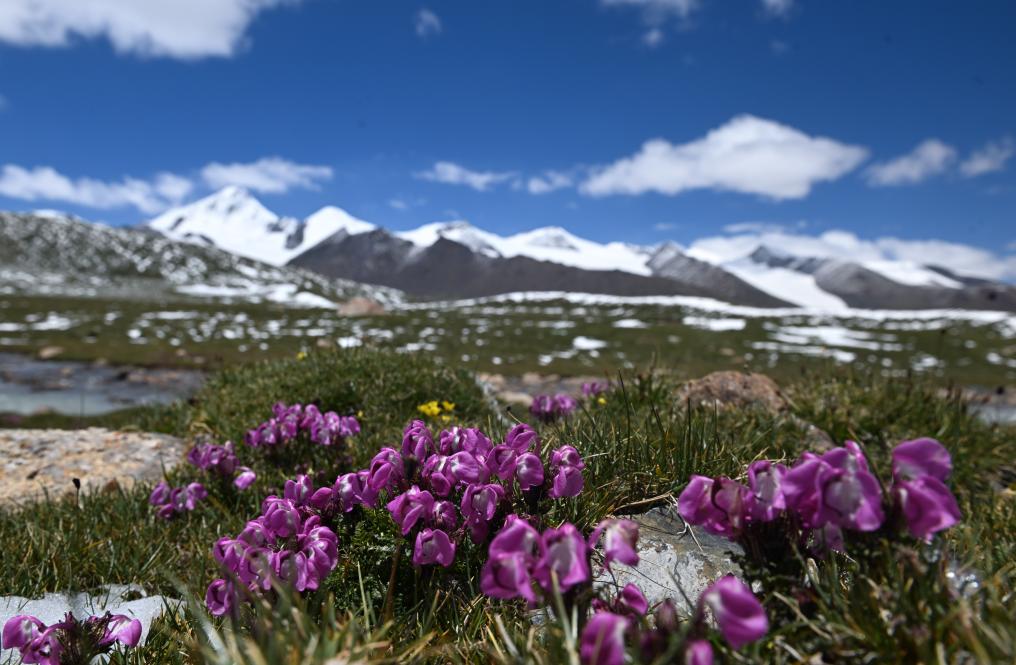
 This photo taken on July 21, 2022 shows a view of the Mount Geladandong in the source region of the Yangtze River in northwest China's Qinghai Province. (Xinhua/Zhang Long)
LANZHOU, March 17 (Xinhua) -- Chinese scientists have uncovered the drivers of divergent climate changes across Asia over the past 130,000 years, making headway in the study of dust accumulation, humidity evolution, and the driving mechanisms at multi-spatial and temporal scales in Asia, according to Lanzhou University.
"Published in the journal Science Advances, this study provides a long-term timescale benchmark for predicting future climate-change trends," Li Guoqiang, professor at the College of Earth and Environmental Sciences of Lanzhou University, told Xinhua.
"It has also offered a significant scientific basis for analyzing the trend of aridification in Asia, changes in precipitation patterns, and risks of dust activities under the background of global warming," he added.
Climate change in Asia is influenced by several large-scale circulation systems, including the mid-latitude westerly monsoon, the East Asian and South Asian summer monsoons, and the East Asian winter monsoon. The fluctuations in strength and weakness of these climate systems and their interactions have profoundly shaped the hydroclimatic pattern in the region and had a far-reaching impact on people's living environment and social development.
Previously, there was considerable controversy over the evolution processes and driving mechanisms of different climate systems, as well as their impacts on the spatial differentiation of climate change in Asia, according to Li.
Loess-paleosol sequences across Asia provide a critical archive of past dust deposition and climate dynamics shaped by westerlies and Asian monsoons. Applying a new potassium feldspar infrared luminescence dating technology, the study team systematically established high-resolution dating scales for over twenty loess-paleosol sequences in the arid regions of Central Asia and the Qinghai-Tibet Plateau.
In collaboration with researchers from over 30 universities and institutions both at home and abroad, the study team constructed and released the world's first dataset of Asian Loess luminescence dating and paleoclimate proxy indicators, providing an important data basis for conducting comprehensive research on the Asian continental scale.
The study results showed that dust accumulation in Asia is not a single response to variations in winter wind strength. The accumulation of loess across different regions is jointly influenced by multiple factors, including material supply, vegetation cover, local topography, sea-level fluctuations, and human activities.
Meanwhile, the discontinuity of loess sedimentary strata was widespread in different regions of Asia during the late Quaternary, and wind erosion might be the main cause, according to the study results.
"Our study has for the first time comprehensively reconstructed the history of dust accumulation and humidity changes in Asia over the past 130,000 years on a continental scale. It provides new key evidence for understanding the climate change processes and their driving mechanisms in Asia at different time scales," Li said.
It has also deepened the understanding of the mechanism underlying the evolution of the Asian climate system in a more scientific manner. Meanwhile, it established an important reference sequence for humidity and precipitation to assess the long-term evolution of the climate system, according to Li.
 A single purchase