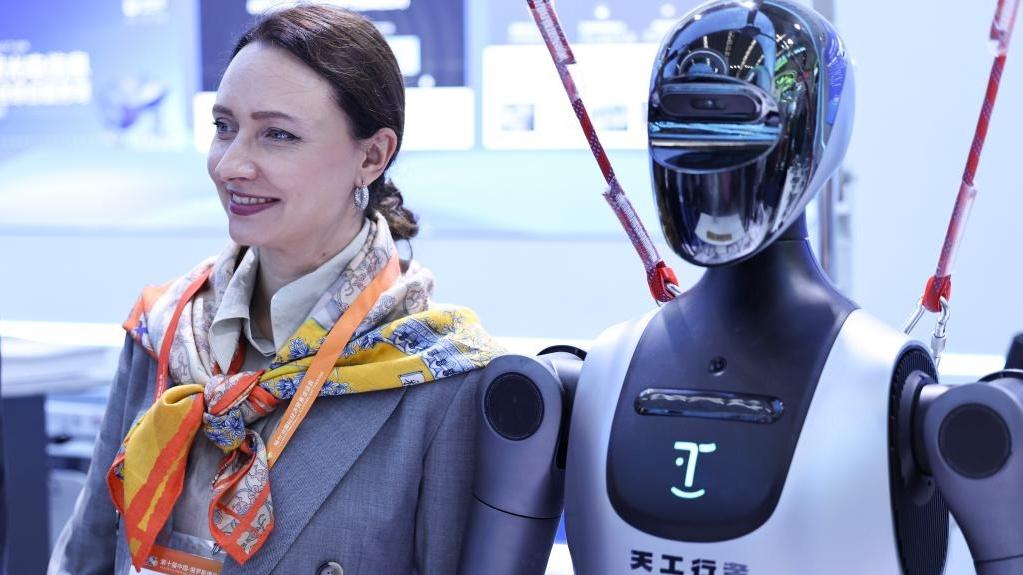



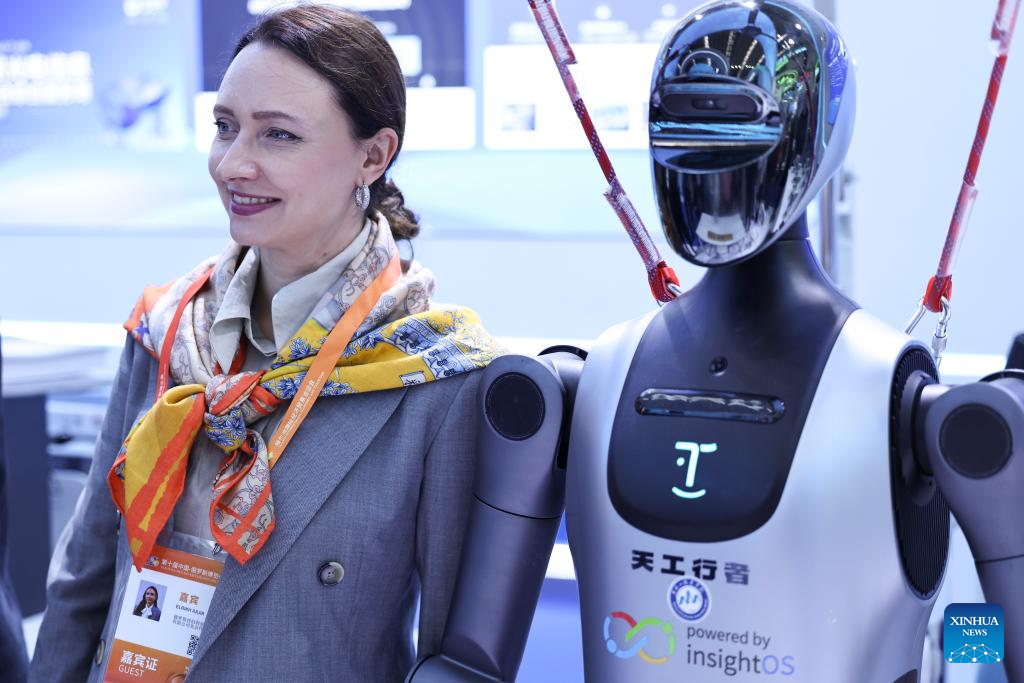
An attendee poses for a photo with a humanoid robot at the 10th China-Russia Expo in Harbin, northeast China's Heilongjiang Province, May 17, 2026. The 10th China-Russia Expo opened to the public on Sunday. The expo covers a total exhibition area of 55,000 square meters and features over 1,500 enterprises from 46 countries and regions. (Xinhua/Zhang Tao)
HARBIN, May 18 (Xinhua) -- A silvery model surgical robot at the exhibition hall of the 10th China-Russia Expo has become a magnet for visitors, many stopping to learn how the device performs remote-controlled vascular interventional surgeries.
Unlike conventional procedures, where doctors operate under heavy lead aprons and are exposed to radiation, the robot enables surgeons to perform operations remotely, reducing radiation exposure and improving precision and efficiency.
This year, with a subsidiary founded in Harbin, the capital of northeast China's Heilongjiang Province, the company is using the expo to explore the Russian market, said Qin Guanbo, an executive with Beijing VAS Medical Tech Co., Ltd.
"Though we only brought product models this time, we hope to use the China-Russia Expo to carry out medical cooperation with Russian partners and expand overseas markets for high-end domestic medical devices," Qin said.
At another booth, Heilongjiang Huida Technology Co., Ltd. showcased smart agricultural machinery, including an unmanned vehicle designed for orchards and greenhouses.
"The multi-functional unmanned equipment supports autonomous path planning and modular multi-task operations," said Chu Haibo, deputy general manager of Huida Technology. "It can be equipped with modules for spraying, transportation and mowing to enable smart and efficient farming in complex agricultural environments."
Chu said consecutive participation for four sessions has helped the company expand its market by connecting directly with buyers, strengthening supply chains, and learning advanced industrial technologies.
"We hope to deepen cooperation in smart agriculture and the low-altitude economy while expanding into Russia and other Belt and Road markets," Chu said.
This year's expo has attracted more than 1,500 enterprises from 46 countries and regions, with a total exhibition area of 55,000 square meters, according to Chen Shijun, president of the China Council for the Promotion of International Trade Heilongjiang Committee.
Nearly 100 supporting events covering industrial matchmaking, investment promotion, international cooperation, tourism and consumption will be held during the expo. Chinese and Russian exhibitors are also expected to stage over 100 events to debut and release new products.
Nearly 300 Russian enterprises are participating in the event, displaying achievements in high-end manufacturing, energy equipment, modern agriculture and digital technologies. Its procurement group is expected to exceed 5,000 people.
Chen said China-Russia economic and trade cooperation has expanded beyond traditional sectors such as energy and minerals into emerging industries, including the digital economy, green development and cross-border e-commerce.
High-tech firms and specialized, sophisticated enterprises account for more than 20 percent of exhibitors at this year's expo, which showcases more than 500 new products and equipment, as well as over 800 new projects, technologies, and cooperation initiatives.
Chinese Vice Premier Zhang Guoqing and Yury Trutnev, Russian deputy prime minister and presidential plenipotentiary envoy to Russia's Far Eastern Federal District, attended the five-day expo's opening ceremony in Harbin on Sunday.
Zhang said China is willing to work with Russia to follow the important consensus reached by the two heads of state, make good use of platforms such as the China-Russia Expo, give full play to the role of the Northeast-Far East cooperation mechanism between the two countries, and continuously expand the space for win-win development.
Trutnev said Russia is willing to make good use of the intergovernmental cooperation mechanism, unleash the potential of local cooperation, and enrich the achievements of the development of bilateral relations.
Since its launch in 2014, the expo has evolved into the highest-level, largest, and most influential institutional platform for economic and trade cooperation between China and Russia, facilitating cooperation in areas including infrastructure, cross-border logistics, and regional connectivity, Chen said.
More than 7,200 Chinese and Russian enterprises and 1.05 million business visitors have attended the expo since its inception. According to organizers, the cumulative transaction volume of the China-Russia Expo has exceeded 300 billion yuan (about 43.9 billion U.S. dollars).
 A single purchase