


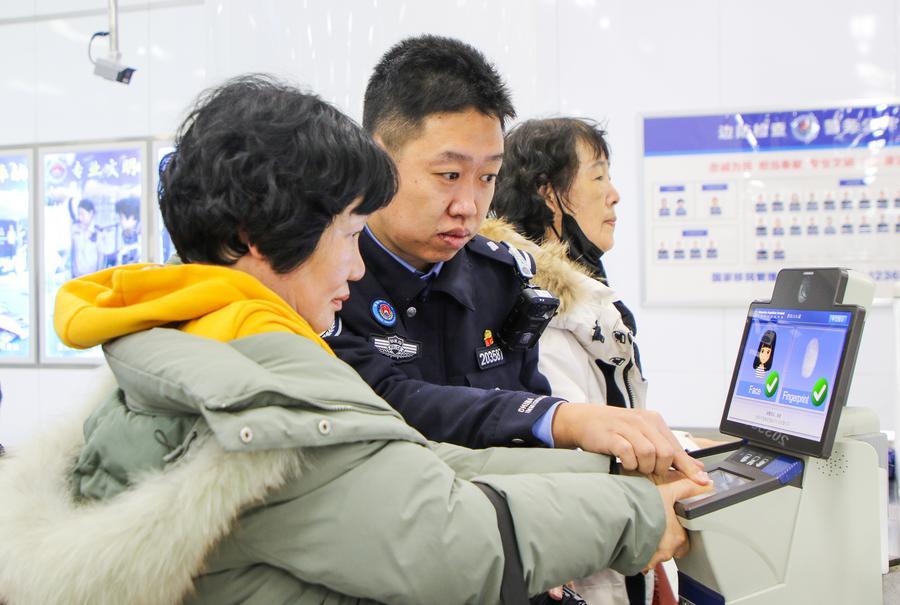
A police officer helps a South Korean tourist scan fingerprint at the arrival hall of the international passenger terminal of Lianyungang Port in Lianyungang City, east China's Jiangsu Province, Dec. 28, 2025. (Photo by Wang Jianmin/Xinhua)
SEOUL, Jan. 4 (Xinhua) -- People-to-people exchanges between South Korea and China in 2025 have continued to pick up pace, driven by visa-free policies, rising mobility and expanding cultural interaction.
Since China introduced the visa-free policy for South Korean citizens in November 2024, cross-border travel has increased notably. At Gimpo International Airport, China has once again become a popular destination for South Korean travelers, many opting for short-term visits to major Chinese cities.
According to statistics from South Korea's Ministry of Justice, bilateral personnel exchanges exceeded 7.28 million visits in the first 11 months of 2025, up 24.7 percent year-on-year, reflecting a strong recovery in mutual visits.

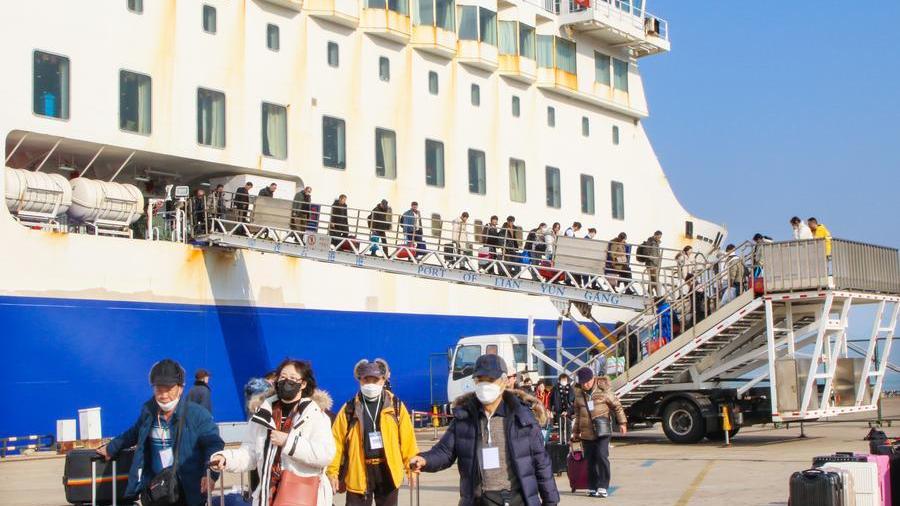
Tourists from South Korea get off from the "Harmony Yungang" cruise ship at Lianyungang Port in Lianyungang City, east China's Jiangsu Province, Dec. 28, 2025. (Photo by Wang Jianmin/Xinhua)
Personal stories underscore this trend. Over the past year and a half, South Korean social media influencer Jang Su-seok has made more than 30 trips to China, visiting over 30 cities across the country.
Through images of everyday street life and candid encounters, he has documented not only China's urban rhythms but also his own evolving views. "China is a country that makes you want to return once you've been there," he said, adding that the sense of warmth he felt is drawing people closer.
The surge in exchanges is also clearly visible in the aviation sector. Korean Air's 2025 year-end report indicated a marked rise in passenger numbers on China-bound routes, with flights to Shanghai, Beijing and Qingdao all recording substantial increases compared with the previous year.

Tourists take photos at Gyeongbokgung Palace in Seoul, South Korea, Nov. 7, 2025. (Xinhua/Yao Qilin)
Observers note that easier travels help broaden exchanges beyond tourism. Lee Jeung-eun, president of Chinese Bridge Club in Seoul, said the visa-free policy has encouraged more South Koreans to experience China firsthand, fostering a more direct and practical understanding.
Analysts agree that the steady growth of people-to-people exchanges is reinforcing mutual familiarity and helping anchor China-South Korea relations.
Exchanges among young people, along with tourism and cultural interaction, are becoming increasingly embedded in everyday life, helping to translate bilateral engagement into tangible connections, said Ryu Ji-won, director of the Institute for Korea-China Relations at Wonkwang University.
 A single purchase