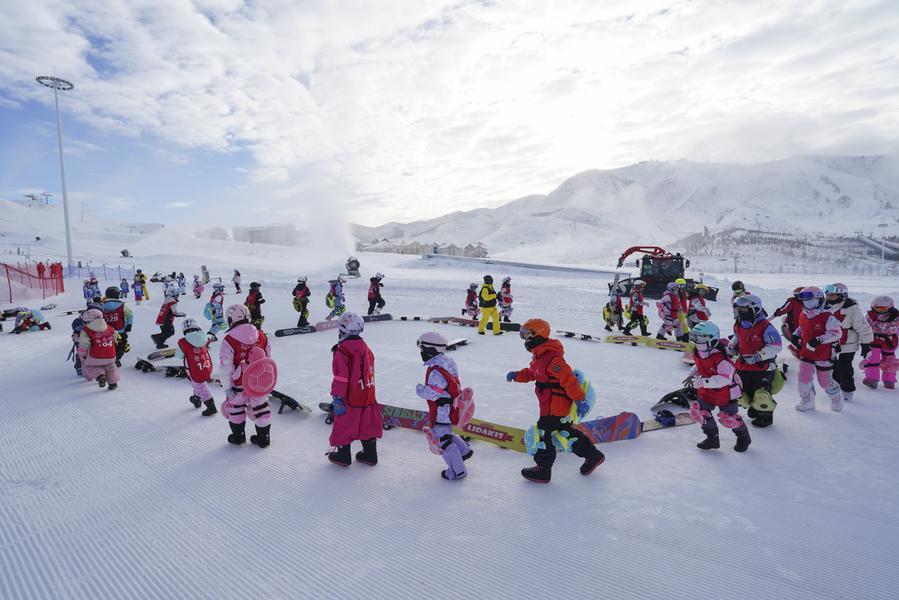



Students do warm-up exercises at Jiangjunshan International Ski Resort in Altay, northwest China's Xinjiang Uygur Autonomous Region, Dec. 1, 2025. (Xinhua/Aman)
BEIJING, Dec. 15 (Xinhua) -- As winter arrives, several regions in northern China have kicked off their "ice-and-snow holidays" for primary and secondary school students, offering them a unique opportunity to engage in winter sports while boosting local tourism economy.
Students in Urumqi and Altay in northwest China's Xinjiang Uygur Autonomous Region welcomed their off-season "snow holidays" from December 1 to 5, while in Jilin Province in northeast China, their peers also enjoyed the first "ice-and-snow" holidays on December 3 to 7.
As new business forms related to ice and snow tourism keep emerging and favored policies targeting the entire tourism chains are implemented, the number of bookings for scenic spots tickets, hotels and flight tickets throughout the region has jumped remarkably, driving an in-depth integration of culture, sports and tourism and injecting impetus into the development of local economy.
-- Tour of culture and sports
Curling, frisbee shooting, snow football, skiing experience... On the first day of the snow holiday, the Nami Valley Resort in Jilin City was crowded with people. The sound of skis whooshing across the snow and the cheerful laughter of children echoed throughout the valley.
"Imagine greeting a little squirrel. Tilt your skis inward and you will make the turn smoothly," said a coach who is teaching Pan Shian, a primary student in Jilin City, the skiing skills. "I can ski now and I want to keep skiing in the future", said Pan.
The ice and snow holidays not only lit up people's enthusiasm for sports but also extended its influence to the cultural industry.
Thousands of kilometers away in Xinjiang, an educational tour combining knowledge and fun is underway. In the Museum of the Origin of Human Skiing inside the Altay Jiangjunshan International Ski Resort, students immerse themselves in exploring the origin of human skiing and systematically learn about the long history and unique charm of the sport.
During the snow break, museums, art galleries and libraries in Urumqi, Altay and Jilin Province will be open to the public for free.
"Taking advantage of this rare snow holiday, I brought my child to visit the latest exhibition on modern and contemporary history of northeast China to give my child a deeper understanding about the history in the region," said Peng Yao, a citizen of Changchun, capital city of Jilin Province.
The establishment of the snow holiday is an innovative practice based on the region's unique ice and snow resources, aiming to promote quality education and regional development, said Wang Juan, vice director of the cultural, radio, television and tourism department of Urumqi.
-- A boost for regional economy
The snow vacation has begun to unleash consumption potential and promote regional development, with its economic spillover effects already becoming visible.
According to data from Qunar, a popular online tourism services provider in China, ticket bookings for scenic spots in Jilin Province increased by 13 percent year on year from December 3 to 7. During Xinjiang's snow break, ticket bookings rose by 16 percent compared with the same time of November.
Urumqi introduced a free-entry policy for primary and secondary school students across Xinjiang, bringing a large flow of visitors to the city's 5S-rated ski resorts.
In the past days, the amount of tourist arrivals in our resort have nearly matched the peak during the Chinese New Year, said Zhuang Hong, marketing manager of Xinjiang Silkroad Mountain Resort, adding that the resort's free skiing lessons for students have been fully booked.
Fan Lanlan, deputy general manager of Urumqi Baiyun International Ski Resort, noted that on December 1 alone, the resort received about 6,200 visitors, including more than 3,000 primary and secondary school students, marking a peak in tourist arrivals.
Zhong Shuru, deputy dean of the School of Tourism of Xinjiang University, explained that the snow vacation avoids traditional peak seasons, such as the New Year's Day and the Spring Festival, while creating shared leisure time for families with school-age students. This has fostered new winter tourism consumption scenarios and effectively boosted related sectors including dining and transportation.
Hotels in Jilin have also seen strong performance. On the first day of the holiday, the occupancy rate at the Changbai Mountains Huamei Resort exceeded 70 percent, the highest level ever for the same period. The resort received 1,468 visitors that day, with many parents bringing their children to learn skiing and enjoy hot springs, said the resort's marketing director Lei Yanwen.
-- Policy incentives lower threshold for holiday participation
Multiple departments of Jilin Province jointly released a work plan for the 2025 ice-and-snow holiday, stipulating a full vacation for primary and secondary students with no written homework assigned. Parents were encouraged to take paid leave to accompany their children during the holiday.
According to the work plan, a total of 36 ski resorts and three skating rinks across the province were open to students free of charge, while 171 A-rated scenic spots offered free first-entry tickets. Additionally, the province has issued 100 million yuan worth ice-and-snow consumption vouchers covering transportation, accommodation and more.
Urumqi also rolled out policy incentives to boost the snow holiday spree by integrating resources from scenic areas, ski resorts and travel agencies. Diverse cultural and tourism products coupled with multiple discounts were provided. Six major ski resorts offered free entry to all primary and secondary school students in Xinjiang. Homestays offered discounts as low as 30 percent off.
A flock of favored policy measures have significantly lowered the threshold for participating in ice-and-snow tourism, said Zhong Shuru. With stronger cross-sector collaboration and an increasingly comprehensive support system, the region's "cold resources" are rapidly transforming into a "hot economy". It has not only injected sustained momentum into regional development but also explored paths for people to share the fun of snow tourism and inherit ice-and-snow culture. (Edited by Li Xueqing with Xinhua Silk Road, lixueqing@xinhua.org)
 A single purchase