



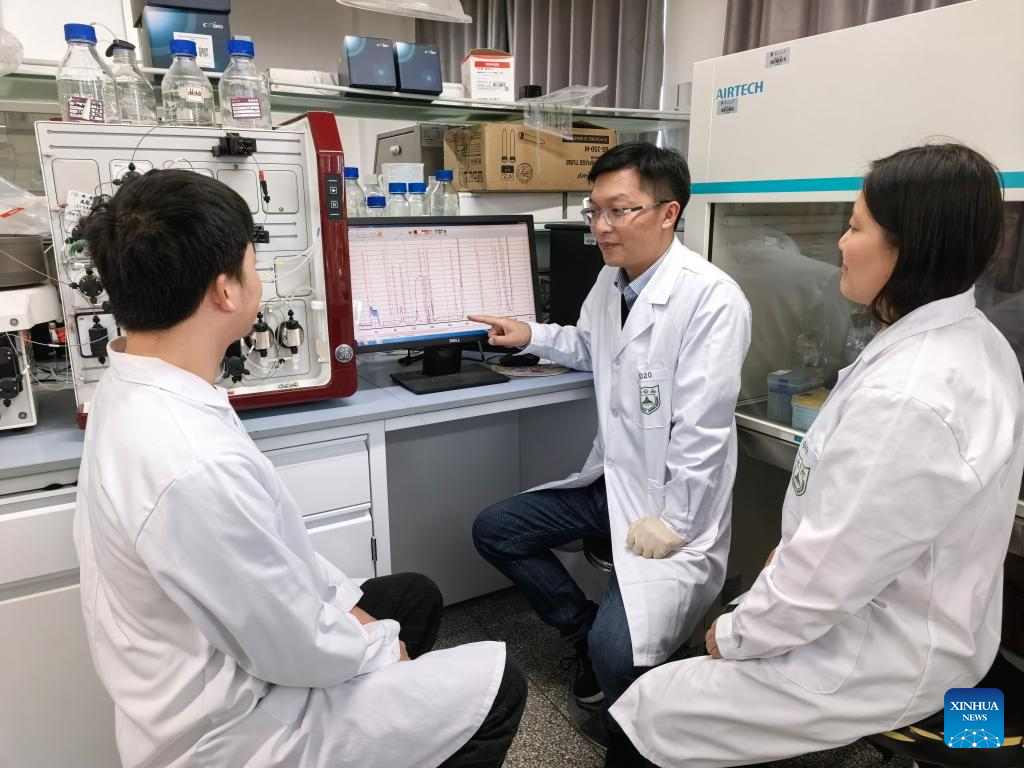
Professor Wu Xilin (C) works with his team at Nanjing University Medical School in Nanjing, east China's Jiangsu Province, Nov. 20, 2025. (Nanjing University/Handout via Xinhua)
NANJING, Nov. 20 (Xinhua) -- A Chinese research team has developed a combination of nanobodies that shows potent and broad efficacy against Severe Fever with Thrombocytopenia Syndrome (SFTS), a severe infectious disease commonly known as tick fever.
With global incidence of SFTS rising and no specific treatments currently available, this breakthrough offers a potential therapeutic solution.
The study, led by Professor Wu Xilin and his team at Nanjing University Medical School in collaboration with several domestic institutions, was published this Thursday (Beijing Time) as the cover story in the journal Science Translational Medicine.
SFTS infections often occur from April to September when people are bitten by ticks in grassy or wild areas. The disease can lead to severe symptoms such as high fever and a sharp drop in platelet count.
Previously, researchers at Nanjing University had isolated first-generation nanobodies against the virus from alpacas, which showed preliminary efficacy in trials done on mice.
To address the challenge posed by the multiple subtypes of SFTS virus, the researchers adopted a "cocktail therapy" approach. They immunized alpacas with antigens from different viral subtypes and screened for two potent nanobodies that target distinct conserved viral sites and block infection. These nanobodies were then combined into a single treatment.
In tests, infected ferrets treated with this nanobody cocktail all survived. Their viral loads dropped to undetectable levels, with significant improvements in platelet counts and reduced tissue damage.
The research team has initiated preclinical research on this nanobody combination. "We hope to deliver a drug solution that can both treat and prevent SFTS," Wu said.
 A single purchase