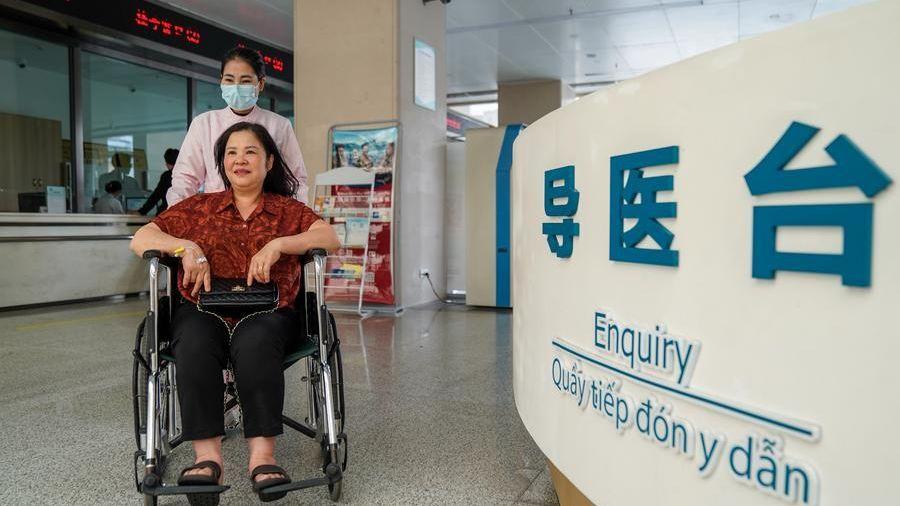



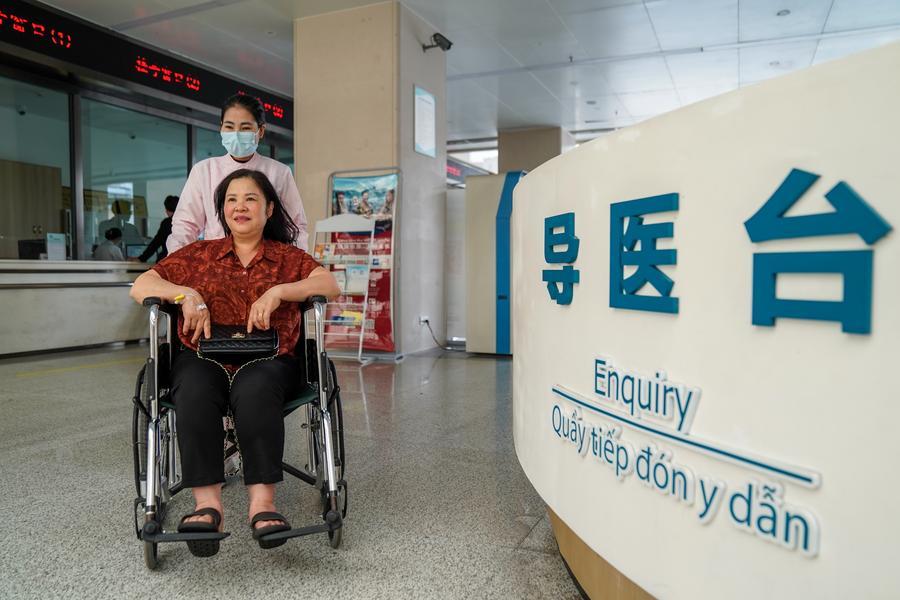
A staff member helps a Vietnamese patient in wheelchair at Remin hospital in Hekou Yao Autonomous County, southwest China's Yunnan Province, Feb. 28, 2026.(Xinhua/Peng Yikai)
HANGZHOU, March 18 (Xinhua) -- American content creator Lucian George took to social media to share his opinions on the hospital experience in China. The video quickly went viral, garnering more than 70,000 likes and sparking lively discussions.
"The appointment was four U.S. dollars without insurance. In America this would cost at least 300 U.S. dollars," he said in the video. "Considering China has so many people, I'm very impressed by how efficient the healthcare system is."
George described his physical examination at the Second Affiliated Hospital of Zhejiang University School of Medicine in east China's Zhejiang Province as "unbelievable," completing nine tests in just two and a half hours. Each check was done at a different clinic, and everything went really smoothly. The test results were sent straight to his phone, complete with instant alerts for any issues.
George is among a growing number of foreign patients who have been impressed by the efficiency of China's healthcare system. Many have shared similar experiences online, drawing more global attention to the country's increasingly digital, proficient, and cost- and time-saving healthcare services, a new Chinese "must-try" after mobile payment, high-speed railway and hotel delivery robots.
Officials from several hospitals told Xinhua that, although foreign patients still make up a small share of total hospital visits, their number keeps growing. Relaxed visa policies have also contributed to the increase, with some travelers seeking emergency medical treatment during their China trips.
In Zhejiang's Yiwu city, often dubbed the "world's supermarket," the Fourth Affiliated Hospital of Zhejiang University School of Medicine received more than 26,000 foreign patients in 2025, a year-on-year increase of 33 percent.
Similarly, the international medical center of the Second Affiliated Hospital of Hainan Medical University in south China's tropical island province Hainan has seen a rapid increase in foreign patients, with most coming from countries such as Russia, Singapore and the United States.
"The upward trend has become more apparent since 2024," said Tian Zhuang, director of the International Medical Department at Peking Union Medical College Hospital (Dongdan campus) in Beijing.
Foreign patients range from long-term expatriates working in China to increasingly more traveling specifically to seek medical care. Behind the growing interest lies a simple question: what makes China's healthcare system so appealing?
High efficiency, modern facilities, well-trained medical staff and relatively low costs are the key attractions, according to Robert Noble, a 73-year-old American architect who received treatment in Hangzhou, Zhejiang Province.
Within two years, he was treated for four conditions at the First Affiliated Hospital of Zhejiang University School of Medicine, undergoing three surgeries -- a minimally invasive lumbar spine procedure and cataract operations on both eyes.
China has accumulated rich clinical experience and achieved leading expertise in some specialized medical fields, according to an official with the National Health Commission. The costs of advanced treatments and medications, such as proton therapy and targeted drugs, are also lower than those in developed countries.
Complex conditions such as cancer, cardiovascular diseases and neurological disorders are common reasons for patients coming to China for treatment.
Beyond one-stop half-day check-ups and hospital treatment in international medical departments, Traditional Chinese Medicine (TCM) is also emerging as a new attraction.
At the Gao Xiangfu clinic in Zhejiang Provincial Hospital of Traditional Chinese Medicine, a patient from Tajikistan with kidney disease received a comprehensive treatment plan combining TCM, acupuncture, massage and dietary therapy.
"As the patient would be returning to Tajikistan, we prepared traditional Chinese medicinal pills that are easy to carry and consume. This not only ensures the continuity of treatment but also enhances the convenience of cross-border healthcare," said Gao.
The increase in foreign patients has also coincided with China's efforts to boost inbound spending, thanks to supportive policies and improved services.
In an action plan to boost service consumption released in January, the State Council listed high-quality international healthcare services as a key growth driver.
Shanghai now has 22 pilot public medical institutions for international medical tourism. In Beijing, the number has reached 19, and 40 TCM programs are also available there for international patients with clear treatment plans, expected efficacy and predictable treatment timelines.
China's healthcare services have been boosted by the integration of artificial intelligence (AI) into clinical services. Today, AI-powered medical imaging, assisted diagnosis and personalized treatment are becoming more widely used across the country.
By 2024, 850 medical institutions across 57 cities in the Chinese mainland were providing international medical services, according to a report by the Chinese Hospital Association.
"The global medical market is undergoing structural transformation," said Wang Kai, Party secretary of the Fourth Affiliated Hospital of Zhejiang University School of Medicine. "Public medical systems in some developed countries are under huge pressure, often with long waits and high costs, while rising health awareness in emerging economies is creating demand that local resources cannot always meet."
"Against this backdrop, China stands out as a highly cost-effective option," he added.
 A single purchase