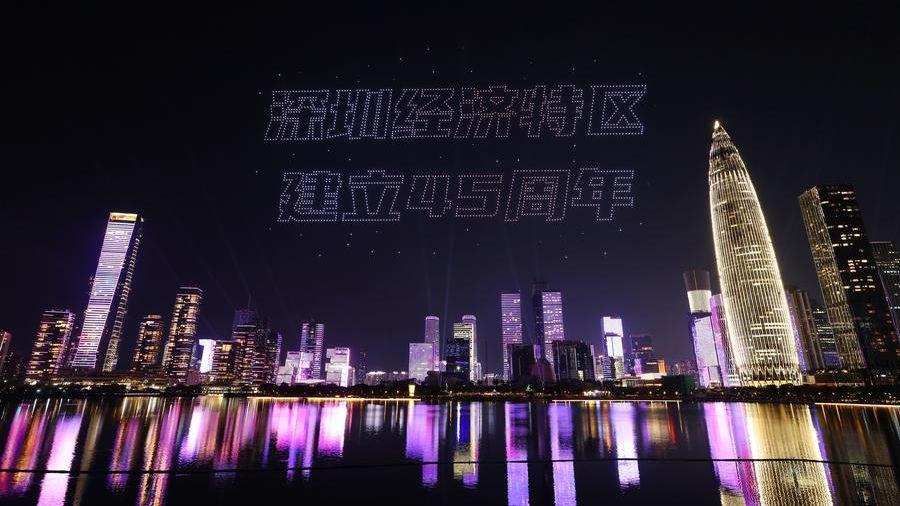



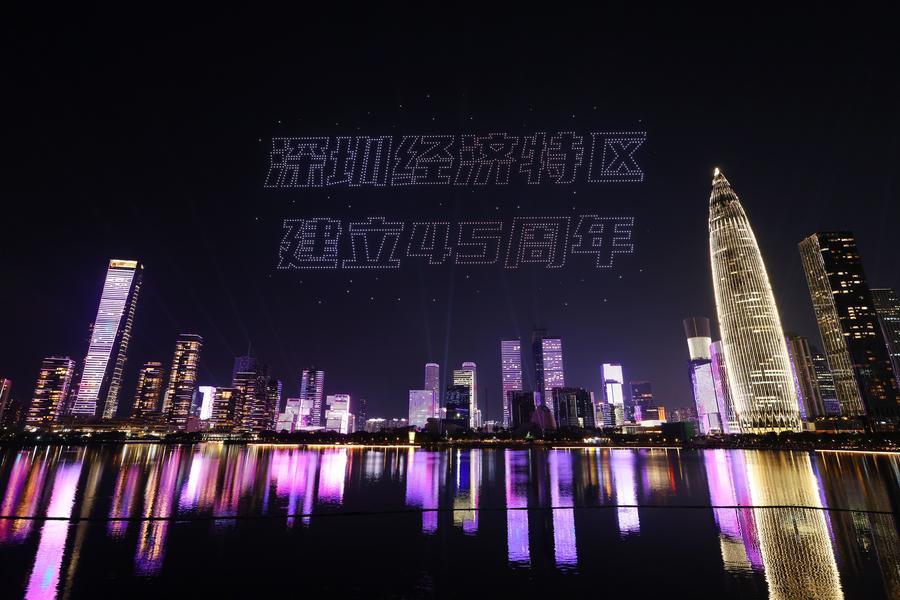
A drone light show is staged to mark the 45th anniversary of the special economic zone of Shenzhen in Shenzhen, south China's Guangdong Province, Aug. 26, 2025. (Xinhua/Mao Siqian)
BEIJING, Feb. 6 (Xinhua Silk Road) -- Amid the new global wave of technological and industrial transformation, leveraging decades of accumulated industrial foundations and a keen acumen for markets and technologies, Guangdong-made products have evolved from "manufacturing" to "creation", and from "following the trend" to "leading the trend". A range of new "Guangdong Goods" -- including new energy vehicles, industrial robots, drones and cultural products -- are making their way to countless households via AI computing infrastructure and e-commerce platforms.
Currently, the global industrial chain is undergoing accelerated restructuring. Behind the success, pioneering role and unimpeded global reach of "Guangdong Goods" lie the key codes to the resilience, potential and vitality of China's economic development.
-- Industrial accumulation builds core strength of "Guangdong Goods"
Guzhen Town in Zhongshan City, south China's Guangdong Province -- known as the "China Lighting Capital" -- boasts a dazzling array of shops lining its streets. The head of a lighting enterprise said, "All components can be sourced within a 5-kilometer radius, from design drafting to finished product delivery."
In Huaqiangbei, Shenzhen, makers can quickly assemble a prototype of smart hardware devices.
This efficiency marvel of the "one-hour industrial circle" is the ultimate embodiment of the industrial ecosystem forged by Guangdong over decades.
At present, Guangdong covers all 31 major manufacturing categories, with nine trillion-yuan-class industrial clusters thriving robustly -- namely next-generation electronic information, light industry and textiles, materials, petrochemicals, agriculture and food processing, home appliances, software and information services, automotive manufacturing, and new energy. Leading enterprises like Huawei and Gree stand tall alongside numerous specialized, sophisticated, and innovative small and medium-sized enterprises (SMEs), each shining in their own niche.
From dacron shirts to drones, "Guangdong Goods" are everywhere. This is underpinned by the unparalleled synergy of the industrial cluster ecosystem built over decades of development as the "world factory".
-- "Hardcore technology" + "humanistic aesthetics" co-define new "Guangdong Goods"
From meeting market demand to pioneering new demand through iterative technological innovation, "Guangdong Goods" are steadily moving from "followers" in the global industrial chain to "standard-setters" in key fields.
A report released by the World Intellectual Property Organization (WIPO) in September 2025 shows that the Shenzhen-Hong Kong-Guangzhou innovation cluster has topped the WIPO 2025 Global Innovation Index for the first time. Future industries such as commercial aerospace, artificial intelligence, and genetic technology have already been planned ahead in Guangdong.
Technological empowerment, manufacturing aesthetics and cultural integration are profoundly reshaping the future of "Guangdong Goods".
The openness, inclusiveness, pragmatism and innovation of Lingnan culture are deeply embedded in products such as Cantonese cuisine, Lingnan-style garments, arts and crafts, smart home appliances, and trendy cultural and creative products -- becoming a powerful tool for boosting the added value of "Guangdong Goods" in the new era.
Pan Helin, a member of the Ministry of Industry and Information Technology's Expert Committee for Information and Communication Economy, noted that when the world learns about Chinese culture through "Guangdong Goods", it sees not only the creativity of a major economic province, but also dynamic, multidimensional and vibrant "Chinese business cards", and more importantly, an innovative expression of an ancient civilization in the contemporary world.
-- Active participation in dual circulation of domestic and international economies
Mao Yanhua, dean of the Institute of Regional Openness and Cooperation at Sun Yat-sen University, held that digital technology is reshaping the development ecosystem of "Guangdong Goods" in an unprecedented way, injecting new impetus into global trade.
Against the backdrop of fostering a new development paradigm, promoting the global reach of "Guangdong Goods" also means deepening domestic layout, and forging closer links between Guangdong's strong manufacturing capacity and China's vast, ever-upgrading consumer market.
In early 2026, Guangdong launched the "Guangdong Goods Global Reach" spring promotional campaign. The commerce department coordinated national-level exhibition platforms such as the Canton Fair to build a "golden showcase" for "Guangdong Goods" to the world. The industry and information technology department focused on advantageous industries including new energy vehicles and consumer electronics, organizing a series of targeted promotion activities. The agriculture department advanced the branding and standardization of "Yue-brand" agricultural products, helping them move from rural areas to urban markets via e-commerce channels.
A relevant official from Guangdong Province stated that promoting "Guangdong Goods Global Reach" will transform Guangdong's industrial advantages into strong market competitiveness, actively participate in both the domestic and international dual circulation, and demonstrate Guangdong's responsibility and contribution within the overall national development framework. (Edited by Yang Yifan with Xinhua Silk Road, yangyifan@xinhua.org)
 A single purchase