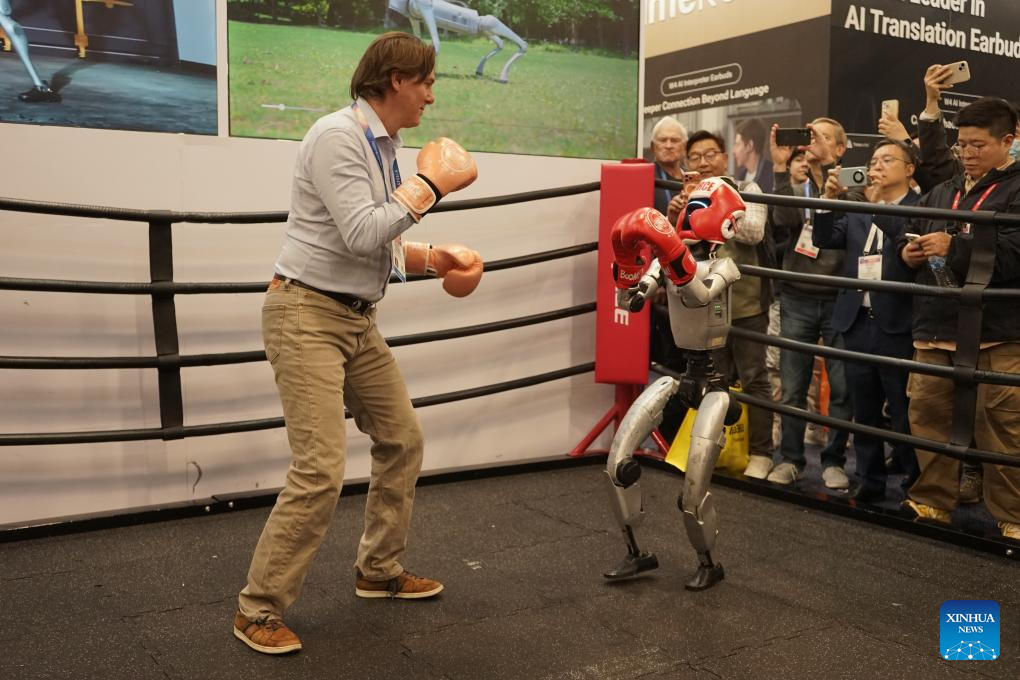



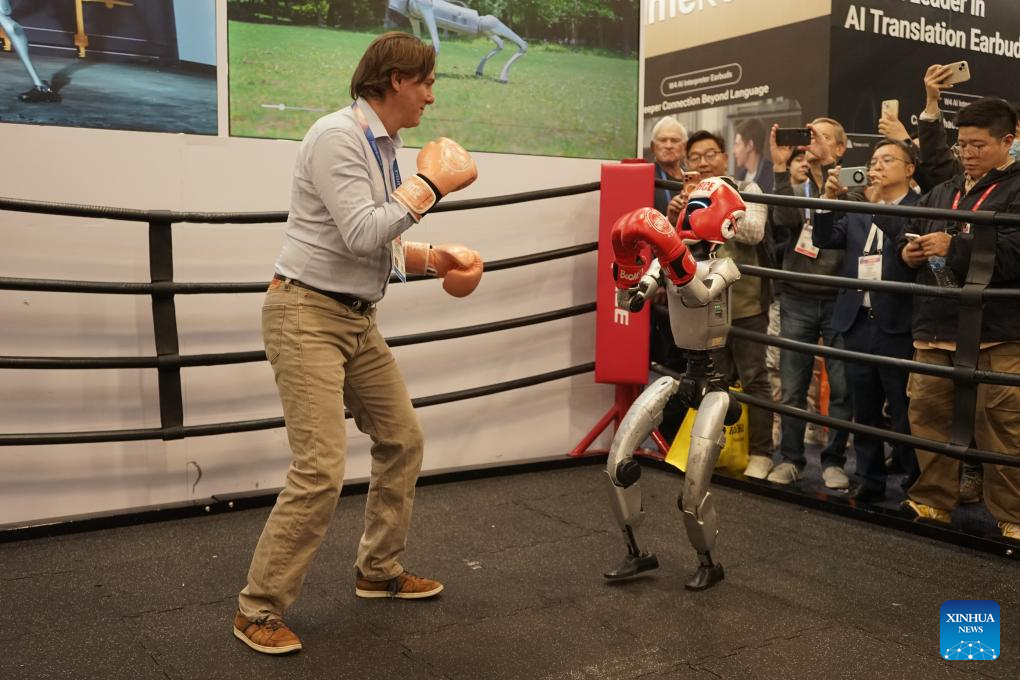
A robot from Chinese company Unitree is displayed during the 2026 Consumer Electronics Show (CES) in Las Vegas, the United States, Jan. 8, 2026. (Photo by Zeng Hui/Xinhua)
BEIJING, Jan. 19 (Xinhua Silk Road) -- Nearly 30 Chinese embodied AI companies made appearance at the 2026 Consumer Electronics Show (CES) in Las Vegas, the United States, showcasing a full spectrum of products ranging from complete machines to key components. The rapid growth of China's robotics industry has captured global attention, offering a glimpse into the solid fundamentals of the country's sci-tech innovation.
-- Vast application scenarios: transforming exhibits into market-ready products
Every precise movement of Chinese robots at this year's CES is underpinned by the integration of core technologies, reflecting capabilities honed through extensive real-world deployment.
For instance, the humanoid robot presented by Beijing Innovation Center of Humanoid Robotics demonstrated core capabilities in industrial scenarios, such as sorting components on assembly lines and sustained autonomous operations. In April last year, the robot series became a household name for running alongside humans and completing a half-marathon.
Meanwhile, from factory floors and unmanned inspections to entertainment performances and tour guiding services, the Chinese market offers a wealth of embodied AI application scenarios, serving as a real-world testing ground for humanoid robots.
Accumulating technological expertise through application scenarios has bolstered Chinese exhibitors' confidence in securing global orders. Noetix Robotics, an emerging robotics company is targeting five major regions -- North America, the Middle East, Europe, Southeast Asia, and East Asia (mainly Japan and the Republic of Korea) -- with plans to expand its business presence to the scale of thousands of units in the second quarter of this year, according to Zhang Shipu, its co-founder.
-- Building an open-source ecosystem: from sharing to co-creation
At this year's CES, the Chinese enterprise AgiBot took the lead by unveiling Genie Sim 3.0, a large language model-driven, open-source simulation platform, along with an open-source simulation dataset. This move has drawn attention from leading domestic and international robotics companies, including Tesla and Unitree Robotics.
Besides, compared with previously prevalent closed-source large language models (LLMs) adopted by Western tech firms, open-source architectures enable greater flexibility and faster iteration through community-driven collaboration, thus propelling the industry's transition toward co-construction and co-creation.
This is not the first time Chinese enterprises have embraced open source. Through open source and open collaboration, China is well-positioned to pool global innovative resources, produce more original achievements with international influence, and promote the adoption and application of new technologies worldwide, thereby shifting from sharing to co-creation, said Li Zhiqi, chairman of the Vitalization International Institute.
-- Science-based industrial planning: turning potential into reality
Global shipments of humanoid robots in 2025 reached approximately 13,000 units, with Chinese companies accounting for nearly 80 percent of the total, according to the recently released report by Omdia, a market research firm.
China's leading mass-production capability stems from its comprehensive industrial ecosystem and science-based industrial planning. For example, regions such as Shanghai and east China's Zhejiang Province and Jiangsu Province moved swiftly to introduce supportive policies in 2017, prioritizing the development of the AI industry.
In the future, the strength of AI will be measured not by advantages in a single segment, but by the completeness, resilience, and self-reliance of the entire ecosystem, noted Li Zhiqi.
(Edited by Yang Linlin with Xinhua Silk Road, linlinyanglyn@163.com)
 A single purchase