


Behind the busy international logistics artery of the China Railway Express (CRE), there is a group of unsung guardians. They are working at the key nodes of railway lines as long as tens of thousands of kilometers, ensuring the smooth and efficient operation of the passage with their youth, sweat and wisdom.
Team A's Precision Dispatch
In Zhangping city in east China's Fujian Province, the CRE and the sea-rail intermodal freight yard are bustling with activity. Every day, about 2,000 vehicles are reorganized into trains at the small-capacity hump yard here and dispatched to Europe and Southeast Asia, operating around the clock.

Team A shunting locomotive crew members are at work. (Jia Ruichen)
During China's National Day and Mid-Autumn Festival holiday in 2025, a group of young men born in the 1990s and 2000s, forming the "Team A", remained on duty to ensure smooth freight transportation during the holiday.
Team A's shunting locomotive is specifically used for train reorganization and line transfer operations, requiring frequent starts and stops and high work intensity. "Our Team A shunting crew handles around 100 shunting operations during the day shift and 180 or 200 during the night shift, with each operation lasting from 5 to 20 minutes on average," said Lin Kecheng, the driver of Team A. This means that during the long night, they are constantly racing against time and precision, according to him.
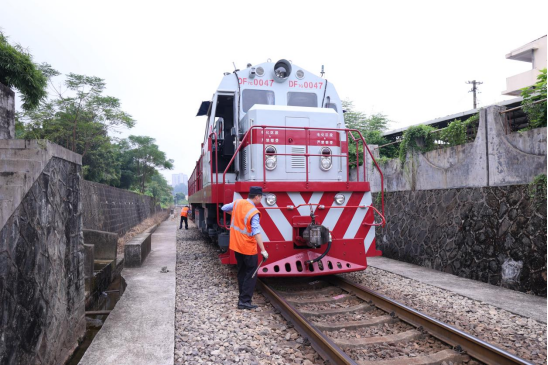
Before departure, Team A shunting locomotive crew members are inspecting the running gear of the locomotive. (Jia Ruichen)
With 11,000 push-hump operations each year, it tests not only their skills but also their willpower. On the one hand, they must ensure that the couplings are "light" and "accurate" to minimize the risk of cargo damage; on the other hand, they have to deal with the challenge of working at a speed of two kilometers per hour for a long time - this near-walking pace is extremely demanding on their concentration. Deputy driver Zhu Jingye shared their "secret tips": "Sometimes we feel sleepy, so we take some measures to stay alert, such as washing our faces with cold water or standing while working."
It is precisely the dedication of these young people that has increased the daily arrivals and departures of trains from 20 to 50. With each precise coupling operation, they infuse youthful vitality into the ever-flowing "Steel Silk Road".
Sleepless Nights in Horgos
One day during the Spring Festival of 2024, the railway port of Horgos in northwest China's Xinjiang Uygur Autonomous Region was experiencing a cold spell with temperatures dropping to minus 10 degrees Celsius and heavy snowfall. At 3 a.m., Kurken Mauleiti, a 28-year-old shunting instructor, after completing over 40 safety checks, embarks on his "challenge" in the snowy night.
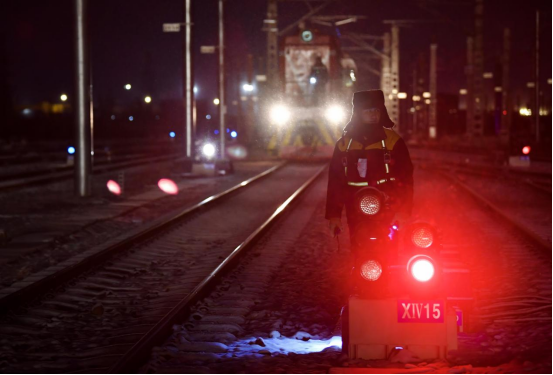
Kurken is working at the Horgos Railway Port, on Jan. 16, 2024. (Xinhua)
Horgos, which means "the place where camel caravans pass" in Mongolian, has now become an important port for the CRE. Kurken is the only "post-95s", namely born after 1995, shunting instructor at the Horgos Railway Station of China Railway Urumqi Bureau Group Co., Ltd. The area he works in is about 1 million square meters, larger than 140 football fields. Due to the different railway gauges between China and Central Asian countries, this vast area is crisscrossed with 41 lines of different gauges.
In the next six hours, Kurken must stay highly alert and complete the shunting of 10 CRE trains and hundreds of carriages. "Shunting is to rearrange different carriages according to the dispatching instructions. It's a physically demanding job, with constant climbing and exposure to the elements, and I'm always dirty," the young man, who graduated from university, admitted. At first, he found it very hard to get used to, but over time, a sense of responsibility and achievement overcame everything.
He has witnessed the rapid development of Horgos firsthand. Since the first CRE train departed from Horgos in March 2016, the port has seen over 50,000 such trains pass through. "It's good to be busy. The income will increase, and besides, I'm still young. How can I have a future if I'm not busy?" Kurken's simple words reflect the work ethic of the younger generation.
At 8:32 a.m., Kurken completed the shunting of the last train. With a long whistle, the train slowly departed, and the dispatching chart was now full. In the wind and snow, this post-95s and his colleagues are safeguarding this increasingly busy "wealth channel".
Kazakh Young Dreamer's Global Quest Based in Lianyungang
The vigorous development of the CRE has also touched the hearts of young people in the Belt and Road partner countries. In Lianyungang, east China's Jiangsu Province, a young man from Kazakhstan, Bekjerov Akinkhan, is busy working to bring his country's goods to the sea.
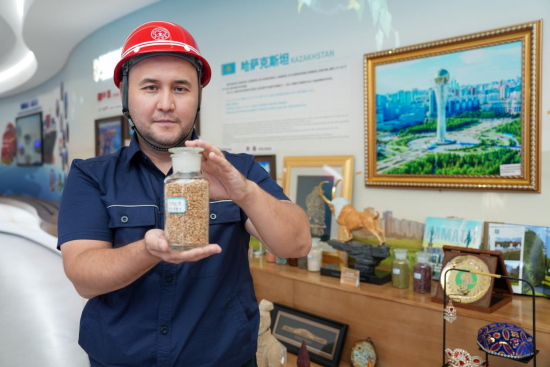
Akinkhan is displaying samples of wheat that transited through Lianyungang from Kazakhstan and will be transported to Southeast Asia, on July 25, 2024. (Xinhua)
Kazakhstan is the world's largest landlocked country. In 2014, the China-Kazakhstan Logistics Cooperation Base was established in Lianyungang, giving Kazakhstan access to touch "the pulse of the ocean". Akinkhan is now the deputy general manager of Lianyungang China-Kazakhstan International Logistics Co., Ltd., responsible for coordinating goods traveling east and west. When talking about the wheat, ferroalloys and other goods transported from Kazakhstan to Lianyungang, he can recite them off the top of his head.
"Kazakhstan is a landlocked country. Lianyungang has provided us with an opportunity to reach the sea. It was also in Lianyungang that I saw the sea for the first time in my life," Akinkhan said emotionally. "My friends in Kazakhstan are curious and envious that I can work in such a coastal city. They often say they want to come and visit me, and let me show them the delicious food and beautiful scenery of China." Like nearly ten other foreign colleagues, he is a key link in faster transmission of logistics information and improving efficiency.
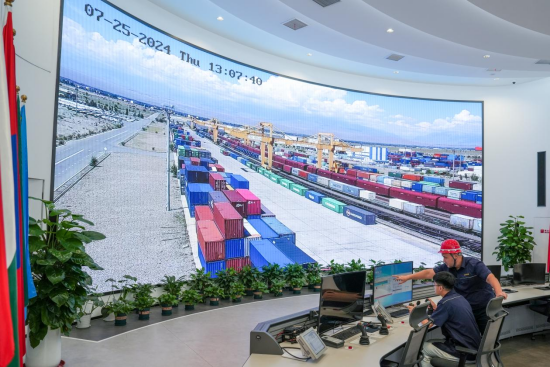
At the China-Kazakhstan (Lianyungang) Logistics Cooperation Base, Akinkhan (right) is checking the containers through the China-Kazakhstan Logistics Station's information tracking system, on July 25, 2024. (Xinhua)
For more than a decade, the CRE has been shuttling between Lianyungang and Central Asia, connecting trade between the two regions and also weaving a community of shared future for them.
With his and his Chinese-Kazakh colleagues' joint efforts, this cooperation base with a 220,000-square-meter container yard and 3.8 kilometers of dedicated railway lines has become an important platform for transit transportation, warehousing and logistics, and trade between Central Asian countries. "In the future, I hope to continue to delve into the logistics field, especially to promote the efficient operation of the China-Kazakhstan Railway Express, making this 'Steel Silk Road' even more unobstructed," Akinkhan said.

A China Railway Express train fully loaded with second-hand cars and auto parts is departing from the China-Kazakhstan (Lianyungang) Logistics Cooperation Base, on Mar. 10, 2025. (Xinhua)
From the cold water used by young people in Zhangping hump yard to fight off sleepiness, to the deep snow trodden by Kurken in Khorgos, and then to the blue sea gazed upon by Akinkhan in Lianyungang, different geographical coordinates, the same youthful figures, together weave a safety and efficiency guarantee network for the smooth operation of the CRE.
They are the epitome of countless front-line workers of the CRE, the most solid foundation on the "Steel Silk Road". Their stories are not only narratives of personal struggle, but also vivid microcosms of the Belt and Road Initiative. It is the relay and persistence of these guardians that have made "thousands of trains per month" a norm, and turned the "places where camel caravans passed" into prosperous thoroughfares for accumulating wealth and conveying friendship again. (By Han Xiaoning, with research assistance from Chen Wang, Zhao Ge, Li Bo, Zhu Cheng)
 A single purchase