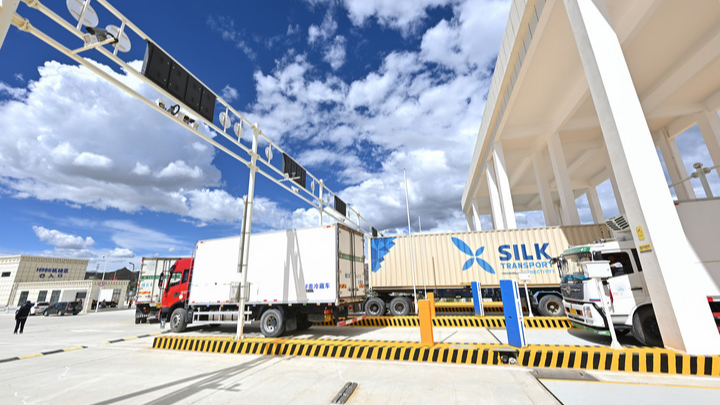



A truck passes through the checkpoint of the export cargo inspection area at the Xigaze International Land Port, July 16, 2025. (Xinhua)
Many people might have experienced this awkward situation: At the airport security check, you are asked to open your overstuffed suitcase that you struggled to zip up. After you remove a single non-compliant item from the bottom, your meticulously packed belongings lay scattered all over the place, all while the boarding announcement is sounding.
Now imagine if it is a 20-foot container instead of a 20-inch suitcase. During customs inspection, if a problematic piece of cargo needs to be pulled from deep inside the container, all the meticulous loading and stacking would be undone and the entire container might risk being detained.
This was once the persistent anxiety about container issues of many foreign trade enterprises. However, a change has been quietly taking place over the past few years.
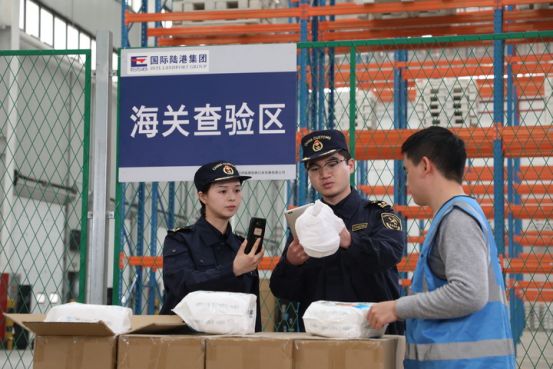
Yiwu Customs officers inspect packages under the inspection-before-loading model. (Hangzhou Customs)
In 2022, the China Railway Express (Xi'an) consolidation center in the port operation area of the Xi'an Comprehensive Bonded Zone was approved by Xi'an Customs to become a supervised site for rail export container consolidation. In 2023, the supervision model of inspection before loading was piloted at the second-phase consolidation warehouse of the Yiwu railway port.
This means that less-than-container load (LCL) export goods have found a different ending to their story. LCL bulk cargo can enter the customs inspection process before being loaded into a container. Cleared goods move directly into the container cargo consolidation process and are shipped on schedule. Goods that need further checks are directed to a specific area for separate examination by customs officials. The two processes operate in parallel without interfering with each other.
This innovative model precisely addresses the efficiency bottleneck of the traditional clearance process, in which the whole container must be detained if a single piece of cargo has to be inspected. By moving inspection before loading, this targeted reform has pressed the acceleration button for the China Railway Express (CRE) to reduce costs and increase efficiency.
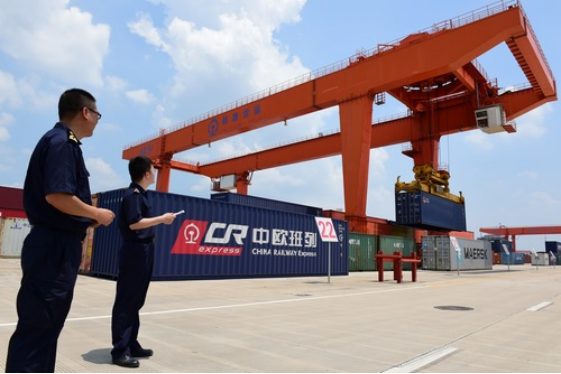
Yiwu Customs officers monitor the hoisting of imported containers into the site, Aug. 4, 2017. (Xinhua)
In late 2024, China's General Administration of Customs further promoted the inspection-before-loading model in its 167th announcement. The model is piloted at 12 directly subordinate customs authorities, including those of Shanghai and Xi'an, and applies to LCL export goods. The key idea is to allow bulk cargo from cross-border e-commerce exporters to first enter the customs supervision area for inspection and then be consolidated into containers based on actual order needs. This process optimization aims to achieve flexible cargo consolidation and efficient cargo flow.
The vitality of top-level design often originates from primary-level practice. Various regions are leveraging their local characteristics to launch unique and innovative measures. Scattered sparks are gradually spreading across the vast land.
In February 2025, monitors from Huizhou, Guangdong Province, and a batch of electronic products from Chengdu, Sichuan Province, arrived at the inspection-before-loading consolidation warehouse at the Chengdu railway port. There was no anxious waiting or complex coordination. Supported by smart tallying and customs clearance services, the two batches of cargo were consolidated in less than half an hour after entering the warehouse. They were then immediately transferred to the Chengdu central station to board a CRE train bound for Europe. For businesses, the new supervision model not only alleviates the previous uncertainty of having to wait for goods and containers, but also brings the benefits of more diverse consolidation options, lower operating costs and more efficient loading.
In August 2025, at a consolidation center in Changsha, Hunan Province, a batch of goods bound for Russia was neatly arranged, awaiting their journey on the CRE. At this point, the person in charge of the freight forwarding company was finally relieved. Just a few days ago, the tight delivery deadline had kept him awake at night. Under the guidance of Xingsha Customs, the declaration, security check and inspection of these goods were all done at the consolidation center. Here, the goods were inspected, loaded into containers and seamlessly transferred for rail loading, ultimately arriving safely at their destination a week ahead of schedule.
Today, the implementation of the inspection-before-loading model at the export consolidation center of the Xi'an railway port has shortened the overall customs clearance time by two to three days. Furthermore, the joint operation area of the Xi'an Comprehensive Bonded Zone and the rail container central station has piloted a "zone-port integration" mechanism. Goods no longer need to be temporarily stored in the zone before transfer. The time for goods to leave the zone has been compressed from about two days to within two hours, and export clearance time has been reduced to 48 minutes. This is expected to save enterprises about 30 million yuan in annual logistics costs.
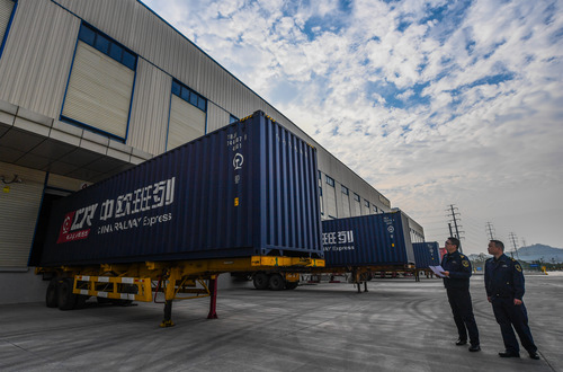
Customs officers inspect imported goods transported by the China Railway Express at Yiwu West Station, Nov. 8, 2017. (Xinhua)
The smooth customs clearance is turning into strong momentum for development. The significance of the inspection-before-loading model goes far beyond an isolated measure that brings convenience to enterprises; it marks a crucial leap from process optimization to model innovation. Thanks to the model, the anxiety about container consolidation that lingered for years has quietly dissipated like morning fog. The CRE is thus becoming stronger and more vibrant, not only transporting goods but also witnessing a combination of efficiency, collaboration and openness. (By Yu Huichen)
 A single purchase