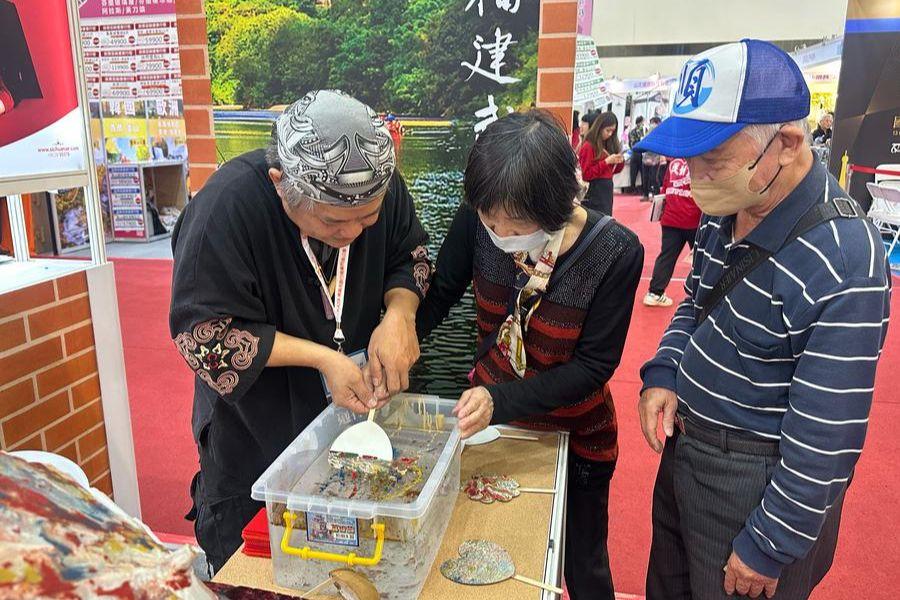



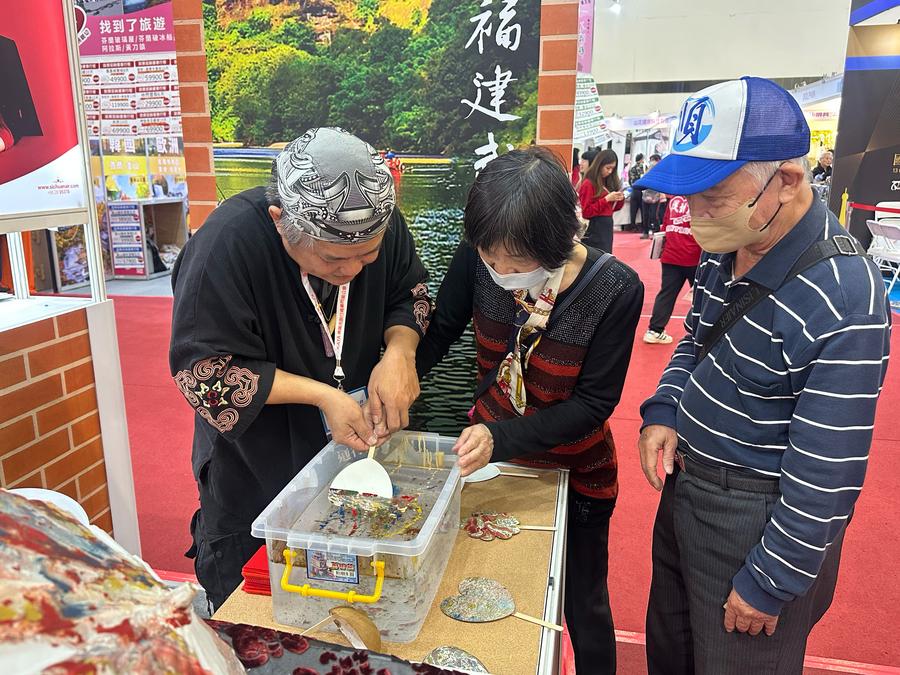
This photo taken with a mobile phone shows lacquerware artist Huang Shou-kun (1st L) guiding a visitor to make a lacquer-colored miniature fan at the 2025 Kaohsiung Winter International Travel Fair in Kaohsiung, southeast China's Taiwan, Nov. 29, 2025. (Xinhua/Huang Shuo)
BEIJING, Dec. 15 (Xinhua) -- At the 2025 intangible cultural heritage brand promotion week held recently in Dali, southwest China's Yunnan Province, hundreds of outstanding intangible cultural heritage brands showcased their flagship products, drawing large crowds of consumers.
Industry experts note that with the support of technology, the market, and other sectors, intangible cultural heritage has found a new footing for development in contemporary life, and also brought fresh highlights to the consumer market in China.
-- Intangible cultural heritage "experiential consumption" gains popularity
At the Quanjude booth, a young staff member calls out enthusiastically as he places plush roast duck toys into a cardboard toy oven, attracting tourists to stop and make purchases.
At another booth nearby, an inheritor of the Lei Cha custom, a provincial-level intangible cultural heritage representative item of east China's Jiangxi Province, is vigorously grinding tea leaves, peanuts, sesame, and other ingredients in a mortar while explaining the benefits and flavors of the Lei Cha to onlookers.
It is learned that 121 intangible cultural heritage brands from across China took part in the 2025 intangible cultural heritage brand promotion week, including time-honored brands like Tong Ren Tang and Quanjude, and youth innovation brands.
The on-site sales data confirms the trend that intangible cultural heritage is becoming a new consumption hotspot. For instance, the Liuhe Pillow logged 422,295 yuan in a single day via live-streaming, plus 12,500 yuan in on-site retail sales; Chongqing Youzhou Miao Embroidery saw average daily sales reaching 20,000 yuan.
Consumers are not only buying products but also actively engaging in interactive experiences. At Taobao's "Chinese Treasures" exhibition area, experience zones for bamboo weaving DIY among others saw long queues; at Quanjude, customers could even pick their own plush "duck" and personally send it into the "oven".
In this regard, Tuo Zuhai, vice president and secretary-general of the China Intangible Cultural Heritage Safeguarding Association, pointed out that building intangible cultural heritage brands is a systematic project requiring long-term effort, and it is essential to both preserve tradition and embrace innovation, enhance brand development capabilities, and promote the integration of intangible cultural heritage into modern life.
-- Intangible cultural heritage drives rural employment and empowers culture-tourism integration
The popularity of intangible cultural heritage brings not only more interesting consumer products with rich cultural connotations, but also new pathways for rural revitalization through workshops and training. Many intangible cultural heritage workshops transform fingertip skills into a "fingertip economy" through models like "company + base + rural households".
The Guizhou Danzhai Ninghang batik intangible cultural heritage workshop was established in 2019, said Ninghang batik designer Cheng Hao from Guizhou, adding that relying on the national-level intangible cultural heritage representative item, Miao batik techniques, it focuses on exploring Miao batik products, including clothing design, production, processing, sales, import and export, etc.
"We provide skills training. Leveraging the heritage foundation of this intangible cultural heritage item in Danzhai, we have successfully helped hundreds of Miao women, who grew up with this craft, boost their income," said Cheng.
This project not only directly employs 48 Miao women, but also, through the "company + base + rural households" model, generates employment for over 200 people, Cheng added, noting that driven by the workshop, the number of sizable batik workshop enterprises in Danzhai County has grown to more than 20, with batik output value exceeding 20 million yuan.
Xu Bo, vice president and deputy general manager of China Travel & Tourism Press, stated that from culture-tourism integration to urban renewal, from the transformation of time-honored brands to rural revitalization, intangible cultural heritage is integrating into modern life through multiple pathways, becoming a new engine for economic development.
Many inheritors of intangible cultural heritage representative items are building integrated ecosystems centered on intangible cultural heritage, such as "intangible cultural heritage + cultural tourism" and "intangible cultural heritage + commerce", promoting mutual empowerment of cultural and economic values, turning tradition into trends, and traditional skills into exceptional industrial wisdom, Xu added.
-- Platforms facilitate digital empowerment to pioneer new space for intangible cultural heritage development
Looking ahead, industry insiders widely agree that by partnering with e-commerce platforms and leveraging empowerment of digital technology, intangible cultural heritage has the potential to pioneer new development space.
Li Miao, senior director of public affairs at Alibaba Group, mentioned that consumer attention and passion for intangible cultural heritage continue to grow, noting that the transaction volume of intangible cultural heritage-related products on Taobao and Tmall has exceeded 100 billion yuan for two consecutive years.
In the future, Taobao will support the development of inheritors in diverse ways, and will continue to serve as a "digital partner" for intangible cultural heritage inheritance, helping more Chinese treasures to be seen, loved, and passed down, said Li.
"We will use our platform ecosystem to promote and sell intangible cultural heritage products by pairing them with scenarios like fashion, dining, trendy toys, and home decor, helping them find their perfect 'match' in these contexts. At the same time, we will assist intangible cultural heritage inheritors, workshops, and related small- and medium-sized enterprises (SMEs) in opening free Douyin e-commerce stores with clear identifiers, and match them with specialized training and traffic support," said He Hui, project lead for the intangible cultural heritage plan of Douyin.
Cross-border collaboration with digital technology is also creating new scenarios for immersive experiences and global dissemination of intangible cultural heritage.
Wang Bin, co-general manager of the cultural tourism exhibition division at Ewin Technology, mentioned that digitization can make intangible cultural heritage exhibitions more immersive, and AIGC (Artificial Intelligence Generated Content) technology offers audiences personalized cultural consumption experiences.
"We are using intangible cultural heritage digital boxes to bring digital intangible cultural heritage experiences to more cultural tourism destinations, streets, and neighborhoods. In the future, we will also leverage our digital media at urban landmarks and venues across China to host digital intangible cultural heritage-themed events, helping more people fall in love with intangible cultural heritage," added Wang.
Sun Yu, deputy secretary-general of the cultural communication committee of the China Culture Administration Association, stated that as cultural digitization has been elevated to a national strategy, technology is playing a crucial role in promoting the creative transformation and innovative development of intangible cultural heritage.
As digital technology, content platforms, e-commerce systems, and cultural tourism scenarios converge at an ever-faster pace, intangible cultural heritage is gaining a new gateway to further integrate into modern life and achieve sustainable development, said Sun.
(Edited by Gu Shanshan with Xinhua Silk Road, gushanshan.1987@163.com)
 A single purchase