


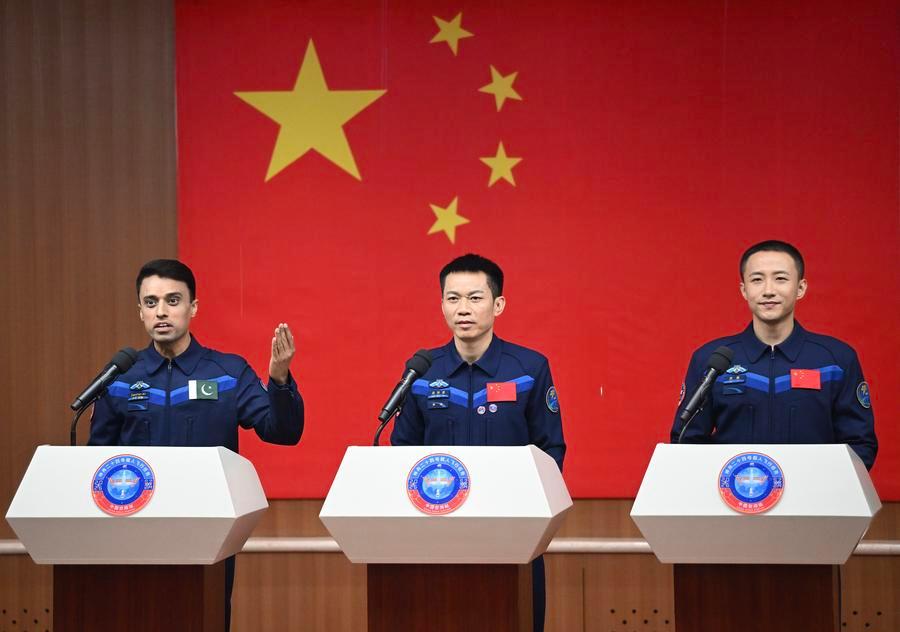
Chinese astronauts Tang Hongbo (C), Wu Yi (R) and Pakistani astronaut Muhammad Zeeshan Ali, for the upcoming Shenzhou-24 spaceflight mission, meet the press at the Jiuquan Satellite Launch Center in northwest China, Nov. 24, 2026. (Xinhua/Lian Zhen)
BEIJING, Nov. 24 (Xinhua) -- China announced on Tuesday that Pakistani astronaut Muhammad Zeeshan Ali will join in the Shenzhou-24 mission as the first foreigner to board China's Tiangong space station, in the latest move showing that China embraces international cooperation in space exploration with open arms.
The upcoming mission will be the first joint flight by Chinese and foreign astronauts in the country's history, and Tiangong for the first time will host a foreign visitor. The significance, however, lies in what this cooperation actually involves.
The Pakistani astronaut will not simply be a passenger on a short visit. As a payload specialist during the mission, Ali has undergone tough training in China, including lectures on spacecraft and space station knowledge as well as specialized operations, with emphasis on experiment operations and emergency response.
For Pakistan, the gains extend well beyond several days in orbit. The mission offers an opportunity to obtain practical experience in human spaceflight, scientific payload operations and astronaut training, all contributing to its future space ambitions.
The exploration of the vast universe and peaceful use of outer space are humanity's shared pursuit and bear on the welfare of all peoples. China advocates the peaceful use of outer space, and engages in active international cooperation to share its continuous advances in space science and technology with the world.
Through cooperation with the United Nations Office for Outer Space Affairs, China has opened its space station to international experiments. The first round of cooperation selected nine projects involving 23 institutions from 17 countries, with particular attention to opportunities for developing countries.
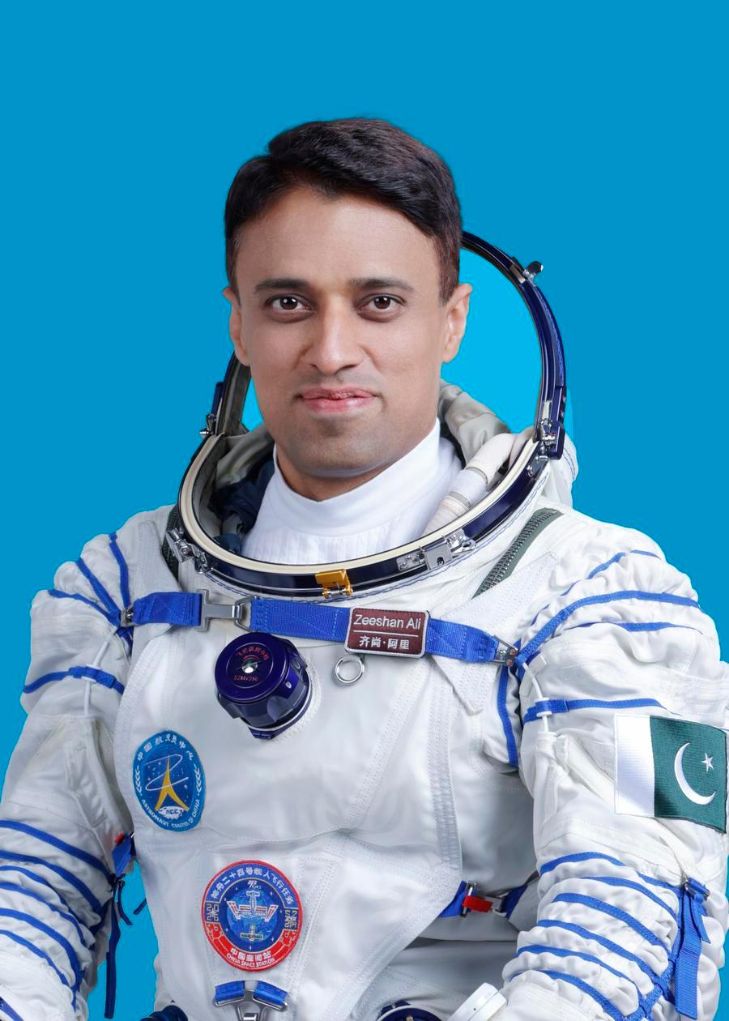
This undated photo shows Shenzhou-24 crew member Muhammad Zeeshan Ali. (Xinhua)
China's Chang'e-6 lunar mission carried scientific payloads from several countries, including Pakistan, France and Italy. Samples that Chang'e-6 collected from the far side of the moon for the first time in human lunar explorations have since been opened to international research institutions. The Tianwen-1 Mars mission involved cooperation with international partners on payload ride-sharing and tracking and control. China has signed more than 200 space cooperation agreements with over 50 countries and international organizations.
Yet some Western coverage views the cooperation primarily through a geopolitical lens. Such reading glosses over who truly benefits from it.
Genuine cooperation does not merely give partners a seat on a spacecraft; through training foreign astronauts, helping conduct experiments and offering experience, China enables those without crewed-flight infrastructure to build capacity. International cooperation is no substitute for a country's own long-term investment in science and education, but can make that investment more effective.
With the vision of building a community with a shared future in the domain of outer space, China stands ready to work with all countries to strengthen exchanges and cooperation, jointly explore the mysteries of the universe, and deliver more benefits to all humanity.
 A single purchase