


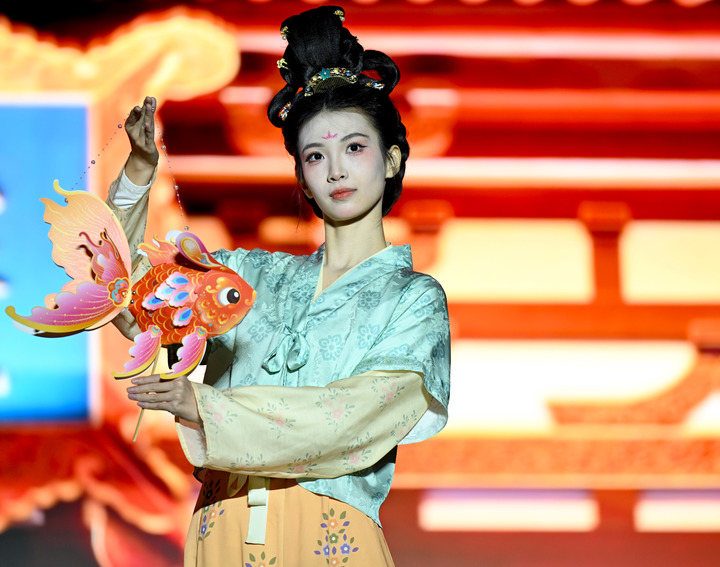
A model presents a creation at a fashion show held at Luoyi ancient city in Luoyang, central China's Henan Province, Oct. 29, 2025. (Xinhua/Hao Yuan)
BEIJING, June 29 (Xinhua Silk Road) -- Ancient city walls illuminated by dazzling light shows, centuries-old intangible cultural heritage crafts revitalizing in modern industries, and thousand-year-old terraces nurturing thriving rural economies......Across China, cultural heritages are no longer confined to museums or historical records. Instead, they are increasingly being transformed into dynamic drivers of economic growth.
In recent years, while consolidating conservation of its rich cultural heritages, China has promoted the creative transformation and sustainable utilization of cultural heritages. By integrating heritage resources with tourism, cultural consumption, traditional industries and rural revitalization, many regions have successfully converted historical and cultural assets into new engines of development.
-- Cultural heritages become new engines for local economy
China's cultural industry has continued to expand rapidly. In 2025, revenue generated by the designated-scale cultural and related enterprises exceeded 15 trillion yuan (about 2.2 trillion U.S. dollars), up 7.4 percent year on year, highlighting the growing contribution of the cultural economy.
In Qahar Right Wing Middle Banner in north China's Inner Mongolia Autonomous Region, local authorities have leveraged rich heritage resources, including a 6,000-year-old Yangshao cultural site, historical relics such as the Great Wall built in the period of Western Han Dynasty, and the region's grassland tourism brand, to stimulate economic growth.
Through measures including holding cultural festivals, presenting drama shows integrating intangible cultural heritage elements, and cultivating cultural creative products with local characteristics, the region welcomed more than 4.4 million visitors in 2025, generating nearly two billion yuan in tourism revenue. The cultural tourism industry has become a vital pillar for rural revitalization and economic growth.
Meanwhile, industries related to intangible cultural heritages have gained momentum, with the related market size exceeding 1.1 trillion yuan in 2025, up 20 percent from a year ago. The sales of intangible cultural heritage products on China's leading e-commerce platform Taobao hit 130 billion yuan, rising 21.3 percent. More than 11,000 intangible cultural heritage workshops and 99 national-level productive protection and demonstration bases have been established. The intangible cultural heritage-related industries are continuously extending industrial chains and creating new business opportunities, becoming an important driver of economic development.
-- Three pathways to unlock heritage value
Across the country, local governments have explored diverse approaches to transforming cultural heritages into economic value. Three major models have gradually emerged, namely promoting cultural tourism consumption, upgrading intangible cultural heritage-related industries, and revitalizing agriculture-related cultural heritage.
Cultural tourism consumption in many regions across the country has transformed from merely "sightseeing" to "immersive experiences".
The ancient city of Luoyang in China's Henan Province has become one of China's most popular tourist destinations, attracting more than 600 million visits over the past five years. Innovative tourism products, including night tours in ancient tombs, Tang Dynasty-themed banquets and interactive museum experiences, have emerged in succession to turn the city into "a museum without walls."
Luoyi Ancient City, a well-known scenic spot in Luoyang, has further enhanced visitors' experiences through immersive cultural programs centered on Hanfu, a kind of traditional Chinese attire. Since 2023, more than 13 million visitors have participated in Hanfu-themed activities, generating over two billion yuan in related consumption. The booming industry has fostered a complete tourism industrial chain covering Hanfu design, rentals, makeup services and photography, creating more than 30,000 jobs.
China's growing enthusiasm for traditional culture has fueled industrial development. A number of intangible cultural heritages have been transformed into industrial advantages and development engines at a faster pace, with more traditional crafts moving from "display" to "production".
Caoxian County in east China's Shandong Province is now the country's largest production base for originally designed Hanfu. It has established a complete industrial chain spanning fabric research, design, manufacturing, e-commerce and cross-border trade.
At present, the county is home to more than 2,800 Hanfu-related enterprises and over 15,000 stores, with products exported to more than 30 countries and regions. Hanfu sales exceeded 13 billion yuan in 2025, accounting for more than half of the national market.
Once focused primarily on reproducing historical clothing, the industry has evolved toward creative design, everyday fashion and international cultural exchanges, reflecting growing cultural confidence among Chinese consumers.
In addition to urban cultural tourism and intangible cultural heritage industries, various regions also rely on agricultural cultural heritages such as ancient terraced fields and ancient villages to cultivate geographical indication products and promote the integrated development of characteristic agriculture, culture and tourism.
Shexian County in north China's Hebei Province is home to a dryland stone terraced system dating back more than 2,000 years, recognized by the Food and Agriculture Organization of the United Nations as a Globally Important Agricultural Heritage System (GIAHS). Supported by its unique agroforestry farming system, the terrace has preserved 171 agricultural varieties while developing geographical indication products such as Chinese prickly ash, walnuts, black dates and traditional medicinal herbs.
By integrating ecological conservation with specialty agriculture and rural tourism, Shexian has successfully transformed agricultural heritage into sustainable economic opportunities, achieving coordinated development in ecological protection, cultural preservation and industrial growth.
As conservation concepts continue to evolve and innovation gathers pace, China's cultural heritage is increasingly being transformed from static historical resources into vibrant, market-oriented assets that people can experience, consume and appreciate.
The integration of heritage protection with industrial development is not only preserving the nation's cultural legacy but also injecting fresh momentum into high-quality economic growth, demonstrating how history can continue to create value in the modern era. (Edited by Li Xueqing with Xinhua Silk Road, lixueqing@xinhua.org)
 A single purchase