


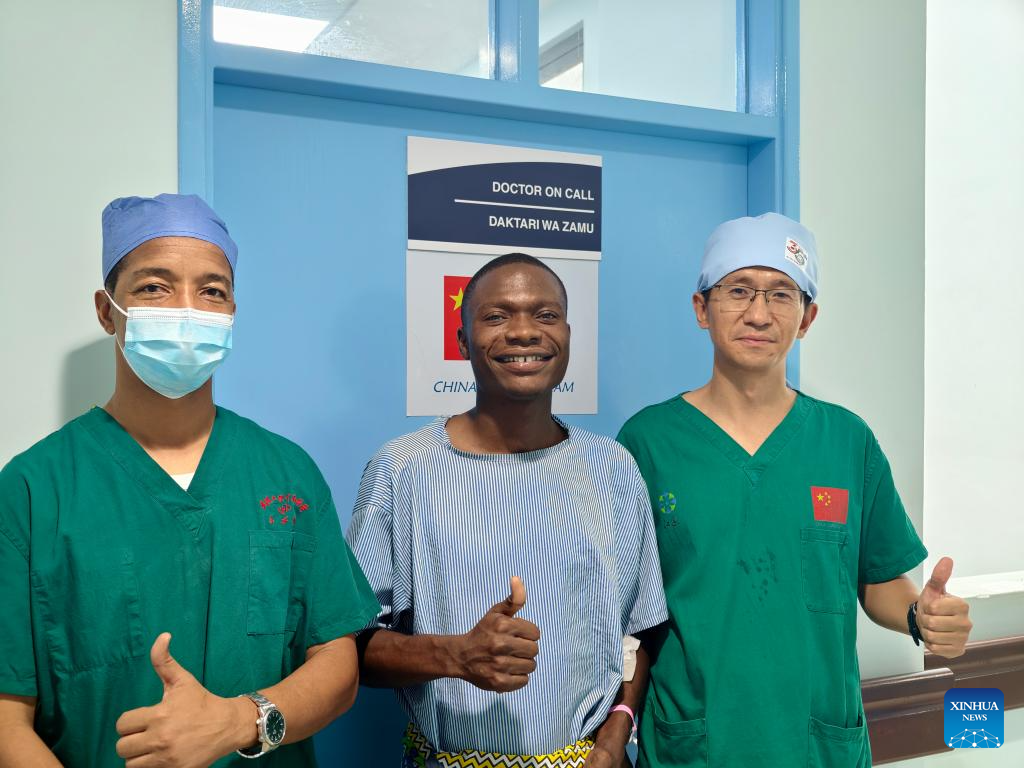
Chinese urologist Wang Kunpeng (R) and a local medical staff member (L) pose for a photo with patient Selemani Juma Selemani after a surgery at Lumumba Hospital in Zanzibar, Tanzania, Jan. 26, 2026. (The 35th Chinese medical team to Zanzibar/Handout via Xinhua)
ZANZIBAR, Tanzania, May 6 (Xinhua) -- For five years, 24-year-old Tanzanian Selemani Juma Selemani lived with persistent pain, fever, and discomfort due to a complicated urinary condition haunting his daily life.
Working at a hotel on Unguja Island, Tanzania's Zanzibar, Selemani struggled to maintain a normal routine. At times, he even restricted his water intake out of fear of worsening his symptoms.
That prolonged ordeal came to an end recently, as he underwent a complex three-and-a-half-hour surgery at Lumumba Hospital in Zanzibar, performed by Chinese urologist Wang Kunpeng. Within hours, the young patient was freed from a years-long health burden.
"I have suffered for five years, but the doctor treated me in less than four hours," Selemani said after the procedure. "I will never forget the Chinese doctor for saving my life."
Selemani's condition dated back to an earlier operation at a local hospital, during which a ureteral stent was inadvertently left inside his body. Over time, this led to recurrent infections and the formation of multiple stones in the kidney, ureter, and bladder, making the case both complex and urgent.
After seeking help at Lumumba Hospital, diagnostic scans confirmed the severity of his condition. Wang, a member of the 35th Chinese medical team to Zanzibar, worked closely with local urologist Hassan Mkoko to assess the case and develop a treatment plan. They first stabilized the patient through anti-infection therapy before proceeding with surgery.
The operation combined several advanced techniques, including transurethral lithotripsy to fragment bladder stones, removal of the retained stent, ureteroscopy, placement of a new stent, and, ultimately, a surgical incision to remove kidney stones.
The procedure required precision and careful coordination, particularly given the patient's prior complications, said Wang.
A key component of the surgery was the use of EMS lithotripsy equipment, which had only recently been repaired and calibrated by Wang himself. Drawing on his technical expertise, Wang had restored the device to working condition and previously carried out Zanzibar's first ureteroscopic EMS lithotripsy procedure, helping fill a gap in local medical capability.
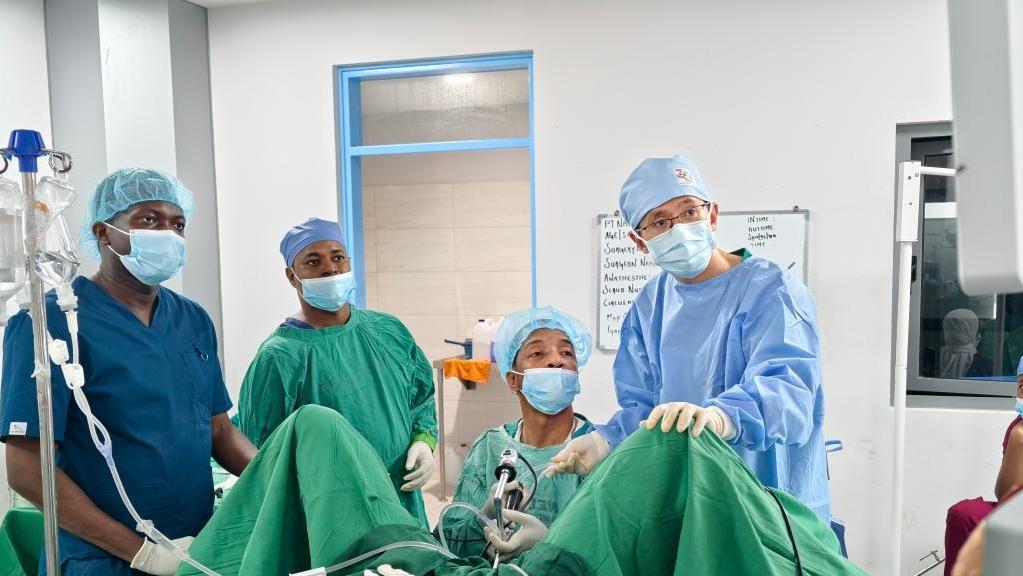
During Selemani's surgery, the equipment played a crucial role. Under high-definition endoscopic guidance, Wang carefully fragmented multiple bladder stones in a process that alone took about 90 minutes. Each step was performed with attention to minimizing tissue damage and ensuring a smooth recovery.
Following the lithotripsy and stent procedures, Wang proceeded with the final stage of the operation to remove kidney stones. Throughout the surgery, he exchanged views with local medical staff, offering insights into the potential adoption of minimally invasive techniques, such as laparoscopy, in future cases.
Initial skepticism among some staff members about avoiding open surgery gradually gave way to confidence as the procedure progressed successfully. By the end of the operation, the atmosphere in the operating room had shifted to one of relief and approval.
The surgery was completed with minimal blood loss, and the patient's vital signs remained stable throughout. Shortly afterward, Selemani began to recover.
"I feel much better now," he told Xinhua, adding that he looks forward to resuming his normal life and work.
The successful procedure highlights the growing impact of Chinese medical teams in Zanzibar and across Tanzania. Since their arrival, the 35th Chinese medical team has provided clinical services while also focusing on skills transfer, equipment maintenance, and capacity building within local healthcare systems.
Through live surgical demonstrations, training sessions, and case discussions, the team has also worked to share knowledge and introduce advanced techniques, aiming to strengthen local medical capabilities beyond their tenure.
Health cooperation has long been a cornerstone of China-Tanzania relations, with Chinese medical teams playing a sustained role in supporting local healthcare systems. In Zanzibar, these efforts continue to deliver tangible benefits, improving patients' lives in meaningful ways.
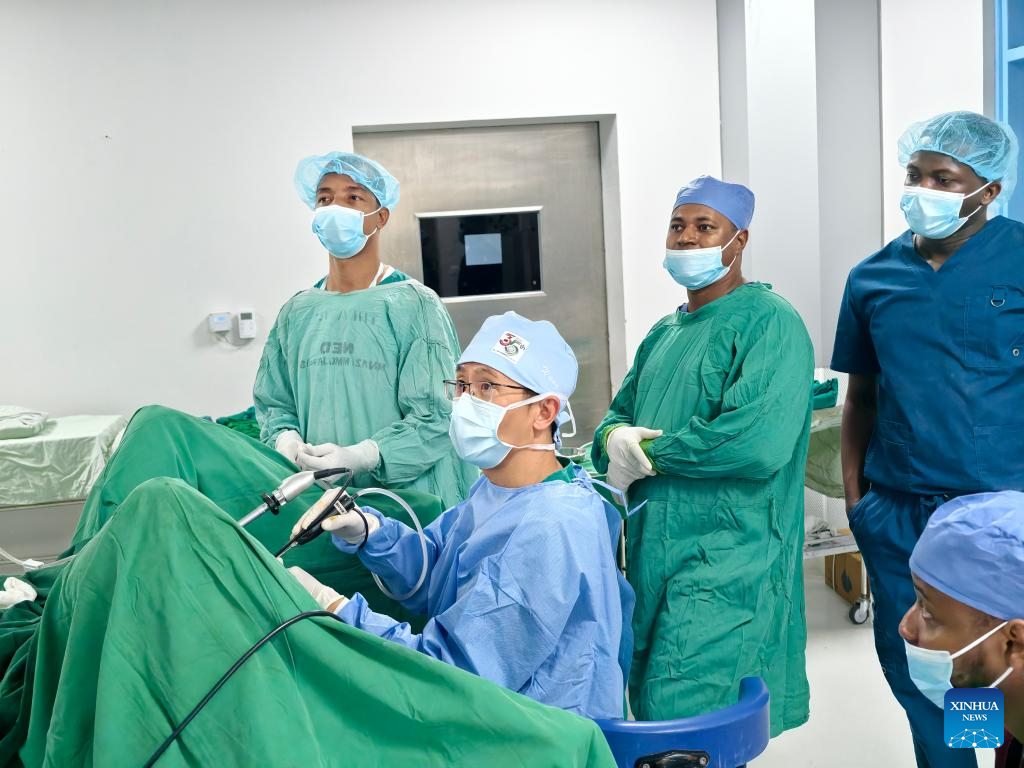
Chinese urologist Wang Kunpeng (front) performs a minimally invasive procedure using endoscopic equipment at Lumumba Hospital in Zanzibar, Tanzania, Jan. 22, 2026. (The 35th Chinese medical team to Zanzibar/Handout via Xinhua)
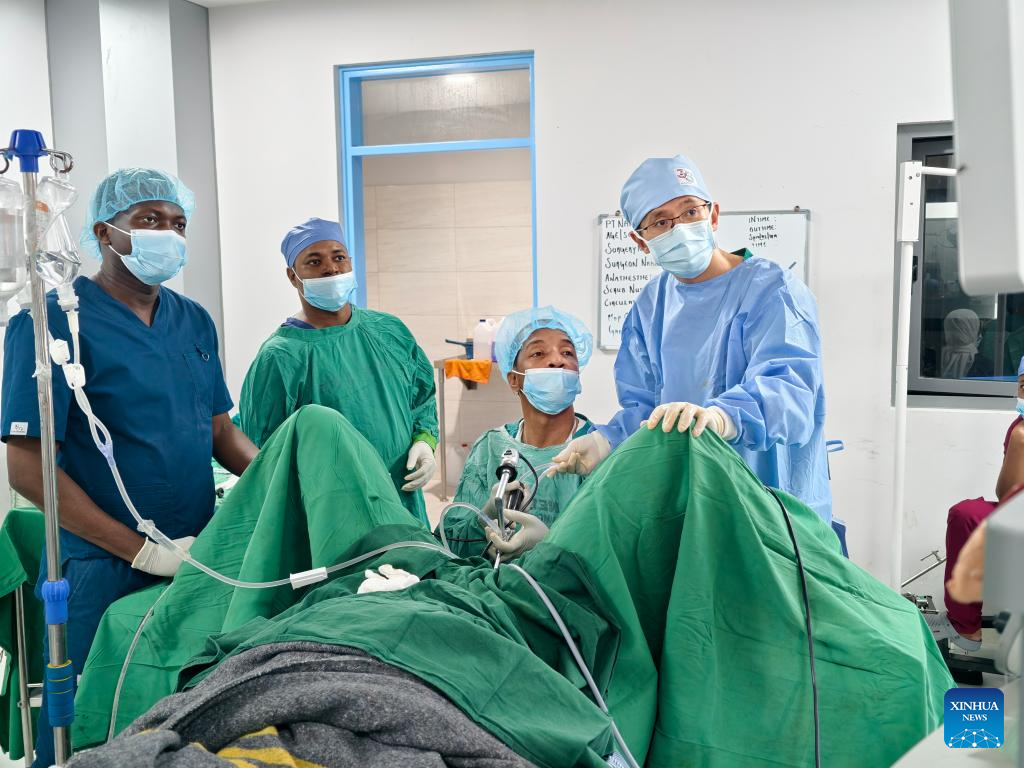
Chinese urologist Wang Kunpeng (1st R) works with local medical staff members during a surgical procedure at Lumumba Hospital in Zanzibar, Tanzania, Jan. 22, 2026. (The 35th Chinese medical team to Zanzibar/Handout via Xinhua)
 A single purchase