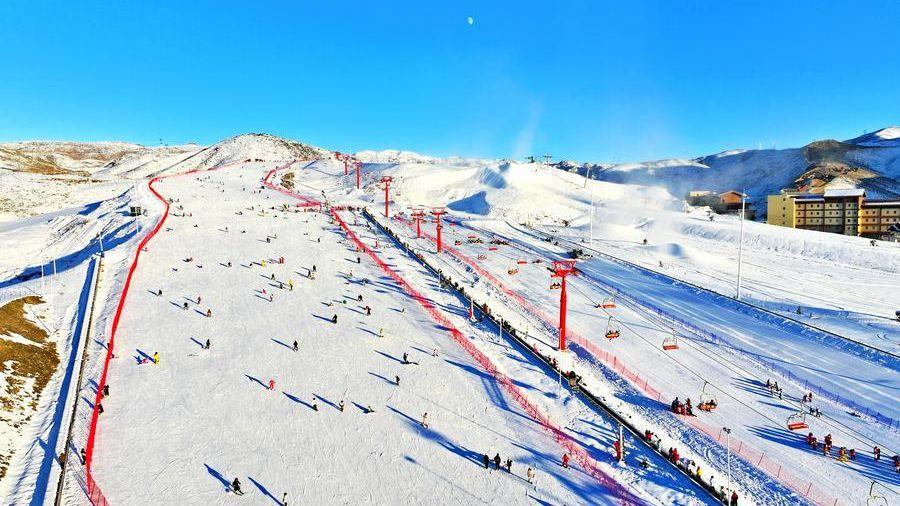



URUMQI, Jan. 28 (Xinhua) -- "Who could have imagined 20 years ago that our snow would turn into a treasure mountain bringing prosperity?" said Huanishibek Slanbek, a fifth-generation inheritor of the craft of making fur skis in Altay.
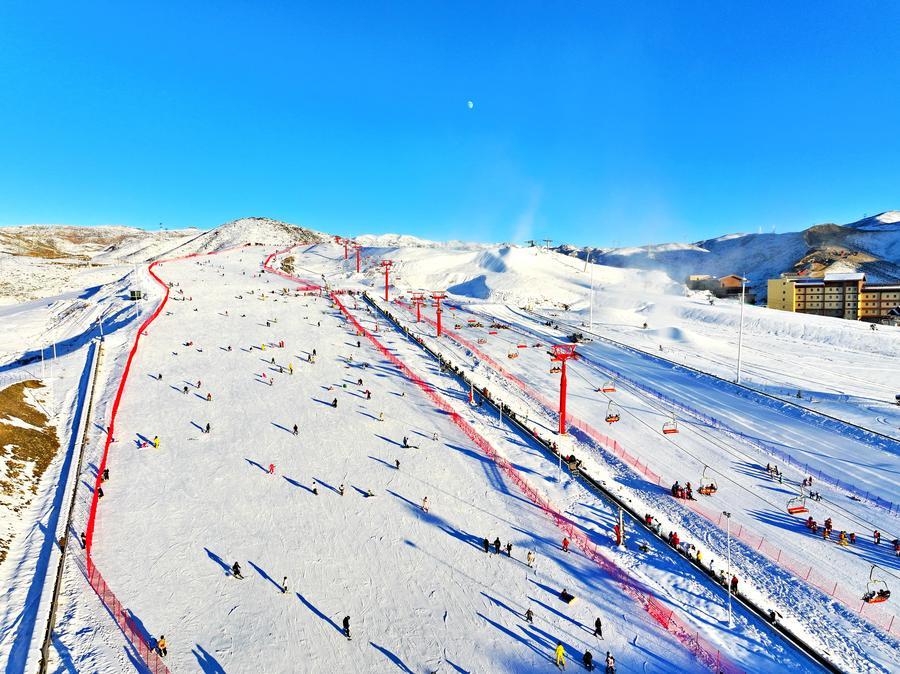
Drone shot of Jiangjunshan International Ski Resort in Altay, Xinjiang, Jan 1, 2025. (Photo by Ming Tingjunjie/Xinhua)
On the southern foothills of the Altai Mountains, which span Mongolia, Russia, China and Kazakhstan, sits Altay, a small city once little known even to many Chinese. Long considered the end of the transportation line, it has fewer than 100,000 residents. Winters are long, with average snow depths of more than 1.5 meters and a season lasting up to six months.
What was once an isolating climate has become Altay's greatest asset, attracting attention for skiing and creating opportunities across a wide range of industries.
SKIING REVIVES AN ANCIENT CRAFT
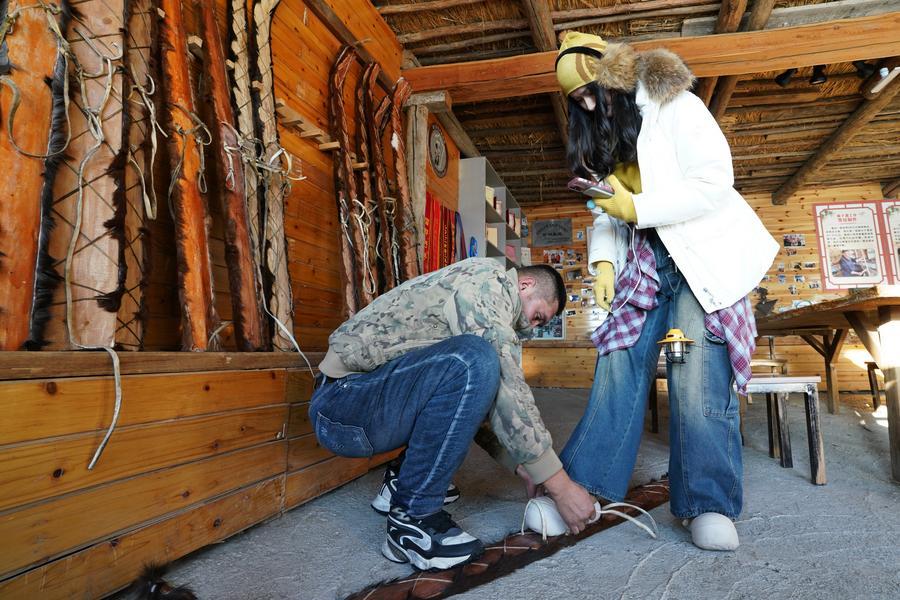
Huanishibek Slanbek (left), Slanbek Sahishi's son, helps a tourist try on fur-covered skis, Jan 20, 2026. (Xinhua/Aman)
Huanishibek inherited the fur skis making skill from his father, Slanbek Sahishi, who learned it from his own father.
In Altay, fur skis were once essential tools that helped ancestors survive harsh winters. Local records trace human skiing activity here back about 10,000 years.
"When the mountains were sealed by snow, horses could barely move. Fur skis became the 'hooves' on the snowfields," Huanishibek said. "They're unique. Uphill, the horsehair faces backward to prevent slipping. Downhill, it lies flat to reduce resistance and gain speed. They're safe and easy to use."
The 35-year-old recalled that his family's workshop used to be simple and cramped. Most of the fur skis his father made were for nearby herders and brought in little income.
"Like this city, people from outside didn't know what this was," he said.
As fewer people used fur skis, Slanbek once worried the craft would eventually fade into history. Instead, skiing itself helped breathe new life into the old boards.
Before the Beijing 2022 Winter Olympics, China promoted a plan to involve 300 million people in ice and snow sports, and Altay, with its abundant snow and relatively mild winter conditions, quickly became a hotspot. With improved infrastructure, services and youth sports programs, the once-isolated city has rapidly developed one of its most promising industries.
As broader efforts to revitalize border regions gained pace, local government support eased the father and son's concerns. They now have a workshop and exhibition room to further develop the area's ice and snow culture.
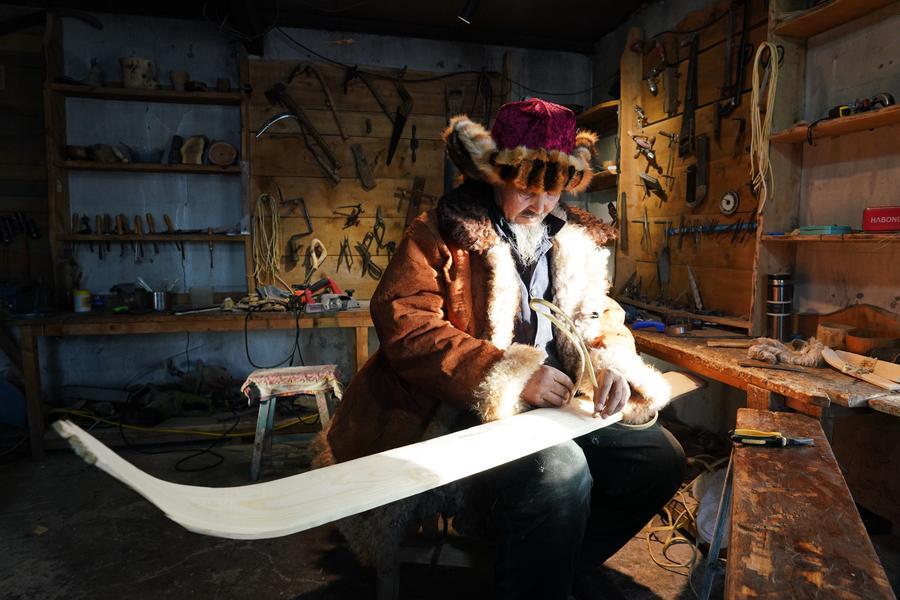
At the ancient fur skis shop, Slanbek Sahishi is threading ropes onto a pair of fur skis, Jan 20, 2026. (Xinhua/Aman)
Today, dozens of tourists visit each day, experiencing the heritage firsthand.
"Skiing is, of course, the main reason we came to Altay, but experiencing the area's ancient ski culture in our spare time is rare," said Dong Yu, a visitor from Sichuan who discovered Huanishibek through posts on the social media platform Xiaohongshu.
"Many tourists like the fur skis, but they're not easy to carry, so I make palm-sized souvenirs," Huanishibek said. "I can sell about 300 pairs in one snow season."
To keep up with demand, he works with his wife, parents and relatives.
In Lasti Village, where Huanishibek lives, Kazakh herders once had little to do in winter. Now many have joined the tourism industry, offering horse rides, running farmhouse guesthouses or working at ski resorts.
"I plan to renovate a larger exhibition hall," Huanishibek said. "The current one is still too small."
SUNSET BEATS ON THE SUMMIT
In late January, a cold wave still gripped northern Xinjiang. Temperatures on the summit of Jiangjunshan International Ski Resort drop below minus 20 degrees Celsius. Yet at sunset, hundreds of skiers and tourists gather near a DJ stage, dancing in colorful gear as pink and blue light washes over the snowy peaks.
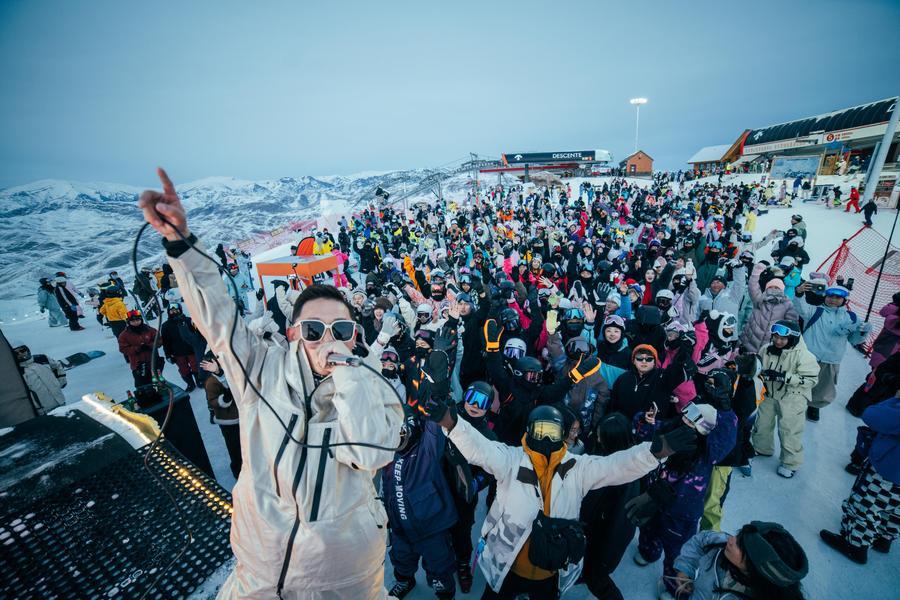
DJ Li Quan leads interactive activities with tourists during a "sunset party" on Jan 2, 2025. (Xinhua)
Behind the decks was Li Quan, 35, from Chengdu, director and DJ of the resort's "Sunside Party." Every afternoon from 5:30 p.m. to 7:00 p.m., he mixes electronic music with traditional ethnic melodies such as Black Walking horse, turning the mountaintop into a festival space.
On peak days, about 3,000 people join the party. Even during cold snaps, around 1,000 still show up.
"Coming to Jiangjunshan for a sunset party has become a must-do for visitors to Altay," Li said.
The idea was born in 2022, when Li first visited Altay on a work trip. Standing on the summit, the ski lover had a thought: create a mountaintop music party for skiers.
That season, he and a small team staged the first Sunside Party. A video of him splashing water that froze instantly in midair went viral on social media, drawing attention from across China and beyond.
The viral moment encouraged Li. With support from the local government and the resort, the party kept growing. Tourists from Australia, Thailand, Japan and Malaysia have also joined the crowds.
"Many told me the party was their best memory of Altay," Li recalled.
Three snow seasons later, the stage has doubled in size from six meters to 12, the music library has expanded, and the team has grown to more than 20 young staff members.
A local Kazakh woman joined after hearing about the project through friends, now working behind the scenes.
"Getting recognition from locals means a lot to us," Li said.
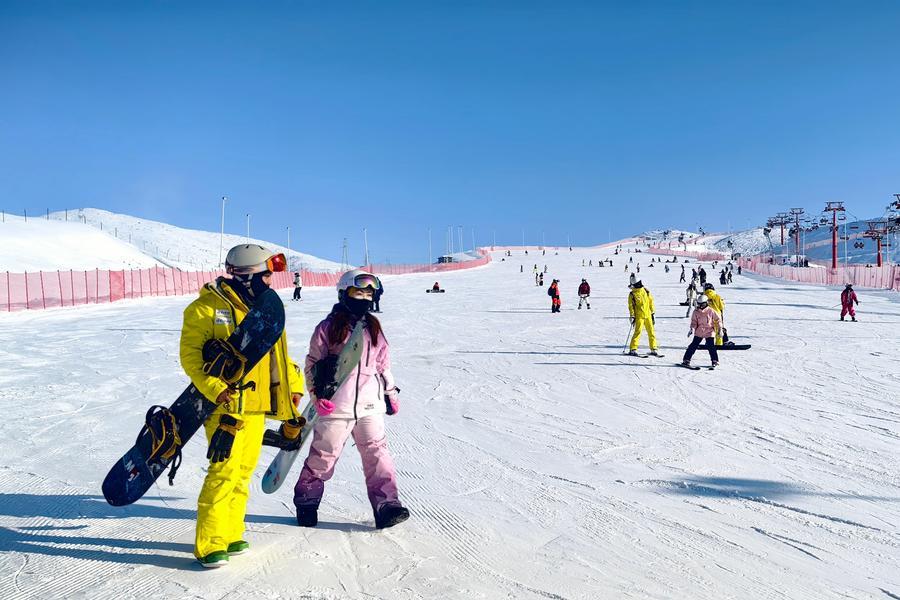
Ski enthusiasts walk at the Jiangjunshan International Ski Resort in Altay, Xinjiang, Jan 15, 2026. (Photo by Dong Fayong/Xinhua)
Winter trips to Altay have become trendy among young people in China. Following this trend, more migratory entrepreneurs like Li are heading to the city. In the 2025-2026 snow season, more than 30 new food- and ski-related businesses opened around the resort, helping winter tourism account for 90 percent of the area's annual revenue.
Li has decided to stay. He plans to buy a home and host Sunside events beyond winter. For him, the attraction is not just snow or scenery, but the energy of young people bringing ideas and investment to the north.
"Altay is famous, but many people only know it from books or short videos," he said. "I hope we can introduce it in our own way."
He imagined a future where visitors can enjoy music and coffee on powder snow in a remote mountain town.
"With more creative minds coming here," he said, "this place can offer something truly special."
LONG WINTERS, MORE HORIZONS
Each year, even before the first snowfall arrives in October, Liu Shunan's real estate agency begins to get busier. In addition to routine secondhand housing deals for locals, his company has in recent years developed a new line of business: helping skiers from outside Xinjiang find rental homes.

At a real estate agency in Altay City, real estate agent Tang Bin is checking property listings online, Jan 20, 2026. (Xinhua/Aman)
The long snow season and improving urban services have led some ski enthusiasts to spend as long as half a year in Altay.
"This is my third straight year coming to Altay to ski," said Li Feng, a freelancer from the southern province of Guangdong. "Since I stay here for a long time, renting an apartment is much cheaper than staying in hotels."
Liu said Altay's property market used to be small and relatively closed off, with few outsiders moving in. Skiing has changed that.
In 2025, Jiangjunshan Ski Resort received 1.12 million visits, up 30 percent from 860,000 in 2024, according to local statistics.
"More people come to ski every year," Liu said. "They bring new demand. Most choose hotels for short stays, but ski instructors and enthusiasts who stay longer rent homes, and some even buy property here."
Liu's agency has 12 employees. They usually contact skiers from across the country online before helping them find properties in person.
A 15-year real estate veteran, he said the whole sector has benefited. Five years ago, there were five agencies in the city. Now there are 10.
For Li, improving city services are a key reason he and other digital nomads choose to live here part of the year, working while skiing.
"I usually handle work on my computer in the morning and head to the ski resort after lunch," he said. "I can eat what I like here, watch the latest movies, and there are direct flights between here and my hometown."
From Altay Airport, travelers can fly directly to 13 major Chinese cities, including Guangzhou, Chongqing and Beijing.
A native of Altay, Liu said the city, once seen as remote and bitterly cold because of its snow, is now finding new development opportunities thanks to that same snow.
"Altay doesn't need to copy other cities' development paths," he said. "Altay is unique. We are embracing our best opportunities yet."
 A single purchase