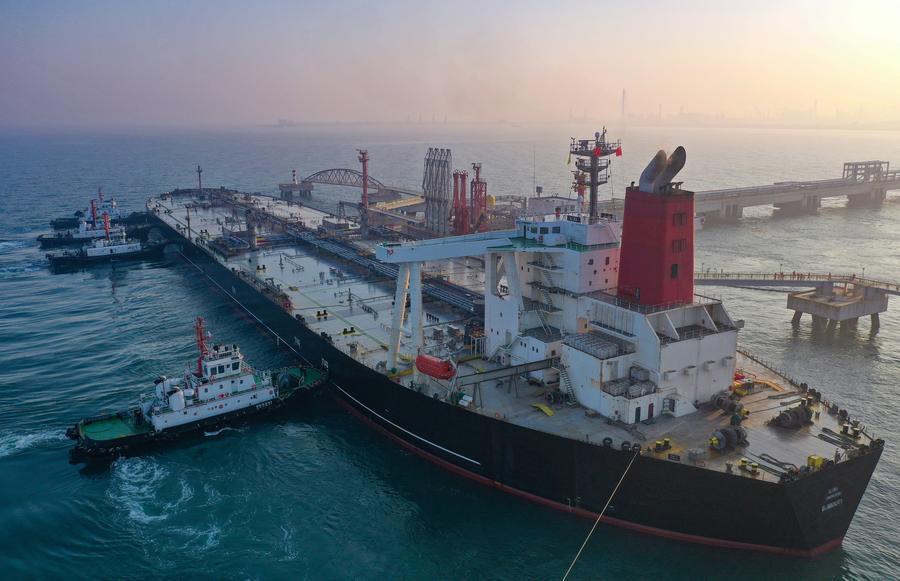



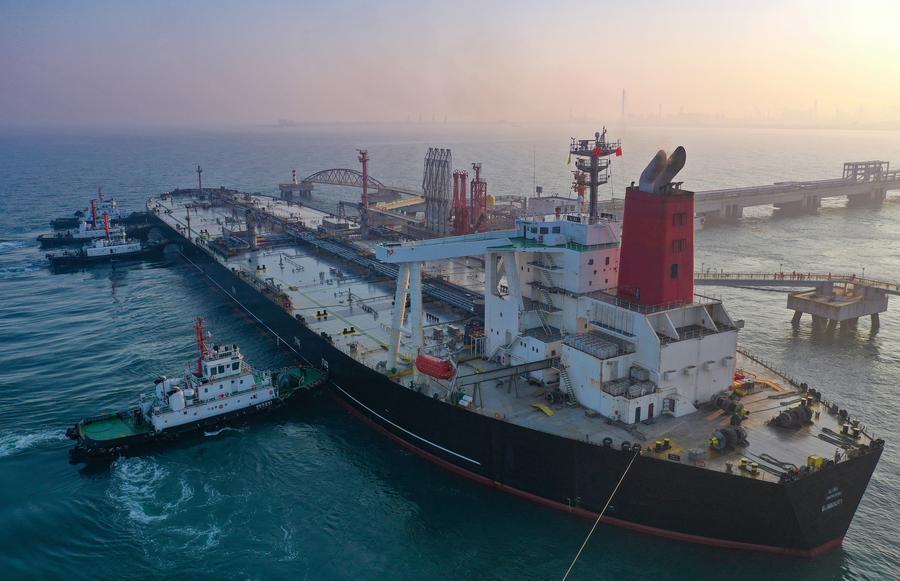
A drone photo shows a vessel carrying 179,000 tonnes of petrochemical raw materials berthing at Yangpu Port in Danzhou, south China's Hainan Province, Dec. 18, 2025. (Xinhua/Guo Cheng)
BEIJING, Jan. 22 (Xinhua Silk Road) -- Hainan Free Trade Port (FTP) in south China has achieved a smooth and orderly overall operation with a good start since its island-wide special customs operations were implemented for a month, with initial results emerging in efficient logistics, convenient travel services, and growing economic flows, said Jiang Hong, vice director of the Hainan Provincial Development and Reform Commission.
The institutional innovations are fueling vigorous growth in the high-quality development of the Hainan FTP.
-- Enhanced appeal for opening-up and business investment
On the first day of operation, Siemens Energy launched its gas turbine assembly base and service center in Hainan, marking the company's first gas turbine assembly project in China. This project underscores the growing attraction of the Hainan FTP for major multinational corporations.
Data shows that from Dec. 18, 2025, to Jan. 5, 2026, Hainan added 207 new foreign-funded enterprises, representing a daily average increase of 10.9 ones. This growth reflects the strong confidence foreign investors have in the FTP's development.
This confidence is supported by continuous policy updates, such as the 2025 version of the "Encouraged Industry Directory for Foreign Investment", which added 102 items specific to Hainan. Consequently, the province saw 14,900 new enterprises established during the same period, averaging 786 new firms daily.
The foreign trade sector has also expanded rapidly. Between Dec. 18, 2025, and Jan. 17, 2026, a total of 5,132 new foreign trade enterprises were registered in Hainan, statistics from General Administration of Customs showed.
From Dec. 18, 2025, to Jan. 10, 2026, Hainan's total import and export volume reached 21.42 billion yuan, a year-on-year increase of 19.6 percent. Specifically, exports grew by 31.6 percent, while imports rose by 13.3 percent.
Aviation connectivity has been further enhanced. Currently, Hainan operates 92 overseas passenger routes connecting 45 cities in 23 countries and regions, strengthening its status as an international aviation hub.
-- Unleashed policy effects and optimized industrial layout
On Jan. 12, 30,000 tonnes of imported mineral products were cleared at Yangpu Port under the "zero-tariff" and "direct release" model. This marked the first batch of mineral products to enter the FTP under the zero-tariff policy since the island-wide special customs operations began.
Customs officials noted that the policy simplifies import procedures and reduces costs for enterprises, improving overall supply chain efficiency. During the first month, customs supervised 750 million yuan worth of "zero-tariff" goods at the "first line".
The benefits of these policies have extended to various sectors, including local hospitals, research institutions, and transport companies, which can now access zero-tariff equipment and vehicles.
While zero-tariff policies reduce entry costs, tax exemptions for processing value-added (PVA) goods are helping to extend industrial chains. Companies like Danzhou Weida Chemical Co., Ltd. have already benefited from these new regulations.
Under the updated policy, value-added components from different island-based enterprises can be combined to meet the tax-exemption threshold for sales to the Chinese mainland. This facilitates smoother industrial collaboration and enhances the stability of corporate orders.
This model bridges international and domestic markets by allowing raw materials imported from overseas to be processed in Hainan before entering the mainland market at lower costs. In the first month of special customs operations, goods worth 85.87 million yuan were sold to the mainland under the PVA tax-exemption policy.
-- Upgraded consumption and logistics services
At the China Duty-Free Mall in Haikou, the market has shown significant vitality since the start of the special customs operations. Service providers have added multilingual staff and foreign currency terminals to accommodate the increasing number of international travelers.
Notably, international tourists have shown a high interest in purchasing Chinese brands, such as domestic smartphones, tea, and coffee.
To further boost consumption, duty-free operators such as China Duty Free Group are integrating cultural and tourism experiences, such as immersive markets and themed performances. These initiatives have successfully extended the time tourists spend in stores, leading to higher conversion rates.
From Dec. 18, 2025, to Jan. 10, 2026, approximately 585,000 shoppers spent 3.89 billion yuan on offshore duty-free items, up 32.4 percent and 49.6 percent year on year respectively. Daily spending averaged 160 million yuan, exceeding pre-operation levels.
The growth in consumption has also spurred cross-border logistics. With about 74 percent of item categories now tax-free, the flow of goods from ASEAN and the e-commerce sector has increased significantly.
Logistics operators have observed that the structure of goods and transport methods are optimizing in line with the FTP's industrial development.
The dual increase in passenger and cargo traffic has prompted airports to upgrade their services. Haikou Meilan International Airport has introduced personalized services and optimized transit processes, such as luggage check-through, to improve efficiency for a more diverse international traveler base.
(Edited by Tian Shenyoujia with Xinhua Silk Road, tianshenyoga0524@163.com)
 A single purchase