


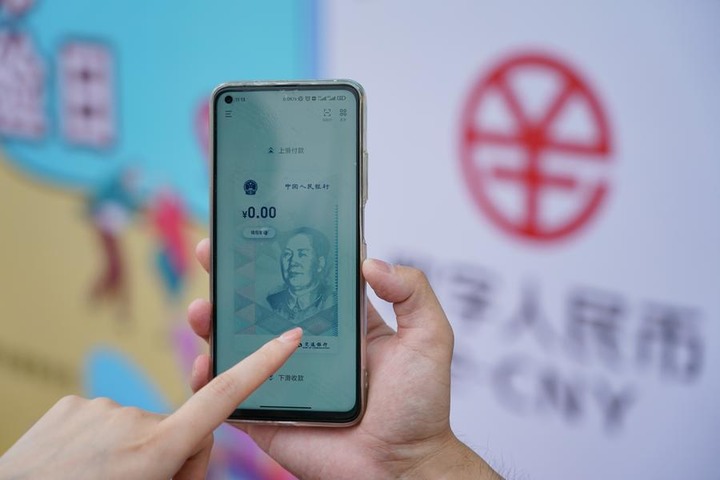
This file photo shows a staff member of the Bank of Communications demonstrating the use of the digital RMB wallet at the Happy Valley Beijing theme park in Beijing, capital of China. (Xinhua/Chen Zhonghao)
BEIJING, Jan. 6 (Xinhua Silk Road) -- China's digital RMB has started accruing interest from January 1, 2026, with the interest rate temporarily aligned with current bank deposit rates, marking a significant shift from its original cash-like instrument nature toward a form of digital deposit money.
Guided by a decade of pilot program experience, the People's Bank of China (PBOC), the central bank, unveiled an action plan at the end of 2025 to strengthen the digital yuan's management system and supporting financial infrastructure. The plan introduces a new measurement framework, a management system, operational mechanisms and ecosystem for the digital yuan, Lu Lei, deputy governor of the PBOC, wrote in an article published on December 29, 2025.
Under the new framework, "the attributes of the e-CNY will shift from cash to deposits, from liabilities of the central bank to the deposit liabilities of commercial banks holding digital yuan wallet balances, and from cash in circulation (M0) to M1 (a measure of money covering cash in circulation, demand deposits and client reserves of non-bank payment institutions), or M2 (a broad measure of money supply that covers cash in circulation and all deposits)."
Experts believe that the upgraded framework will create a win-win outcome for all stakeholders. Enterprises and individuals will earn interest income and gain access to a wider range of financial products and services, while commercial banks will receive stronger incentives to practice and expand digital RMB related businesses. The digital RMB will present a long-term, stable and sustainable development.
-- Sharing same status as ordinary bank deposits
Since its debut, the e-CNY had been positioned as both cash and central bank currency. Following the latest adjustment, the digital RMB now carries the same legal and economic attributes as ordinary RMB deposits.
As the e-CNY enters its "2.0 era", experts expect several direct impacts on the public. First, commercial banks are required to pay interest on balances held in real-name registered digital RMB wallets. During the initial transition period, interest will be temporarily calculated at the current deposit rates. Balances in anonymous wallets will not accrue interest as the ownership cannot be verified.
Second, financial services linked to the digital RMB will gradually be on par with those available for ordinary deposits, and the use of e-CNY will no longer be confined to cash-like scenarios. The digital RMB balances will also be protected by China's deposit insurance.
These balances will be incorporated into banks' regular asset-liability management practices as bank liabilities. As a result, banks will be able to conduct asset and liability management based on the digital RMB holdings. This will enable them to generate profit incentives and strengthen their motivation to provide high-quality and diversified financial products and services for the public.
Experts also noted that restrictions limiting the opening of e-CNY wallets exclusively through the digital RMB App are expected to be "relaxed". Commercial banks will be allowed to open such wallets, enabling them to provide more financial services and functions tailored for digital RMB.
-- Preventing financial disintermediation, creating mutual benefits
Experts believe that the new compatibility incentive arrangements will make digital RMB businesses more sustainable for banks.
Previously, digital RMB business operating institutions including banks were responsible for developing new customers, scenario development, technical maintenance, "three anti" measures (anti-money laundering, anti-counterfeit currency, anti-electronic fraud), and compliance reviews. However, due to the original positioning of the digital RMB, these practices could not generate profits.
Under the new framework, banks will enjoy "equal rights and responsibilities" in digital RMB businesses, allowing them to earn profits and strengthening the commercial sustainability of the digital yuan.
The development of the e-CNY 2.0 version is also expected to support macro-financial stability and mitigate risks of financial disintermediation. The action plan standardizes the measurement framework for the digital RMB and incorporates the digital RMB of bank-typed digital RMB business operation institutions into the reserve requirement system framework for management.
Previously, the digital RMB existed as M0, which did not have the currency derivation function. It means that for every one yuan of digital RMB issued by the central bank, a corresponding yuan had to be returned to the central bank, requiring banks and non-bank payment institutions to maintain a 100-percent reserve with the central bank. This reduced banking system liquidity and has a certain effect of capital contraction on the real economy.
Under the new framework, the digital RMB balances classified as deposits will be counted as M1 or M2 based on liquidity. Banks will only be required to hold deposit reserves with the central bank at the statutory deposit reserve ratio, the same as for ordinary deposits.
Non-bank payment institutions, however, will still be required to maintain a 100-percent deposit reserve for the digital RMB balances, as they are not qualified to conduct deposit business and do not have the currency derivation capabilities. (Edited by Li Xueqing with Xinhua Silk Road, lixueqing@xinhua.org)
 A single purchase