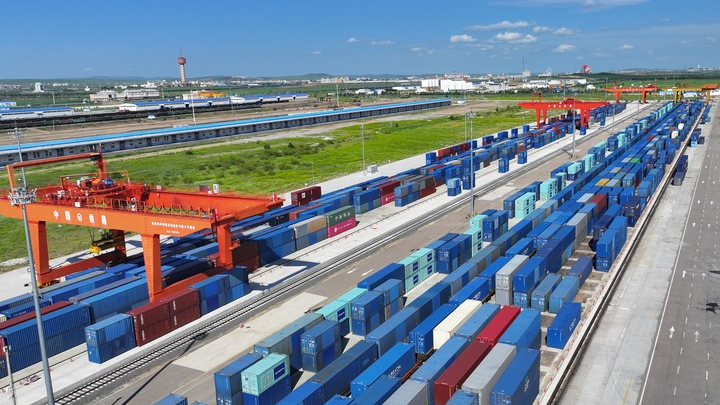



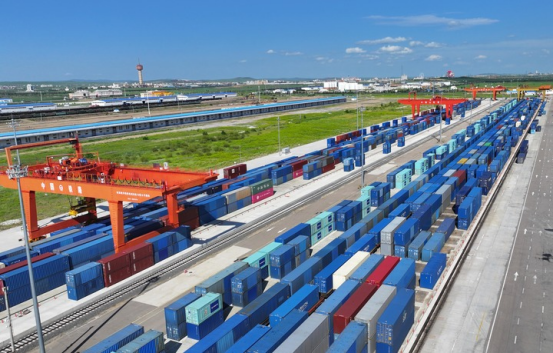
An aerial drone photo shows the CRE return trains undergoing transshipment operations at the container transshipment yard of Manzhouli Station under China Railway Harbin Bureau Group, July 24, 2025. (Xinhua)
On the windy Gobi Desert, the railway stations of China Railway Express (CRE) with twinkling signal lights have replaced the sand dunes where camel bells once jingled. From paper customs documents to "one-click clearance," and from "people finding cargo" to "cargo finding people," digitalization and intelligent technology are not only reshaping the operating model of the CRE trains but also imparting a new core value to the Silk Road.
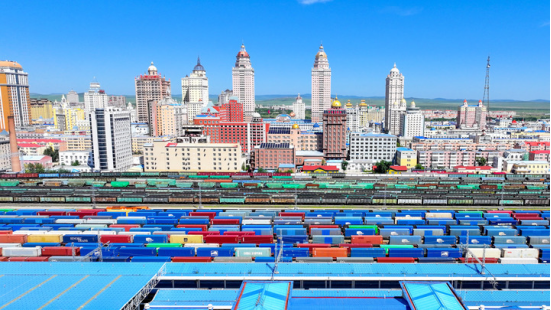
An aerial drone photo shows the outbound CRE trains preparing for departure at the Manzhouli Port in Inner Mongolia, Aug. 20, 2024. (Xinhua)
When Rails Meet Code
At Manzhouli, China's largest land port, a digital revolution is quietly unfolding over the regulation of cross-border trains. Once towering piles of paper documents and dense stamped seals are fading away, replaced by dynamic data on screens, auto-recognized QR codes, and silently circulated electronic signatures.
Through connecting and integrating data from all parties involved in international railway intermodal transport, the 95306 "Digital Port" system applied at the Manzhouli port realizes a series of functions such as rapid declaration inquiry and automatic translation that greatly reduce clearance time.
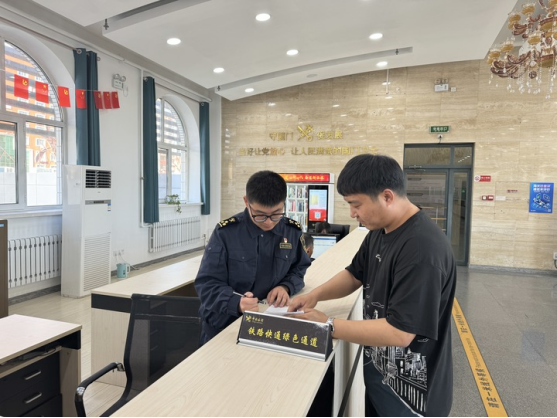
A customs officer at Manzhouli Railway Station assists a representative of an enterprise in applying the "Railway Express Clearance" service. (Xie Juwen)
As a key node of the "Eastern Corridor" of CRE, the Manzhouli port has never slowed its pace of digital transformation. An efficient and convenient sensing system has been established by optimizing and integrating information collection and application from devices such as under-train scanning, radiation detection, and track scale weighing. Information acquisition for each carriage can be completed in an average of 2 seconds, and the verification time for an entire train has been shortened from 10 minutes to less than 1 minute.
In the first nine months of 2025, 3,457 CRE trains passed through the Manzhouli port, transporting 361,842 TEUs, marking year-on-year growth of 4.8% and 2.9%, respectively. 2,128 return trains shipped 221,868 TEUs, ranking first among China's railway ports in terms of return train freight volume. These figures represent a strong testament to Manzhouli's active embrace of digital transformation.
An "Invisible" Corridor
As one of the first cities in China to launch the CRE trains, Chongqing is also undergoing a digital transformation. Driven by data flows, its busy docks and railways have become more intelligent and efficient.
On September 8, a CRE train loaded with "Made in Chongqing" automobiles departed slowly from Chongqing Tuanjie Village Central Station. According to statistics from the Chongqing Railway Logistics Center, from January to July this year, over 3,400 CRE trains (Chengdu & Chongqing) were operated, delivering more than 280,000 TEUs of import and export goods.
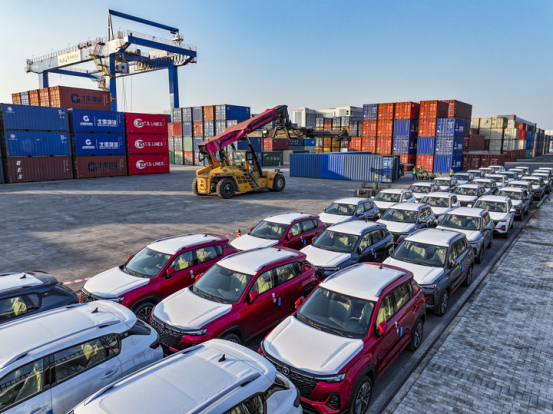
An aerial drone photo shows export automobiles wait to be loaded at the Chongqing Inland Port of the New International Land-Sea Trade Corridor in Chongqing International Logistics Hub Park, Oct. 28, 2024. (Xinhua)
The steady growth in train operations owes to the "1+4+N" digital corridor system built by Chongqing: "1" refers to the "corridor brain" which integrates data resources, exchange platforms, knowledge rules, and algorithm models in the port and logistics sectors; "4" represents four core businesses, namely expanding the corridor, logistics organization, port services, and industrial development; and "N" covers a variety of application scenarios, including intelligent rail-sea intermodal transport.
This system has collected more than 340 million pieces of customs clearance and logistics data, which have been shared and used over 77 million times. It integrates 38 categories of national-level data from institutions including China's General Administration of Customs, China State Railway Group, and Singapore Port, 47 categories of cross-border data related to train services such as China-Laos Railway Express and China-Europe Railway Express, 71 categories of provincial or regional cross-administrative data involving Sichuan, Chongqing and Guangxi, as well as 124 categories of intra-city cross-entity data. These data lay a solid foundation for blockchain applications and the establishment of the smart logistics platform.
The remarkable results of digital transformation are crystal clear. The visualization system for the CRE trains (Chengdu & Chongqing) has reduced logistics information query time from half a day to a few seconds by exchanging over 40,000 pieces of dynamic data with stations along the route. By resolving 26 data bottlenecks, the integrated scenario of "Smart Rail-Sea Intermodal Transportation" has realized "one-code pass" for business processes and full-chain traceability, significantly reducing the operational costs and compliance risks of enterprises in customs clearance and settlement.
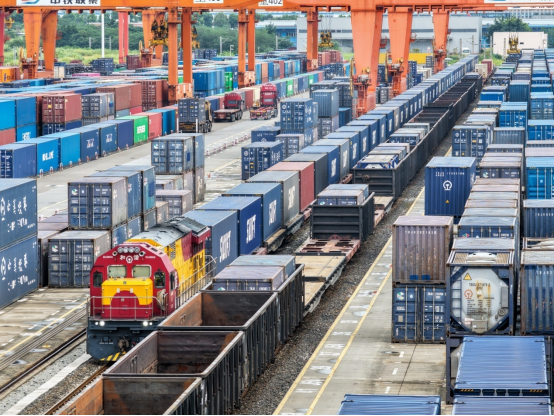
An aerial drone photo shows a CRE train (Chengdu-Chongqing) loaded with "Made in Chongqing" automobiles waiting for departure at Chongqing Tuanjie Village Central Station, Sept. 8, 2025. (Xinhua)
A Distant Destination at the Fingertips
In addition to improving the transportation efficiency of the CRE, the digital transformation has also changed the forms of freight transactions and logistics tracking. On the CRE (Xi'an) service platform, users can check the departure location, destination, departure date, and available booking space of each train. They can also select a train based on their own needs and complete the freight order with a single click.
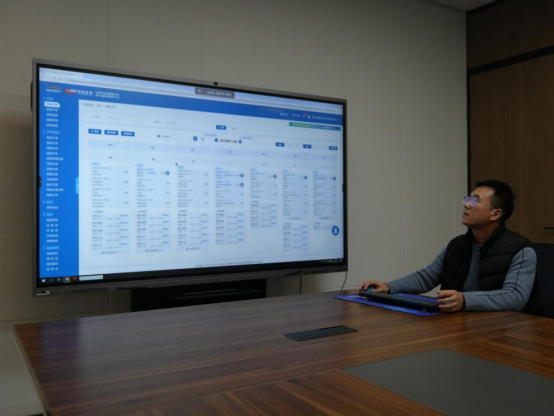
A staff member demonstrates the functions of the comprehensive service platform for the CRE (Xi'an) trains, Dec. 3, 2024. (Xinhua)
"Customers can check all the available cargo space of the CRE trains (Xi'an) on the platform, select a suitable 'schedule,' and place shipment orders at their fingertips," said Li Lujian, from the Transportation R&D Department of Xi'an Free Trade Port Construction and Operation.
At the same time, the CRE (Xi'an) service platform allows customers to track the progress of cargo bookings and the transportation status of departed CRE trains, promoting interconnection and information sharing between China and the rest of the world. "Just like we check the delivery information after online shopping, customers of the CRE trains can query cargo location and status in real time with the shipment code," said Yuan Xiaojun, general manager of Xi'an International Port Group.
Through efficient intelligent stations, smooth digital corridors and real-time tracking online platforms, digitalization and intelligent technology have energized the core engine of high-quality development for CRE, driving this international transportation artery connecting Asia and Europe toward a smarter future. (By Dai Linlin, with research assistance from Wang Songtao, Zhao Yingbo, Lin Shenggai, Li Yunping)
 A single purchase