


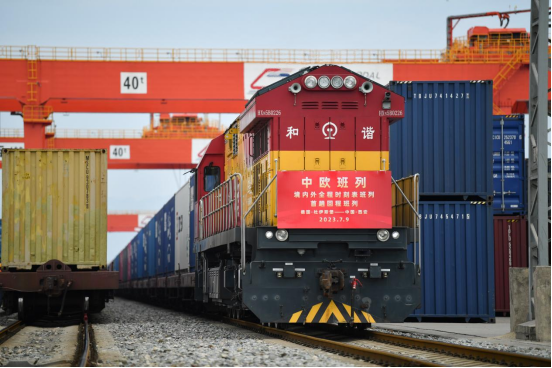
The first CRE train with a full domestic and international operation schedules on its return trip arrives in Xi'an, northwest China's Shaanxi Province, July 10, 2023. (Xinhua)
The China Railway Express (CRE) has achieved exponential growth in the number of train trips — from zero to 110,000 — since its inception. Meanwhile, its network of routes has grown increasingly intricate, transport efficiency has been constantly improving, and the variety of goods has also become richer, now covering more than 50,000 types of goods in 53 categories. Behind these achievements is the CRE's continuous innovation and upgrading across the entire chain. This "steel camel caravan" is demonstrating ever-growing capacity to transport goods and experiencing rapid development.
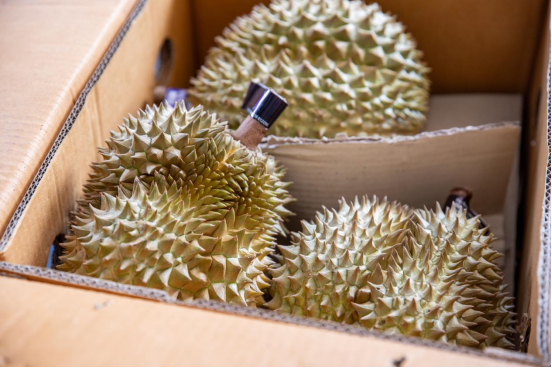
Photo taken on Sept. 30, 2025 shows a box full of durians from Thailand at the Southeast Asian Fruits (Durian) Distribution Center of Chengdu International Railway Port. (Xinhua)
Proper Temperatures to Protect Delicate Goods
Milk, wine and electronic products are all among the most common products transported by the CRE. But have you ever considered the environmental challenges they face during their long journey?
The temperature difference along the CRE routes can be extreme, sometimes up to 70 degrees Celsius, making it a headache to maintain a suitable temperature for goods during transportation. For instance, if milk freezes and then thaws, the milk fat can coagulate and separate from the water inside, severely compromising the taste. For electronic products, the loss could be even more significant.
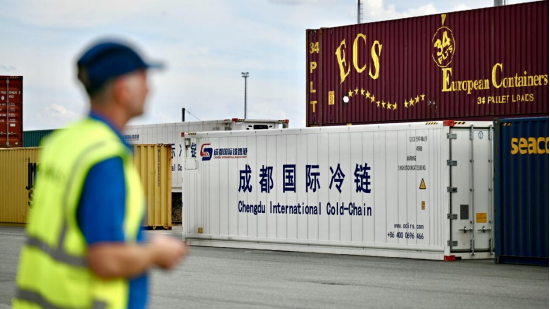
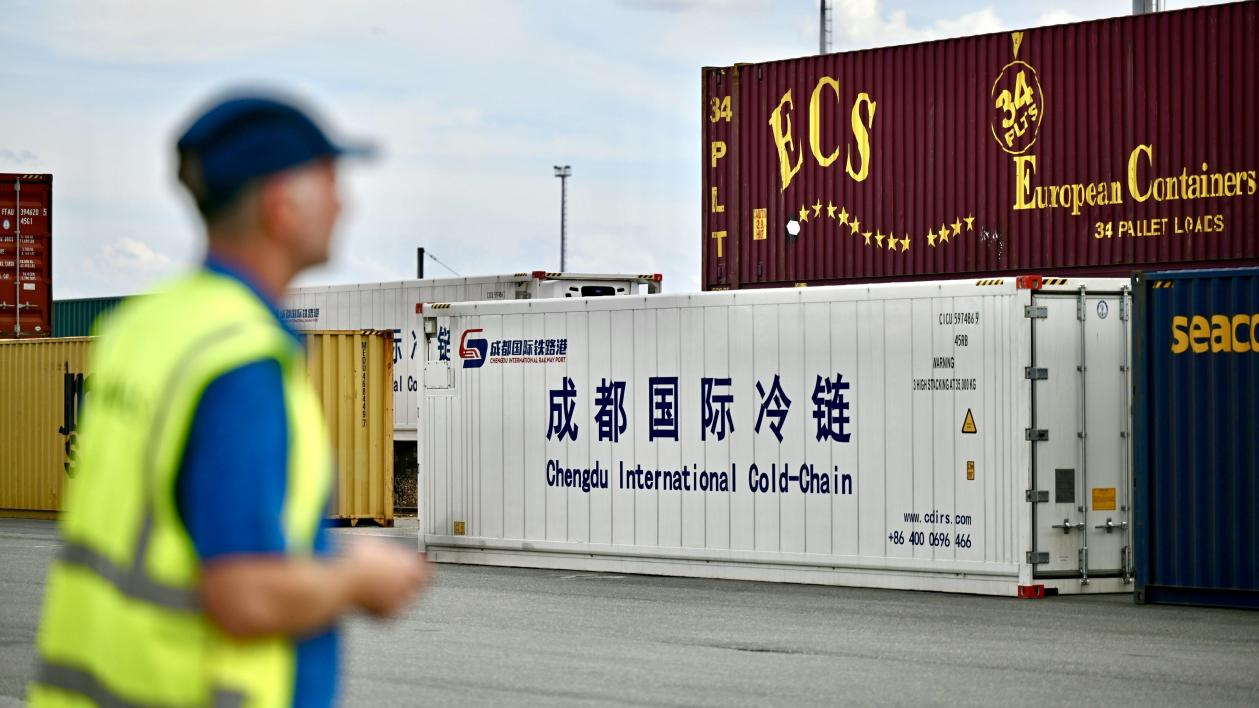
The cold chain containers on a CRE train are unloaded and waiting for transfer, on August 27, 2025. (Xinhua)
Now, with continuous breakthroughs in cold chain technology, the CRE is able to transport more products: not only Chinese specialties like pomegranates and kiwis but also special products from many European and Asian countries, such as Spanish ham, Dutch cheese, Italian coffee beans, Thai durians and Laotian bananas.
The efficient operation of cold-chain trains also provides a reliable transport solution for pharmaceutical companies. "The medicines we transport are extremely sensitive to time and temperature, making the CRE crucial for us," said Jeff Molenaars, sales executive for healthcare transport at Dutch company New Silk Way Logistics.
He revealed that the company transports over 20 temperature-controlled containers of goods on average via the CRE every week. The CRE can meet the company's needs to expand into both European and Asian markets, bringing new development opportunities to the Dutch pharmaceutical industry.
On Sept. 28, 2024, a cold-chain train carrying nasal spray products from Kenvue Inc. arrived in the Chinese city of Chengdu from Europe. This marked the first time for the city to transport imported pharmaceutical products on a CRE cold-chain train, completing the transcontinental journey in just 14 days.
According to Li Junfeng, deputy general manager of Chengdu International Railway Express Co., Ltd., this train uses refrigerated containers with long-lasting battery power, effectively reducing the likelihood of refrigeration anomalies and significantly enhancing the safety and stability of cargo transport.
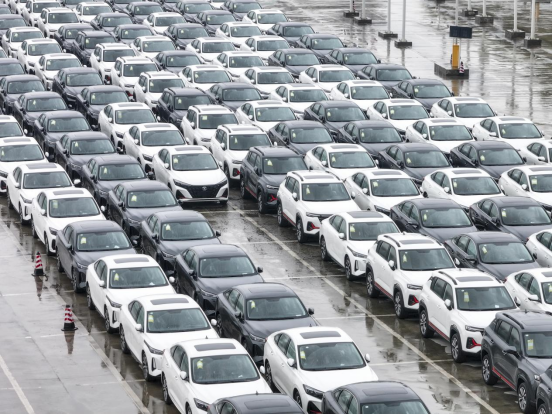
An aerial drone photo taken on Feb. 6, 2025 shows commercial vehicles waiting for loading at the Yuzui Station in Chongqing. (Xinhua)
Large Capacity to Accommodate More Products
As one of the first Chinese cities to launch the CRE service, Chongqing is an important transportation hub and also one of China's core automobile manufacturing bases. At a freight yard of San Yang Ma (Chongqing) Logistics Co., Ltd. in the city, a JSQ-dedicated CRE train, commonly known as a "cage train," consisting of 29 carriages is being loaded. This type of train has two layers inside and the carriages are interconnected. Drivers can drive cars in from the rear of the train and park them precisely inside each carriage. "One carriage can hold 10 cars, so a full train carries 290 cars," site supervisor Wan Neng said.
Currently, various transport forms, including container pallet transport, container chassis transport and cage train transport, complement one another to provide efficient solutions for complete vehicle transport via the CRE.
In June 2025, a batch of German sedans departed from Europe on a CRE train, traveled over 10,000 kilometers and finally arrived at Chongqing Tuanjiecun Station, completing the transcontinental transport in just 16 days.
"In the past, imported sedans mainly relied on sea transport, starting from Hamburg Port in Germany, passing through the Suez Canal to Shanghai, China, and then getting transferred by road to Chongqing, a process that took about 35 days," recalled Tan Renyun, manager of the marketing center at Yuxinou (Chongqing) Logistics Co., Ltd.
Since the city began importing cars via the CRE in 2014, over 40,000 European automobiles have entered Chongqing by rail and have been distributed to more than 10 provincial regions in China.
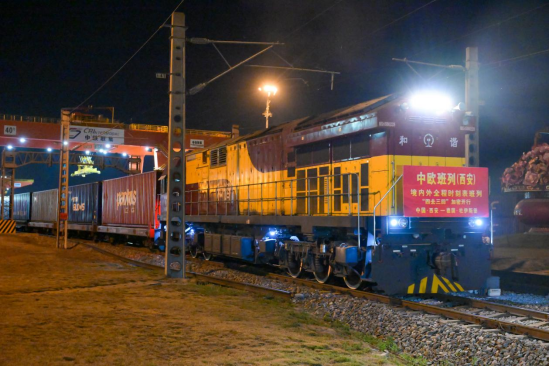
The X8155 CRE train is departing from Xi'an International Port Station and heading for Duisburg, Germany, on June 15, 2024. (Xinhua)
High Precision Leading to Stability and Reliability
On June 21, 2025, an X8155 CRE train operating on full schedules from Xi'an to Duisburg departed from Xi'an International Port Station, carrying goods like auto parts and LED displays. This marked the number of CRE trains operating on full schedules reaching 1,000. The achievement underscores the CRE's new heights of transport timeliness and stability.
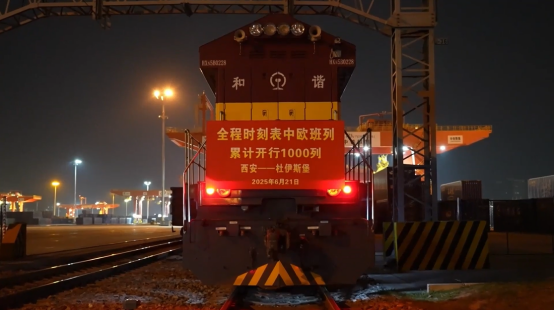
Screenshot from a Xinhua video clip shows the X8155 CRE train (Xi'an-Duisburg) is departing from Xi'an International Port Station on June 21, 2025. (Xinhua)
The CRE train operating on full schedules refers to any train that operates according to the train number, route and schedule established by railway operators of countries along the route, with fixed departure and arrival times, achieving a fully integrated timetable across the Chinese, broad gauge and European sections.
Since its inaugural run on Oct. 26, 2022, the CRE full operation schedules service has become the preferred transport solution for many high-value goods, such as solar panels, solar modules and marine engine parts. The average value per container is roughly 41% higher than that of other trains, and the combined volume of goods shipped has surpassed 98,000 TEUs.
Thanks to the full backing of the "steel camel caravan," the power of open cooperation is flourishing. It is fair to say that the CRE is emerging as a stable driving force for high-quality development. (By Shi Chunjiao and Jiang Yani)
 A single purchase