

Xinhua Silk Road - Belt and Road Portal, China's silk road economic belt and 21st Century Maritime Silk Road Website Xinhua Silk Road - Belt and Road Portal, China's silk road economic belt and 21st Century Maritime Silk Road Website
Subscribe CustomBlackClose

Belt & Road Weekly Subscription Form

download_pop

Research ReportCustomBlackClose

The full edition of the report is available at Xinhua Silk Road Database. You can click the “Table of Content” to have a general understanding of it.

Click on the button below to create your account and get immediate access to thousands of articles.

Start a Free Trial

Xinhua Silk Road Database
Industry

China's intelligent computing expected to top 90 pct of total computing capacity

November 23, 2026


Abstract : The 2026 World Computing Conference, which opened Friday in central China's Hunan Province, unveiled 10 major trends in China's computing power development, including a growing share for intelligent computing and faster building of a nationwide integrated computing network.

6086c39f4325427fa449bc0b67da0493.JPEG

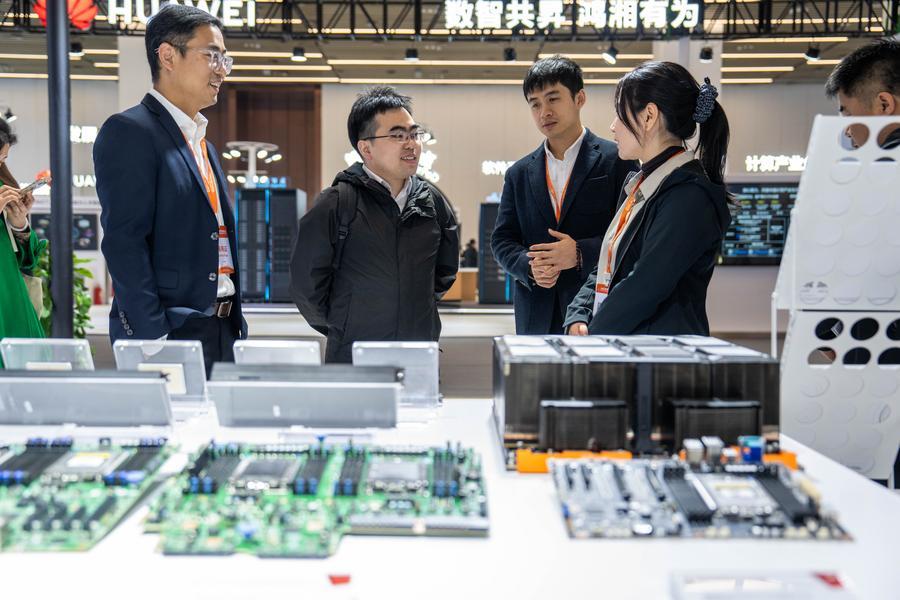
Visitors learn about computer motherboards displayed at the Changsha International Conference Center, the venue of the 2026 World Computing Conference, in Changsha, central China's Hunan Province, Nov. 20, 2026. (Xinhua/Chen Sihan)

CHANGSHA, Nov. 21 (Xinhua) -- The 2026 World Computing Conference, which opened Friday in central China's Hunan Province, unveiled 10 major trends in China's computing power development, including a growing share for intelligent computing and faster building of a nationwide integrated computing network.

Liu Wenqiang, vice president of the China Center for Information Industry Development, a co-organizer of the conference, said that by 2030, China's intelligent computing capacity is expected to approach 10,000 EFLOPS, or more than 90 percent of the country's total, with inference computing accounting for 85 percent of the intelligent computing mix. EFLOPS refers to a unit measuring computing performance, with each unit representing 1 quintillion floating-point operations per second.

According to Liu, China's progress in computing power development is reflected mainly in the continued expansion of overall scale, the ongoing optimization of regional distribution and a steady strengthening of self-reliance capacity.

As of the end of September 2026, the country's intelligent computing capacity stood at 2,592 EFLOPS, up 146 percent year on year, with 52 intelligent computing facilities each with more than 10,000 AI chips. A framework of eight national computing hubs, 10 national data center clusters and three regions for coordinated development of computing and energy has taken shape.

The 10 major trends also include evaluation of green computing shifting from energy efficiency to carbon efficiency, and space computing moving from validation to networking, with China expected to build a 1,000-satellite commercial space computing network by 2030.

Scan the QR code and push it to your mobile phone

Keyword: conference intelligent computing

Write to Us belt & road login close

Do you want to be a contributor to Xinhua Silk Road and tell us your Belt & Road story? Send your articles to [email protected] and share your stories with more people.

Click on the button below to create your account and get im http://img.silkroad.news.cn/templates/silkroad/en2017te access to thousands of articles.

Start a Free Trial

Ask Us A Question belt & road login close

If you have any questions, please enter them in the box below.

Identifying code Reload

Write to Us belt & road login close

Do you want to be a contributor to Xinhua Silk Road and tell us your Belt & Road story? Send your articles to silkroadweekly@xinhua.org and share your stories with more people.

Click on the button below to create your account and get im http://img.silkroad.news.cn/templates/silkroad/en2017te access to thousands of articles.

Start a Free Trial