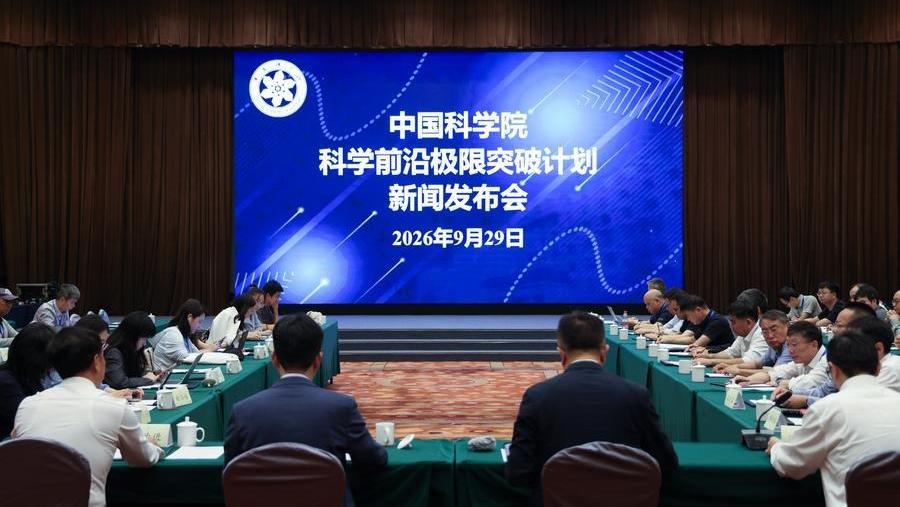



This photo taken on Sept. 29, 2026 shows a scene at a press conference held by the Chinese Academy of Sciences (CAS) in Beijing, capital of China. (Xinhua/Jin Liwang)
BEIJING, Sept. 29 (Xinhua) -- The Chinese Academy of Sciences (CAS) announced on Tuesday the launch of a new program aimed at achieving breakthroughs at the frontiers of science and producing major original research achievements in key fields.
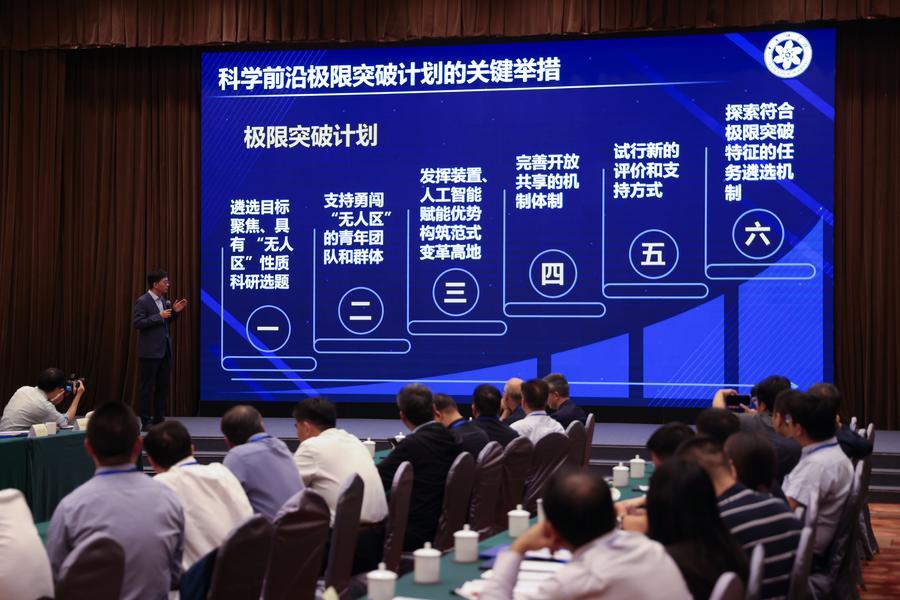
At a press conference held in Beijing, Zhou Qi, CAS vice president, said the program focuses on major scientific questions that will drive a paradigm shift in research and open up new frontiers, harnessing shared access to major scientific infrastructure and AI-empowered scientific research to organize leading talent into systematic, institutionalized research campaigns.
These efforts are designed to support China's pursuit of original, trailblazing breakthroughs on major frontiers of science and in core technologies, Zhou said.
The first batch of 10 projects under the program was unveiled at the media event, targeting research in fields such as the synthesis of new elements, the nature of dark matter and dark energy, microscopic measurement of chemical bonds and the creation of synthetic cells.
Meanwhile, a list of priority areas for the next batch was also released, with key support to be directed toward the fields of physical sciences, life sciences, Earth system sciences, and space sciences.
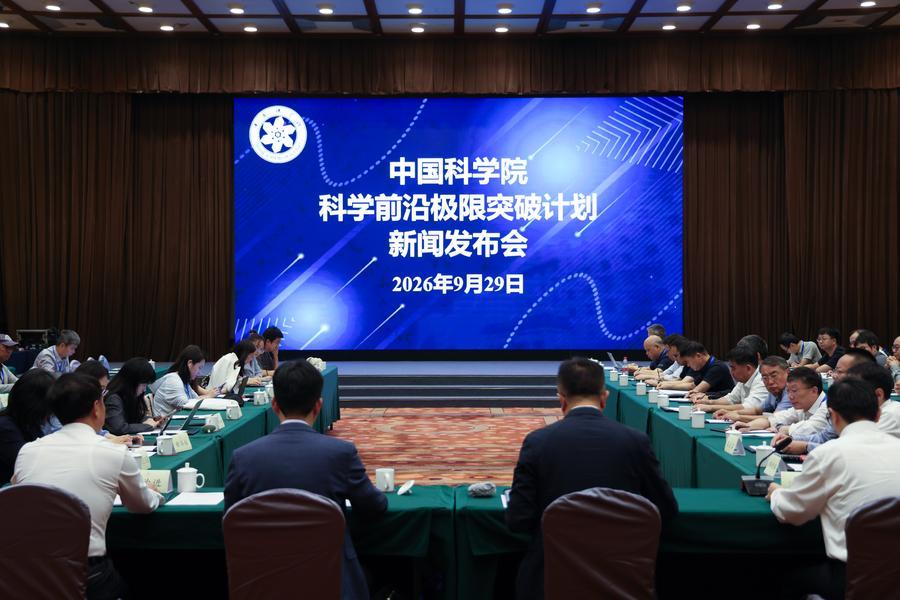
This photo taken on Sept. 29, 2026 shows a scene at a press conference held by the Chinese Academy of Sciences (CAS) in Beijing, capital of China. (Xinhua/Jin Liwang)
Wei Zhixiang, director of the Bureau of Basic Science Research of the CAS, said this program will deeply integrate the coordinated use of major scientific facilities with AI empowerment, centering on the directions of "the extremely macroscopic, the extremely microscopic, extreme conditions, and highly convergent interdisciplinary frontiers."
Outstanding scientists from within and beyond the CAS, as well as around the world, are encouraged to join the program and make full use of the large-scale scientific facilities, AI platforms and networks of the CAS, Wei said.
Li Yuhui, deputy director of the Bureau of Basic Science Research of the CAS, said the program will focus on key difficulties in national security, people's health, and major engineering projects, promote breakthroughs in fundamental theory, and encourage scientists to seek new growth areas in the "uncharted territories" at disciplinary boundaries.
The program will use AI to conduct deep mining of massive literature and experimental data, identify key problems approaching the critical point of breakthrough, and then carry out rapid verification through automated experiments by scientific facility clusters.
Yang Weijin, deputy director of the Bureau of Basic Capacity for Science and Technology of the CAS, said major scientific and technological infrastructures can provide ultimate research means for frontier research and for tackling core technologies, and serve as strategic support platforms in the era of big science.
China has deployed 77 major scientific and technological infrastructures. The CAS now operates 43 of them, accounting for 56 percent of the national total, according to Yang.
 A single purchase