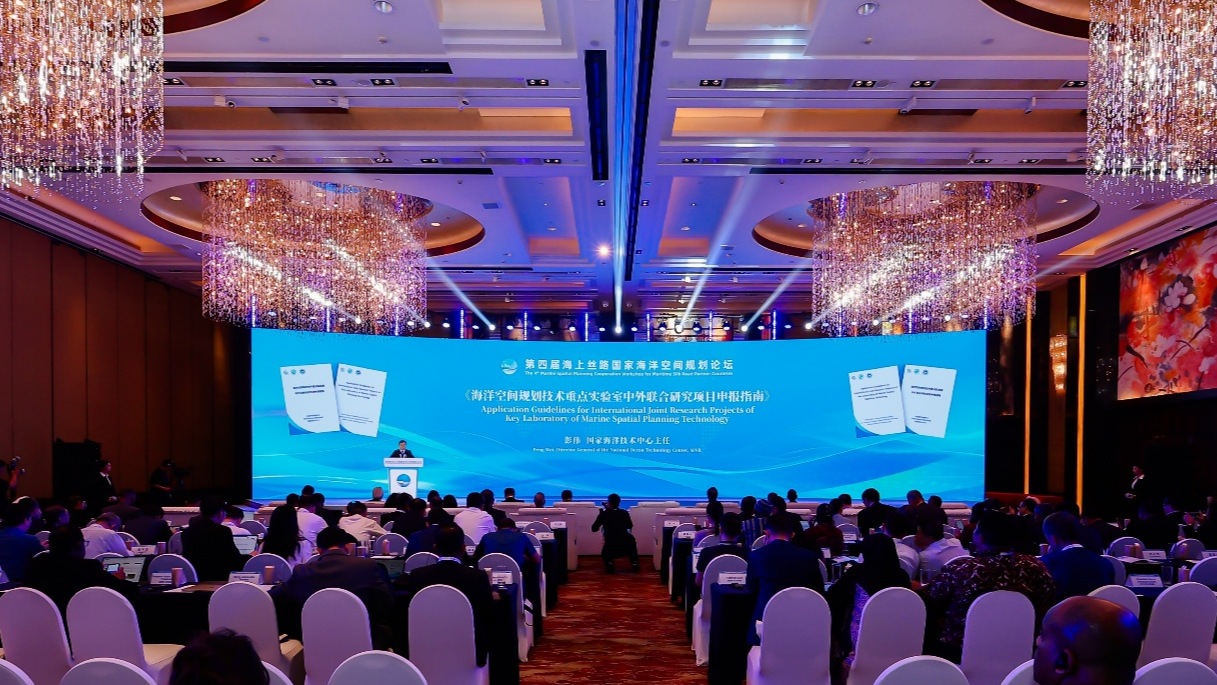



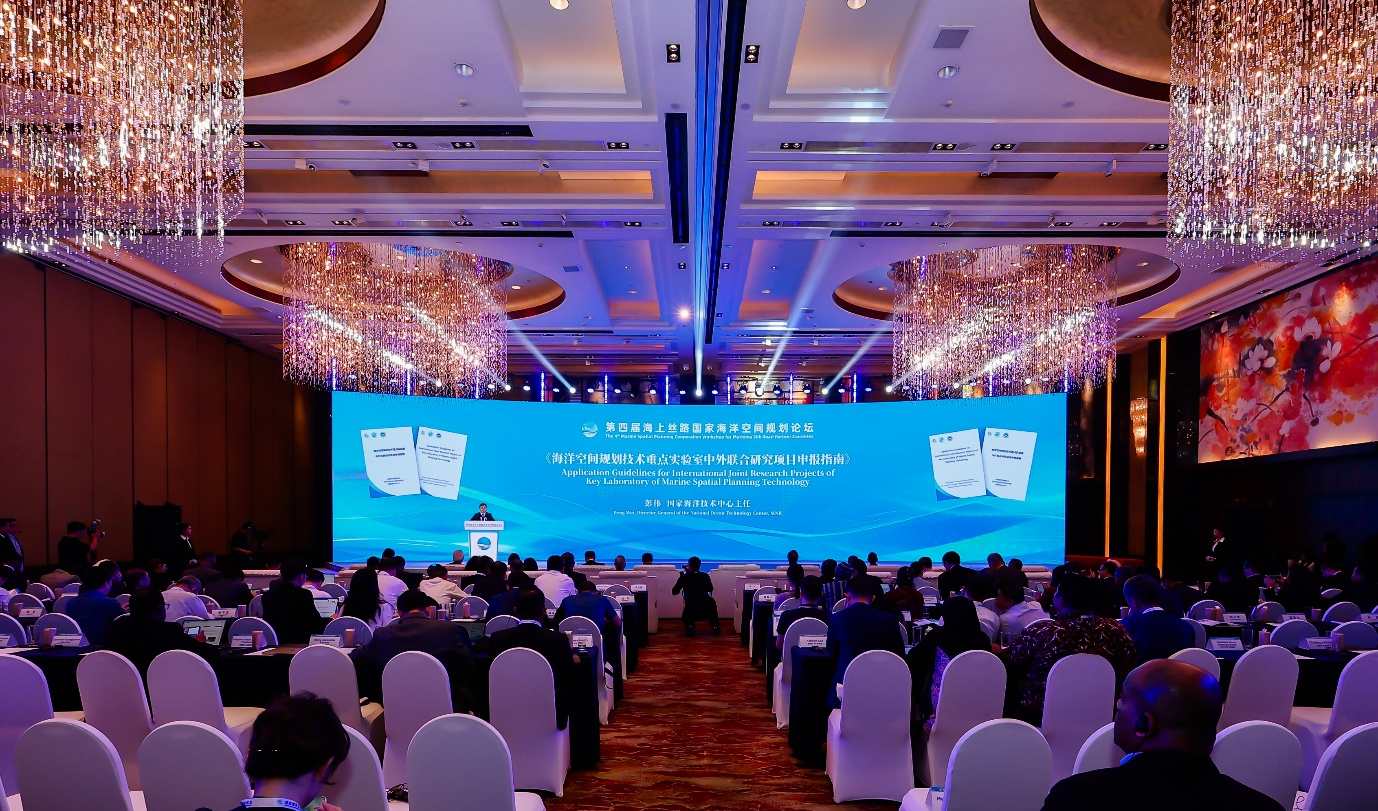
The photo shows the scene of the 4th Marine Spatial Planning Cooperation Workshop for Maritime Silk Road Partner Countries in Beijing on Sept. 22, 2026.
A number of achievements have been made during the 4th Marine Spatial Planning Cooperation Workshop for Maritime Silk Road Partner Countries which was held in Beijing on Tuesday.
The workshop saw the release of cooperative outcomes including the China-Cambodia coastal conservation project, the joint marine spatial planning project for the Balikpapan Bay Area, and the public goods including the marine spatial planning partnership training system, the application guidelines for international joint research projects of key laboratory of marine spatial planning technology, and the capacity index of sustainable coastal development for countries along the Maritime Silk Road (2026).
Vidar Helgesen, executive secretary of the Intergovernmental Oceanographic Commission (IOC) of UNESCO, said that thanks to the leadership and support of institutions such as the China Oceanic Development Foundation (CODF), the field of marine spatial planning is making continuous progress.
Climate change is increasing the risks facing ports, coastal infrastructure and communities. Biodiversity loss is affecting fisheries, tourism and natural coastal protection. At the same time, growing demand for food, energy, infrastructure and trade is intensifying competition for marine and coastal space, according to Neo Gim Huay, managing director and member of the Managing Board at the World Economic Forum and Chair of Greater China.
In her opinion, climate, nature and economic development must be addressed in a coordinated way.
For island countries, this is even more a matter of survival. Zameer Mohamed, deputy minister for fisheries, agriculture and ocean resources of the Maldives, said that for the Maldives, the ocean is not just a geographical space; it is the foundation of the country's economy, food security, livelihoods and national development.
"Our planning mainly aims to achieve a balance between development and protection, which is what the United Nations (UN) calls sustainability," said Pan Xinchun, vice chairman and secretary-general of the CODF, adding that China's approach is to share good practices and also lessons from the detours it has taken. Restoring damaged marine ecosystems requires substantial investment, so for developing and least developed countries, the first thing is not to destroy them.
The consensus among the foreign guests at the event was that the core of marine spatial planning cooperation lies not in delivering a planning document, but in helping partner countries build localized technological, talent and institutional capacity, completing the transition from "learning from experience" to "independent application." This path has taken different forms in different countries.
For example, Cambodia has seen a change from a plan to the national law. Malaysia has made progress from the pilot practice to the national reference. Indonesia has aligned the planning with its national laws and regulations.
Over the years, China has upheld the new development philosophy featuring innovation, coordination, green development, openness and shared benefits, and has explored a path of building maritime strength with Chinese characteristics. Marine spatial planning has gone beyond the scope of a technical tool and is increasingly becoming a driver for leading the high-quality development of the blue economy, according to the industry insiders.
It is learned that heads of marine authorities, experts and scholars from about 30 foreign countries, including the Maldives, Antigua and Barbuda, Cambodia, Bangladesh and Indonesia, as well as representatives from Chinese government agencies, ocean-related research institutes, high-end think tanks and key marine-related central state-owned enterprises, attended the event. More than 300 people attended in person, while over 2,000 joined online. (Edited by Hu Pingchao with Xinhua Silk Road, hupingchao@xinhua.org)
 A single purchase