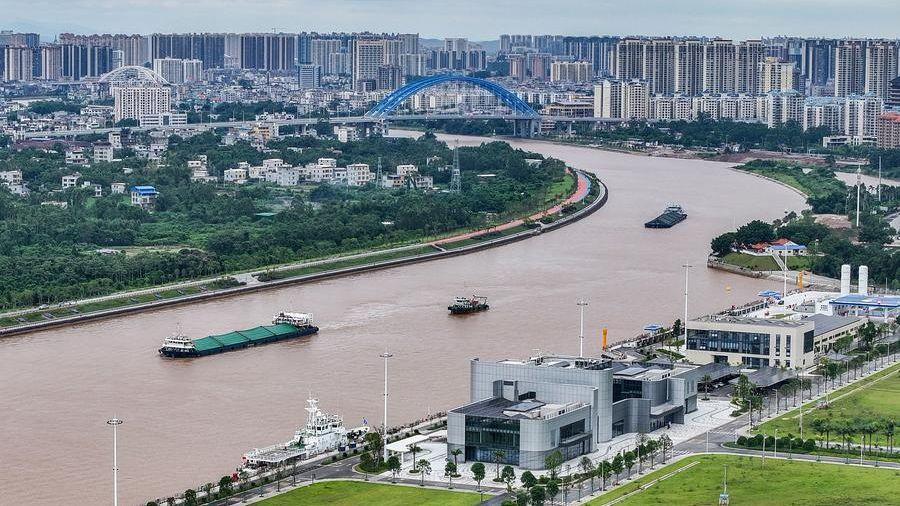



MANILA, Sept. 18 (Xinhua) -- The Pinglu Canal is not simply an important waterway; it is an economic artery and a bridge between inland China and ASEAN, holding potential to deliver win-win results, said a Filipino expert who visited the canal in Guangxi Zhuang Autonomous Region in southern China in early September.
"The canal's opening is good news not only for Southeast Asia and China, but for broader Asian connectivity, trade, tourism, cultural exchange and technological cooperation," Wilson Lee Flores, a columnist for The Philippine Star, a Filipino media outlet, told Xinhua in an interview.
Built at a cost of 72.7 billion yuan (about 10.75 billion U.S. dollars), the 134.2-km canal runs from Hengzhou, a county-level city in Guangxi, to the Beibu Gulf.
Designed for vessels of up to 5,000 tonnes, the canal shortens the inland waterway journey for goods from southwest China to the sea by more than 560 km compared with traditional routes through ports in Guangdong Province.
"I was deeply impressed by its scale, engineering, high technology, environmental safeguards and strategic significance," said Flores. He added that southwest Chinese provinces and cities including Guizhou, Yunnan and Sichuan could particularly benefit from the shortcut.
"As the physical foundation of economic cooperation, better connectivity makes it easier and less costly to move goods, people, capital, technology and ideas," said Flores.
He pointed out that ASEAN and China are not only two of the world's most economically dynamic and fast-growing regions; they also share an exceptionally robust economic relationship. China has been ASEAN's largest trading partner since 2009, while ASEAN has been China's largest trading partner since 2019.
Flores said the Pinglu Canal can add an important physical link to this bilateral economic architecture and become an important new link in the ASEAN-China economic relationship.
"Benefiting from the canal, ASEAN companies can gain easier access to China's vast inland market and diversify their supply chains," he said.
He noted that the canal also makes investment in areas of inland China more attractive. For Chinese enterprises, "they can deepen their engagement with the dynamic economies of resource-rich Southeast Asia."
The canal opens in the first year of China's 15th Five-Year Plan period (2026-2030), as the world's second-largest economy seeks to promote more coordinated regional development and further expand high-standard opening up -- priorities outlined in the plan.
Flores believed the canal's significance goes beyond cargo. It is a potential corridor of opportunity not only for the business sector, but also for workers, farmers, students, scientists and beyond.
"Infrastructure such as the Pinglu Canal can turn geographic proximity into practical economic opportunity and inclusive development," said Flores, adding that it should be efficiently operated and complemented by sustainable policies.
 A single purchase