


*The film is set in the Middle East, but its emotional center lies elsewhere: in the universal desire to live an ordinary life.
*"Don't forget to eat well" is an ordinary phrase in peaceful times. In the film, it becomes something much larger -- a reminder of the normal life that war threatens to take away.
*In the movie, the restaurant becomes a small refuge: water, electricity, food, and people from different backgrounds sharing a table while the outside world is held at bay.
by Xinhua writers Zhang Yunlong, Xing Tuo and Xiong Jialin
BEIJING, Aug. 24 (Xinhua) -- Xu Fu and Ma Junsheng are asleep when a blast wakes them and for a moment, they think it is an earthquake. Then comes the shockwave, and the understanding that war has arrived.
The pivotal scene in Chinese film "Once Upon a Time in the Middle East" turns a restaurant kitchen into the center of a story about war, survival and peace.
Directed and co-written by Wen Muye, the film follows Xu Fu, a Chinese cook who travels to the Middle East to work in a Chinese restaurant after falling into debt at home. He and restaurant manager Ma Junsheng help build a popular eatery that becomes a gathering place for people of different backgrounds. Then war breaks out.
The film opened in Chinese mainland cinemas on Aug. 11. Maoyan, a Chinese ticketing platform, forecasts that the film could gross more than 2.5 billion yuan (about 369 million U.S. dollars) in the Chinese mainland, after it had already taken in around 1.6 billion yuan by Monday. The film has also received a rating of 8.6 on Douban, a major review platform.
The film's appeal lies less in its explosion scenes, than in what happens between them.
WHY FOOD
Wen said the decision to tell a war story through a restaurant came from a simple contrast: war is cruel, while food represents happiness.
The film returns repeatedly to cooking, from dumplings prepared before Xu leaves home to a wedding banquet where Chinese and Arab food traditions meet. Later, fleeing the fighting with a group of orphaned children, Xu prepares a simple pot of rice. The meal is modest, Wen said, but it gives the children a sense of safety. The dish eventually becomes known as "Xu Fu Rice Stew" at the restaurant.
The film is set in the Middle East, but its emotional center lies elsewhere: in the universal desire to live an ordinary life.
"Don't forget to eat well" is an ordinary phrase in peaceful times. In the film, it becomes something much larger -- a reminder of the normal life that war threatens to take away.
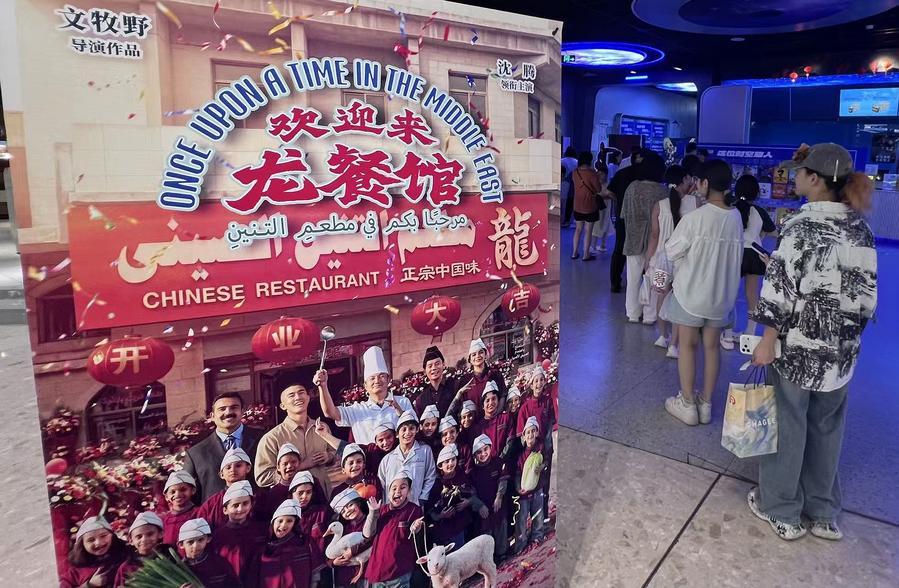
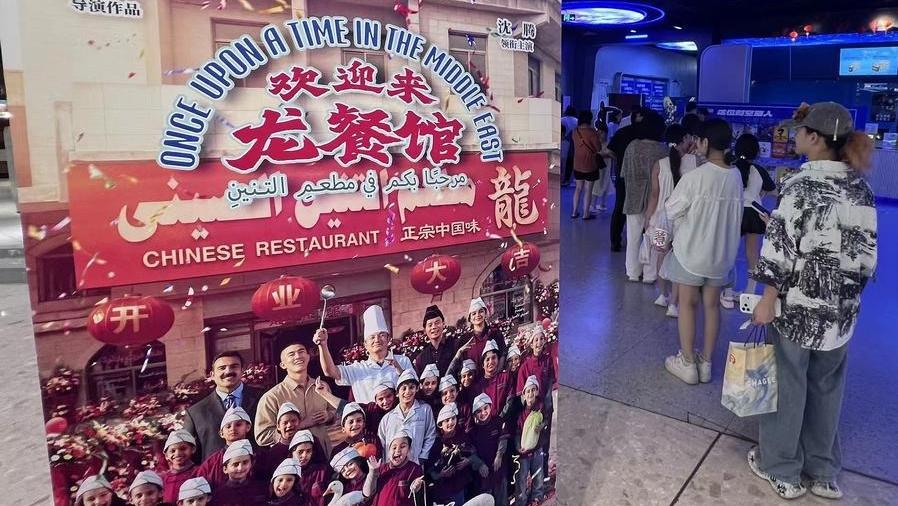
Spectators line up for ticket check next to a poster of the film "Once Upon a Time in the Middle East" at a cinema in Qingdao, east China's Shandong Province, Aug. 24, 2026. (Xinhua/Li Ziheng)
RESTAURANT IN RUINS
The restaurant setting reflects a familiar reality in the history of Chinese migration. For decades, opening restaurants has been one of the most common ways for Chinese migrants to make a living overseas.
The film's Loong Restaurant is rooted in a real story.
Shuai Xuejun, from Jiangxi Province, traveled to Iraq in 2004 at age 31 and opened a restaurant of the same name with friends in Baghdad, in a run-down building with broken windows and no proper door.
The restaurant eventually grew into a thriving business, employing about 20 people and generating daily revenue of 4,000 to 5,000 U.S. dollars at its peak. But the noise of the restaurant could not keep out the war. One morning, Shuai was woken by a blast that shook dust loose from the walls; the bomb had exploded about three kilometers away.
What stayed with him the longest, he said, was not the sound of explosions but small acts of kindness. A regular customer helped him replace a malfunctioning television for recreation when the store was closed during the war. When Shuai finally left Iraq in March 2005, another regular customer told him: "When you leave, there will be no Chinese flavor here."
Shuai and his colleagues later wrote a book about their experiences. A film company acquired the rights years later.
MORE THAN FOOD
The film resonates with the people who have lived through war themselves. Ahmed Mohammed Jaber Alkalthoom, an Iraqi-born actor who appears briefly in the film, is better known in China as a food blogger.
Born in Iraq in 1994, Jaber grew up amid conflict. He later recalled once mistaking the sound of missiles for fireworks. He moved to China with his family in 2014 and began filming Chinese food in 2018. In 2024, while filming a video during the Chinese New Year holiday, he froze at the sound of a firecracker. "I thought it was a bomb," he recalled. Viewers who saw the footage left messages reassuring him: "Don't be afraid. This is China."
"During wartime, there would be no water or electricity. A family would take out the food they had hidden and share it, and that felt warm and healing," he said. For him, being able to eat well became part of everyday Chinese life -- something he still regards as "a great thing."
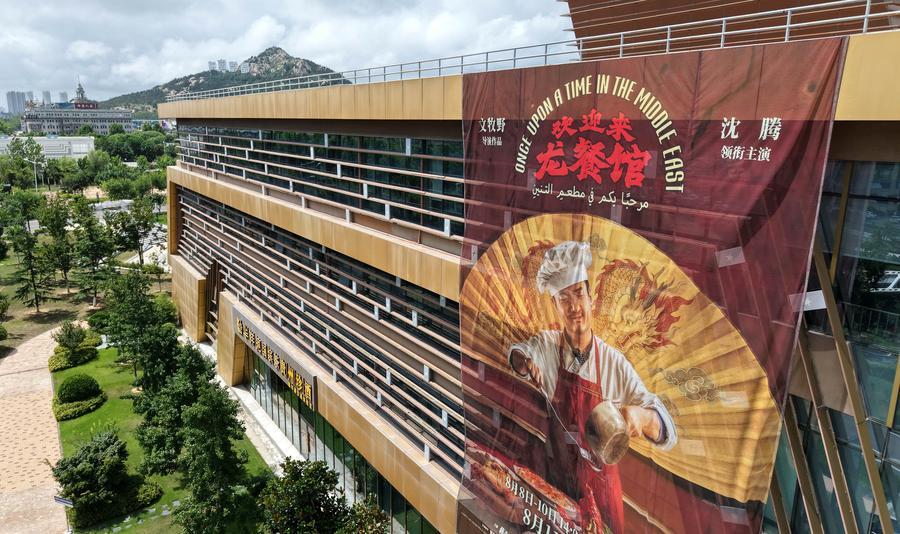
This drone photo taken on Aug. 24, 2026 shows a poster for the film "Once Upon a Time in the Middle East" in Qingdao, east China's Shandong Province. (Xinhua/Li Ziheng)
WAR STORY WITHOUT SUPER HERO
The film also stands apart from more conventional action-driven war stories.
Xu Fu is not a conventional hero. Going abroad to earn money and pay off debt, he is an ordinary man whose life is gradually transformed as the war forces him to confront the fate of those around him. Ma Junsheng, who is more idealistic, ultimately sacrifices himself protecting children. Saif, an orphan who initially steals food to survive, gradually learns to cook under Xu's guidance.
Egyptian journalist Mohamed Mazen, who has lived in China for 17 years, said he did not feel the usual distance he associates with Chinese cinema while watching the film.
Its questions about war, food and ordinary life, he said, cross cultural boundaries.
Mazen said he was struck by the film's perspective on war. Having grown up watching Hollywood films, he was accustomed to stories centered on soldiers, rescuers and larger-than-life heroes.
In contrast, he said, "Once Upon a Time in the Middle East" focuses on cooks, restaurant workers and children trying to preserve a sense of normality amid violence.
In the movie, the restaurant becomes a small refuge: water, electricity, food, and people from different backgrounds sharing a table while the outside world is held at bay.
Years later, Xu Fu returns to the region as a tourist. Finding the Loong Restaurant again, he discovers that Saif, the orphan who he once taught to cook, has become its head chef.
The boy who grew up in war has chosen a life in the kitchen, with a spatula in his hand rather than a gun -- a quiet ending to a film that measures the cost of war not only in lives lost, but in the ordinary life people struggle to preserve.
(Video reporter: Xu Haofu, Yao Bing, Dong Xiuzhu and Zhang Yanfang; video editors: Liang Wanshan, Roger Lott and Zheng Qingbin)
 A single purchase