


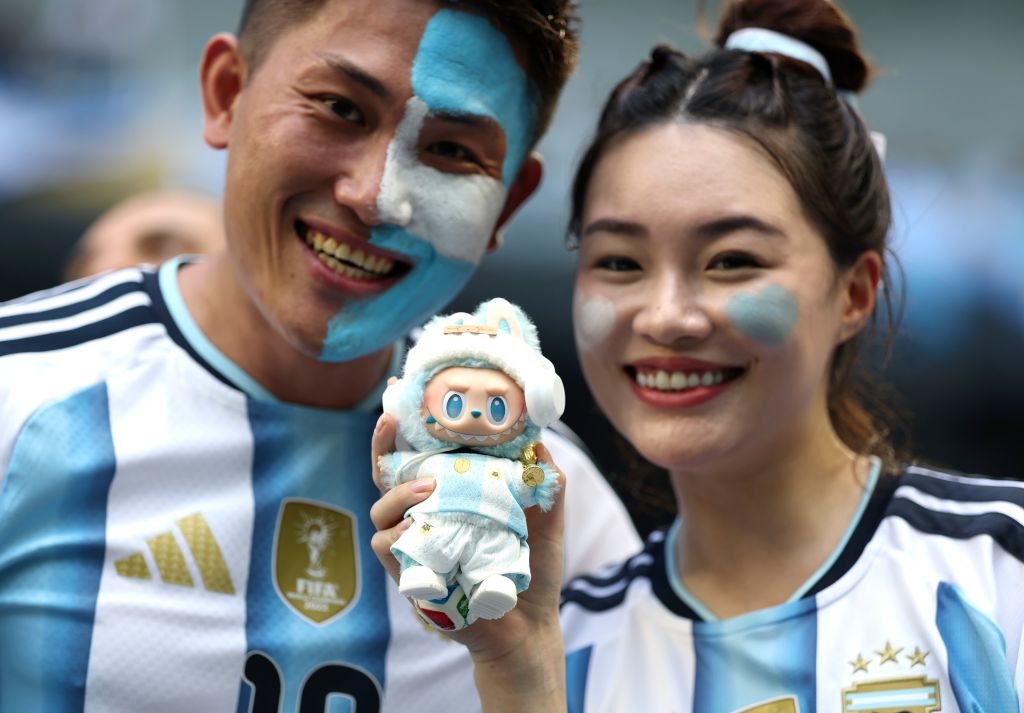
Fans of Argentina hold a Labubu doll to cheer for the team before the round of 32 match between Argentina and Cabo Verde at the 2026 FIFA World Cup at Miami Stadium, Miami, the United States, July 3, 2026. (Xinhua/Zhang Chen)
BEIJING, July 20 (Xinhua) -- China is experiencing a niche transformation in its trendy toy market, as AI, IP and diverse trend drivers unlock added earnings and untapped opportunities for the world's top toy manufacturer and exporter.
The rise of Chinese trendy toy brands is demonstrated with Labubu, the best-known character from Pop Mart's The Monsters franchise, which makes history as the first Chinese original toy IP to appear at a FIFA World Cup opening ceremony, in front of a global audience.
While traditional toy segments face sustained pressure, original IP and AI-powered interactive toys are accelerating the industry's shift toward new and highly sought-after growth tracks.
A KPMG report shows that China's trendy toy market was expected to exceed 82.5 billion yuan (about 12.2 billion U.S. dollars) in 2025, representing a year-on-year growth of 40.5 percent, and is projected to surpass 213.3 billion yuan by 2030, with a compound annual growth rate reaching 18.7 percent.
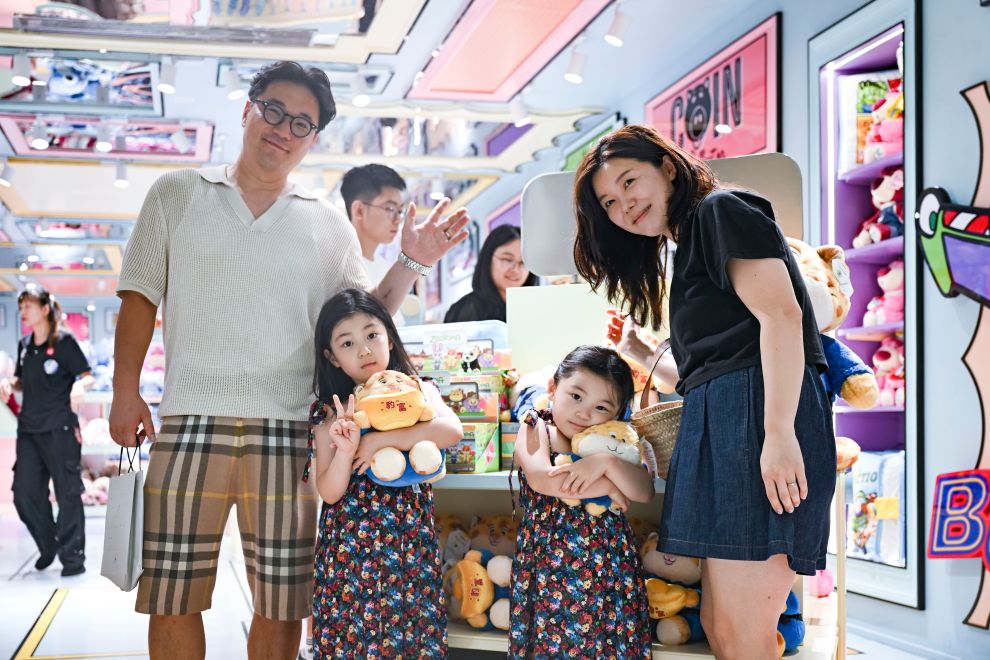
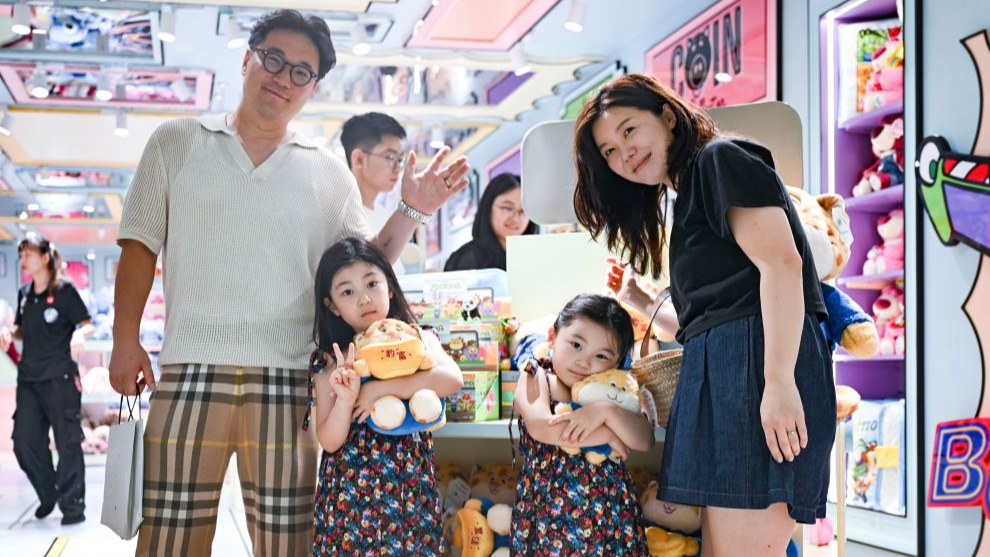
South Korean tourists pose for photos with their favorite items at a trendy toy shop on Nanjing Road in east China's Shanghai on July 17, 2025. (Xinhua/Tang Siqi)
TRADITIONAL SECTORS UNDER PRESSURE
As the market expands, the Chinese toy industry is witnessing fierce competition, with industry leaders racing to expand their global footprint, startup brands carving out their own niches, and even newcomers from outside the sector, such as tea chains and game studios, flooding in with their unique IPs.
Despite a growing influx of new players, the traditional designer toy manufacturing track is facing mounting growth pressures beneath its booming facade.
From the market-response perspective, the novelty dividend of customers is evaporating. The repurchase rates of blind-box toys are trending downward, and the life cycle of blind box series for once-hot IPs has reduced, from six to 12 months to a mere three to six months.
In recent years, some of the once wildly popular blind box toy products have shown a clearly diminishing marginal effect of their dividend, alongside intensifying homogenizing toy products in the market.
According to insiders, as traditional toy segments grapple with sustained pressure, the exploration of new product categories has become a shared focus for the industry. Among these, AI-powered trendy toys and new tech-powered toys have emerged as key niche categories for Chinese toy investors and producers.
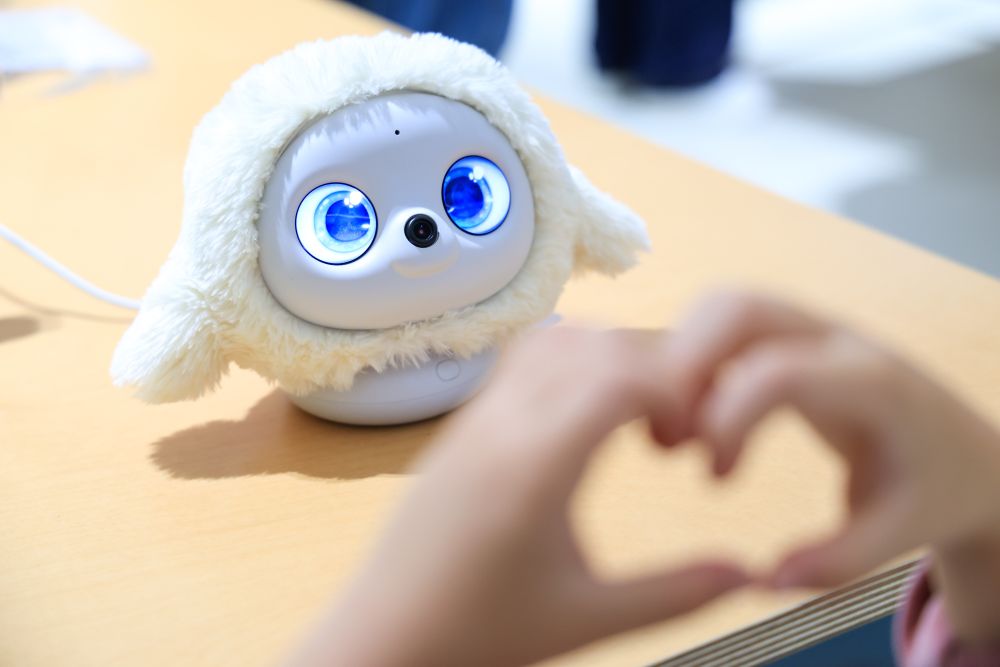
A child interacts with the AI toy Ropet at the inno100 flagship store in Shenzhen, south China's Guangdong Province, Dec. 21, 2025. (Xinhua/Mao Siqian)
AI, IP UNLEASH VITALITY
"China's trendy toy sector is now in a transformation, from 'selling toys' to 'ecosystem IP operations,' with the year 2026 marking a pivotal milestone," Xue Xiaowei, executive president of the Shenzhen Toys Industry Association, told Xinhua.
"The core lies in two major aspects -- the AI-enabled interactive capabilities of toy products and the extended IP value of toys via cultural tourism scenarios, which will jointly accelerate such transformation."
In 2026, both established and emerging industry players in China's trendy toy sector have been making AI technology the core of their product innovation.
"We are currently at a critical window for the large-scale deployment of AI hardware," said Ren Hangbo, marketing director at Tuya Smart, a leading AI cloud platform service provider. "Represented by AI-powered trendy toys, AI-native hardware that has been market-validated is experiencing significant growth."
Ren disclosed that during China's "618" shopping festival this year, AI trendy toy products of Tuya Smart were selling well across the company's product line, with AI toys known as "Fuzozo" achieving sales of about 40,000 units in all of its marketing channels.
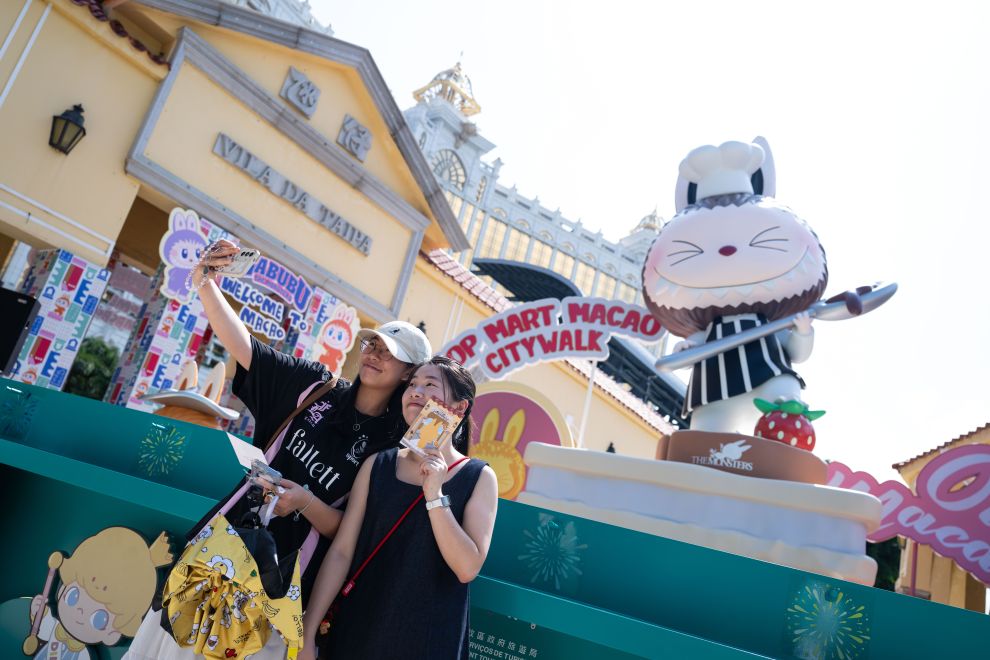
Residents pose for photos at the Taipa exhibition area of "POP MART MACAO CITYWALK" in south China's Macao, June 6, 2025. (Xinhua/Cheong Kam Ka)
"We have noticed that both leading toy enterprises and emerging toy brands are ramping up investment in theme parks and comprehensive cultural tourism projects," Xue said.
Xue cited the example of Pop Mart, which plans to complete a new zone tailored for its flagship trendy toy IP Skullpanda at the Pop Land by 2027. Pop Land is an immersive IP-themed park for the trendy toys at Chaoyang Park, one of Beijing's largest cultural and leisure spaces.
"Thus, this is a move of the company to create an integrated resort destination," Xue said.
Trendy toy companies are actively expanding their IPs into offline experiences and lifestyle consumption through new application scenarios. Some emerging toy brands are also bringing their IPs into diverse application scenarios, such as water-based cultural tourism sites, as well as integrated projects with intangible cultural heritage and sports events. Such moves allow toy products to break free from the constraints of blind box retail shelves and other traditional market models.
"Looking at the big picture, the transformation of China's trendy toy industry hinges on three pivots: AI-driven emotional toys; fusion of toy IPs with culture; and a seamless loop of content, smart products, integrated offline scenarios and digital collectibles, which aim at effectively extending the life cycle of toy IPs," Xue said.
 A single purchase