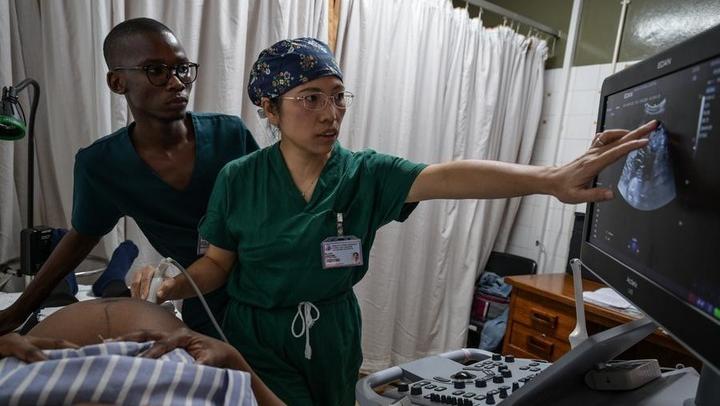



Luo Jinying (R), chief obstetrician with the 17th batch of the Chinese medical team to Botswana, conducts Doppler ultrasound examination for a local pregnant woman at Princess Marina Hospital in Gaborone, Botswana, May 5, 2026. (Xinhua/Yang Guang)
I arrived in China with a fairly grounded perspective shaped by my background in urban–rural development in Botswana. My concerns were practical land allocation, uneven infrastructure, and the persistent divide between urban centers and rural settlements.
At first, ideas like the Belt and Road Initiative (BRI) seemed distant, almost abstract. They appeared to me as belonging more to policy documents than to everyday realities. Over time, however, I have begun to see how such frameworks could be connected to the development challenges we face in southern Africa, including Botswana.
What stands out to me most about the BRI is its emphasis on connectivity, which appears to be physical, economic, and increasingly digital. In China, I observed how transport corridors, particularly high-speed rail and integrated logistics systems, reshape relationships between regions. While southern Africa operates at a very different scale and capacity, the underlying principle linking regions more effectively is relevant. For Botswana, a landlocked country, connectivity is not just a convenience, but a structural necessity.
Within the broader framework of the BRI, there have been tentative discussions around improving infrastructure corridors in southern Africa. If implemented carefully, such efforts could support projects like the Trans-Kalahari Corridor, which links Botswana to Namibia's Walvis Bay. Improved rail and road infrastructure along this route could reduce transport costs, shorten delivery times, and make Botswana's exports, such as beef and minerals, more competitive.
Energy is another area where the BRI can have implications. Chinese investment, under the broader BRI umbrella, has already been visible in parts of Africa in the form of power plants and renewable energy projects. If Botswana were to engage more actively, there could be opportunities to expand solar infrastructure, particularly in rural areas where grid access remains uneven. This would not only support local development but could also reduce long-term dependence on external energy sources.
Another dimension that deserves attention is urban development. Cities in southern Africa, including Gaborone, are expanding, sometimes in fragmented ways. The BRI's focus on integrated planning could offer lessons. In China, I observed coordination of transport, housing, and economic zones within broader regional plans. For Botswana, this could mean linking urban expansion with rural development strategies, ensuring that growth in cities does not come at the expense of surrounding regions.
There is also a softer, less visible aspect of the BRI that I have come to appreciate: knowledge exchange. As an international student, I find myself part of this process, even if indirectly. Studying in China exposes me to different planning approaches, governance models, and development philosophies. These experiences do not translate automatically into policy back home, but they do shape how I think about problems. For instance, the idea of experimenting at smaller scales before scaling up something I have observed in China, could be particularly useful in Botswana, where resources are limited and large-scale failures can be costly.
However, I remain aware of the differences. Botswana's socio-economic context, governance structure, and population distribution differ significantly from China's. What works in one setting may not work in another. This is where the notion of adaptation becomes critical. The BRI, if it is to be meaningful for Botswana, must be interpreted through local realities rather than applied as a uniform model.
From a personal perspective, my understanding of the BRI has shifted from seeing it as a distant policy concept to viewing it as a set of possibilities. I recall a field visit in Sichuan Province, where we examined rural revitalization projects, which reflect a broader approach to development that emphasizes connectivity, local industry, and incremental change. It made me wonder whether similar principles could be applied in Botswana's rural areas, where economic opportunities are often limited.
There is also a human dimension that is easy to overlook. Infrastructure projects, trade corridors, and energy investments ultimately affect people's daily lives. Improved roads can mean better access to markets for farmers. Reliable electricity can support small businesses. At the same time, poorly planned projects can disrupt communities or create new inequalities. The BRI operation modifies these problems and eventually improves common people's daily lives.
In southern Africa, regional cooperation will likely play a key role in determining how the BRI unfolds. Organizations like the Southern African Development Community (SADC) provide a framework for coordinating infrastructure and trade policies across countries. For Botswana, working within such frameworks could help ensure that BRI-related projects align with broader regional goals rather than operating in isolation.
In the end, my reflection is shaped by both observation and experience. Being in China has given me a closer view of how large-scale initiatives are implemented, with all their strengths and limitations. It has also made me more aware of the importance of context. For Botswana, the challenge is not simply to participate in global initiatives like the BRI, but to do so in a way that supports its own long-term development goals.
Editor's Note: This article is written by Moemedi Bosupeng from Botswana, who is now studying at Renmin University of China. The views expressed in this article are those of the author and do not necessarily reflect the positions of the Belt and Road Portal or Renmin University of China.
 A single purchase