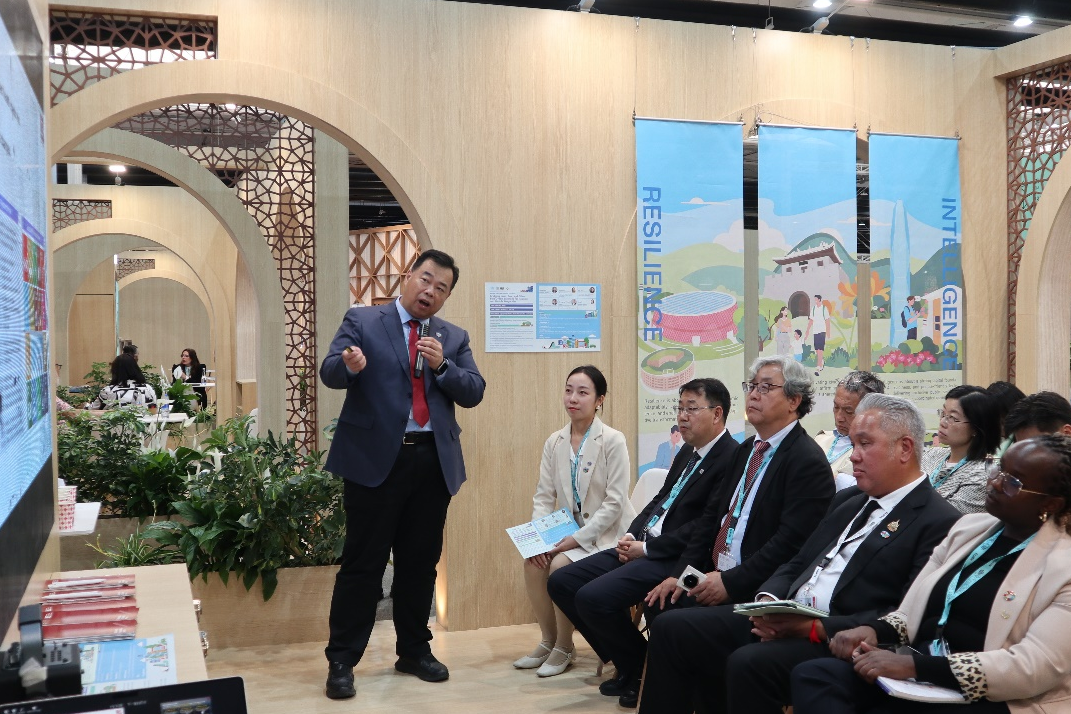



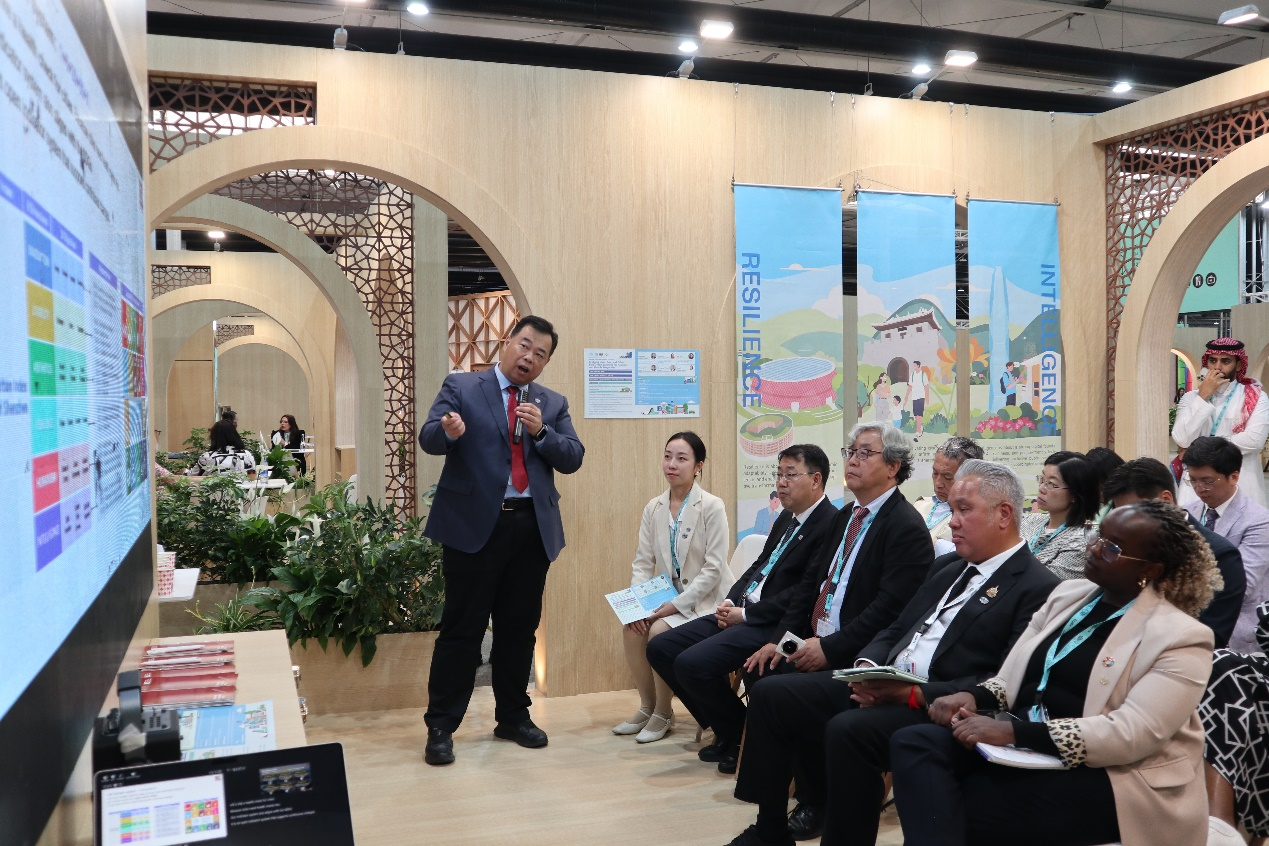
Shan Liang (L), director of the Shenzhen Urban Planning and Land Resource Research Center, gives a speech in Baku, capital of Azerbaijan, on May 19, 2026.
A session under the theme "Bridging Land, Sea, and Cities: Blue-green Solutions for Resilient and Liveable Megacities" was recently held in Baku, capital of Azerbaijan, sharing experiences on how to integrate megacity construction with environmental protection and liveability and introducing the Urban Index of Shenzhen (UIS).
The event, as a part of the 13th World Urban Forum (WUF13), was jointly organized by the United Nation's Human Settlements Programme (UN-Habitat) Planning and Finance Section, the Research Center for Territorial Spatial Planning of China's Ministry of Natural Resources, and the Shenzhen Urban Planning and Land Resource Research Center.
Experts at the event discussed challenges facing global megacities and coastal cities, stressing the role of blue-green infrastructure and ecosystem-based planning in promoting sustainable human settlements.
Shan Liang, director of the Shenzhen Urban Planning and Land Resource Research Center, introduced the UIS and Shenzhen's successful practices in maintaining harmony among people, nature, and urban development. The index, he said, is designed not only for city rankings but also to help cities learn, adjust and grow. Shan added that Shenzhen hopes the UIS will serve as an international public good for urban governance.
Wu Zhiqiang, an academician of the Chinese Academy of Engineering, shared successful experiences of old-town regeneration in Shanghai, China and Hanoi, Vietnam.
Taweebhong Wichaidit, governor of the National Housing Authority of Thailand, presented Thailand's efforts to expand affordable housing coverage for low-income and vulnerable groups. He also introduced Thailand's approach to deeply integrating high-quality living environments and public supporting facilities with community livelihoods and well-being.
Joy Mutai, programme management officer of the Planning and Finance Division at UN-Habitat, shared her views on how to integrate nature-based solutions into urban and regional planning.
Fu Bang, urban expert of the Data and Statistics Section at UN-Habitat, introduced how the Global Urban Monitoring Framework serves as a monitoring tool for UN-Habitat programmes and other partner organizations' implementation plans.
(Edited by Tian Shenyoujia with Xinhua Silk Road, tianshenyoga0524@163.com)
 A single purchase