


*China's national action plan addresses youth employment on three fronts: securing jobs in key industries, tapping new employment potential, and improving job quality.
*AI-related job postings rose 16.9 percent year on year in the month following the Spring Festival holiday, with demand for robotics algorithm engineers up 57 percent, as the market moves faster than policy.
*The plan aims to make the world's largest labor market resilient enough to absorb challenges of the AI age and turn them into opportunities.
BEIJING, May 31 (Xinhua) -- Yu Ziqi was about to graduate from the Liaoning Institute of Science and Engineering in northeast China's Liaoning Province with a degree in mechatronics when anxiety set in.
She wanted to stay in the province but had no idea which local firms were hiring, until she discovered "Jiulai Liao," a digital platform that allowed her to watch livestreamed human resources sessions, polish her resume using artificial intelligence (AI), and practice mock interviews. She ultimately secured a job at a company in the city of Jinzhou in Liaoning.
Huang Jinze from Hubei Province in central China took an even less likely path. A master's graduate from the University of the Chinese Academy of Sciences, he was scrolling through his phone two years ago when he came across a Liaoning livestream breaking down specific positions, subsidies and housing guarantees. "The stream spelled everything out. The job, the support and the residential guarantee. That's what made me decide," he said. He now works in Shenyang, capital of Liaoning.
Their stories reflect a broader shift as 12.7 million college graduates -- 480,000 more than last year, a record -- pour into a job market experiencing changes and transitions. A national action plan issued on May 18 addresses the challenge on three fronts: securing employment in key industries, tapping into new employment potential, and improving the quality of jobs.
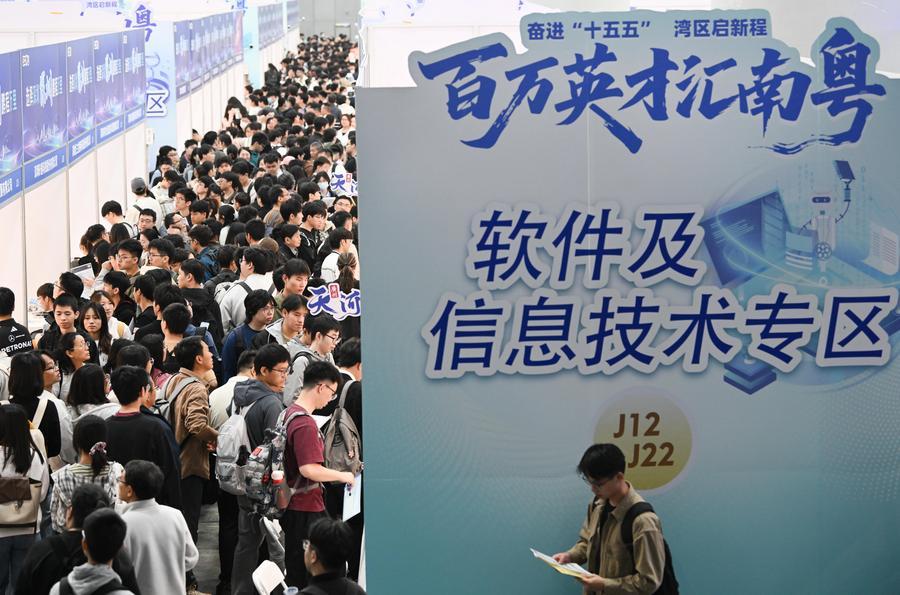
This photo taken on March 15, 2026 shows a job fair in Guangzhou, south China's Guangdong Province. (Xinhua/Deng Hua)
HOLDING THE LINE
The first front is manufacturing, where most jobs still are. The plan calls for preserving the sector's share of the economy and urges companies deploying AI to retrain affected employees rather than simply let them go. State-owned enterprises are being asked to raise campus recruitment quotas by another 5 percentage points.
On the ground, the scramble is already visible. Liaoning has surveyed more than 4,600 companies to consolidate 37,700 positions and publish information on 84,600 openings. A talent-demand directory for 660 positions in the old industrial base now feeds into big-data analysis to match graduates with roles.
The province has built 798 "Shuxin Employment" community stations, the name meaning "worry-free," creating a 15-minute service radius for job seekers. The "Jiulai Liao" platform that helped Yu has topped one million followers, covers all 104 universities in the province, and draws more than 35 percent of its users from outside Liaoning.
Jixi City in east China's Anhui has allocated 170,000 yuan (about 24,935 U.S. dollars) in employment subsidies and 386,500 yuan in skill-training subsidies to local businesses. Hebei Province in north China has rolled out measures targeting young job seekers, including expanded public-institution hiring, while the southwestern province of Sichuan has carved out 30,000 policy-backed positions.
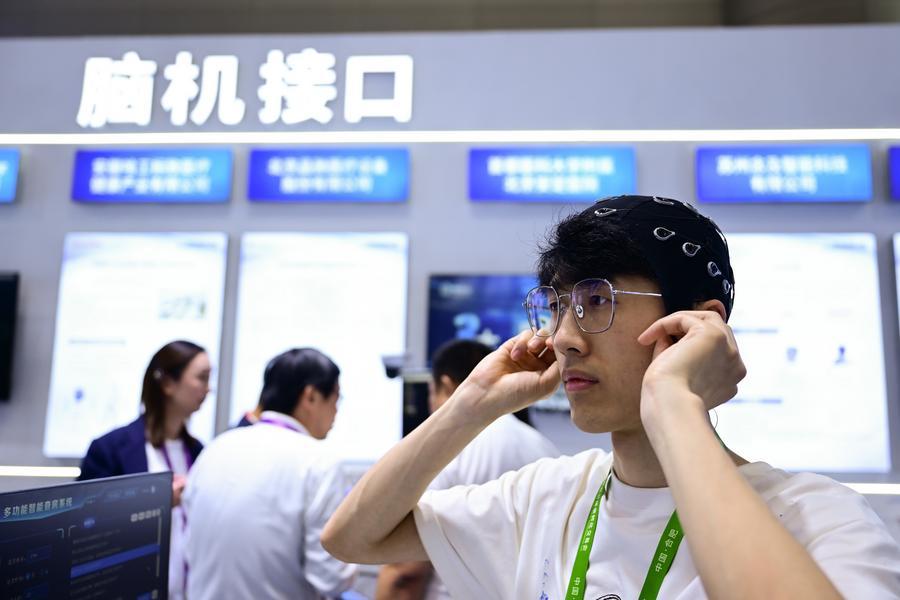
Anhui University's graduate student Wang Chang demonstrates technologies from the university's brain-computer interface (BCI) research team at the 4th China (Anhui) Scientific and Technological Innovation Achievements Transformation Fair in Hefei, east China's Anhui Province, April 26, 2026. (Xinhua/Zhou Mu)
OPENING NEW DOORS
On top of holding the line, the bigger story is the jobs being invented, with AI being one of the engines.
Latest market data shows that the demand-to-supply ratio for AI positions stands at 3.5 to 1 and for robotics engineers, 5.2 to 1. AI-related job postings rose 16.9 percent year on year in the month following the Spring Festival holiday, with demand for robotics algorithm engineers up 57 percent. The market is moving faster than the policy.
Baidu says over 90 percent of its campus hires are now AI-related. At Jiashida, a home service robot maker, the ideal candidate blends liberal-arts sensibility with engineering skills, a sign that the AI era is scrambling old disciplinary lines.
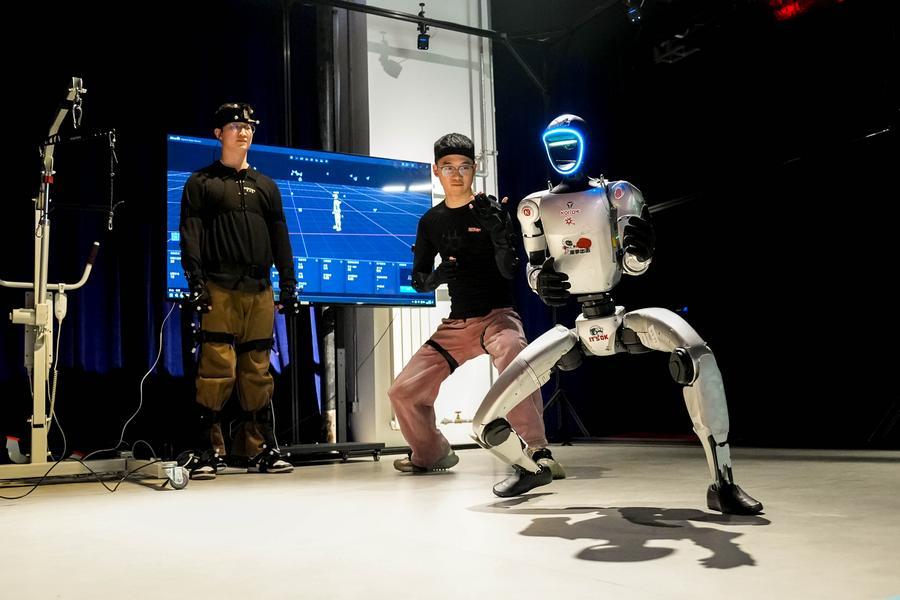
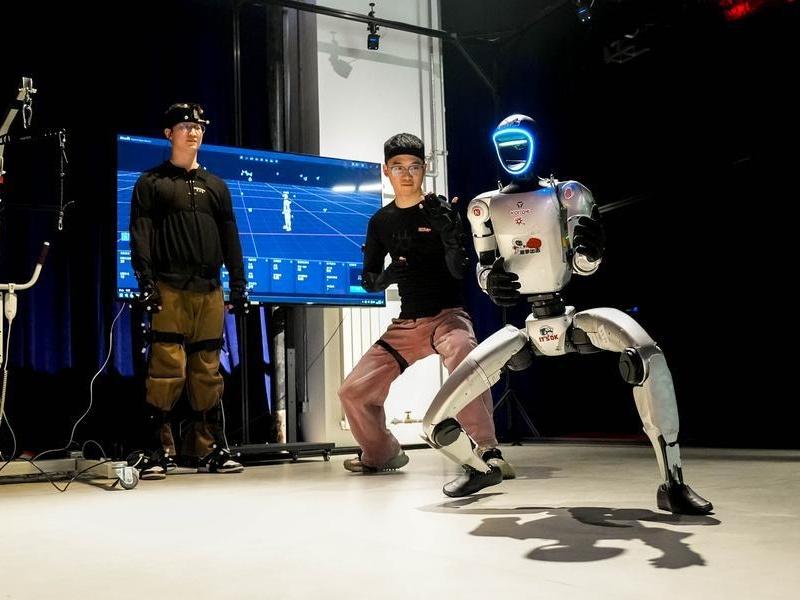
Staff of Noitom Technology Co., Ltd. demonstrate a collaborative robot controlled through motion capture technology during the International Sci-Fi and Future Tech Expo Beijing 2026 in Beijing, capital of China, March 26, 2026. (Xinhua/Xie Han)
Universities are trying to keep pace. Shanghai Jiao Tong University has launched an undergraduate program in embodied intelligence and partnered with over 20 companies to align teaching, research and engineering practice with industry needs. More broadly, the 2026 undergraduate catalog has added embodied intelligence and future robotics to its interdisciplinary category, signaling a systematic push to cultivate talent for the AI era.
Beyond tech, new jobs are emerging in unexpected places. The plan backs consumer-fusion scenarios such as "performance-plus," "sports-plus," "food-plus," and "ice-and-snow-plus" that blend culture, tourism and entertainment.
In Liaoning, employment stations have popped up at concerts and music festivals, weaving job counseling into the crowds. Eldercare and childcare are also opening up, with a proposed "eldercare service professional" certification and integrated childcare centers responding to an aging society and a generation of working parents.
RAISING THE FLOOR
Perhaps the hardest part is not creating jobs but making them worth having.
A "Skills Illuminate the Future" initiative is rolling out AI and service-sector courses in Liaoning, with a goal of building a training system that spans a worker's entire career. Skill-based wage structures aim to ensure expertise, not just tenure, determines pay. Liaoning's "new eight-grade" craftsman system and "degree plus skill" dual certification are early experiments.
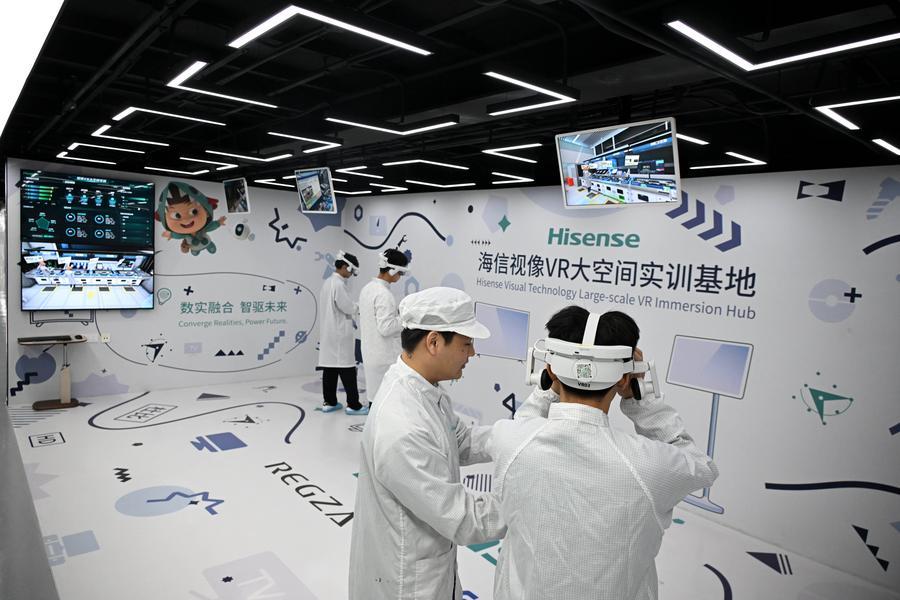
New employees of Hisense Visual Technology take part in a pre-job training at the company's large-scale VR immersion hub in Qingdao, east China's Shandong Province, Jan. 13, 2026. (Xinhua/Li Ziheng)
For gig and platform workers, who form the fastest-growing segment of young employment, the plan proposes a dedicated rights-protection measure, nationwide occupational-injury insurance trials, and incentives to join pension schemes. It also calls for revising paid-annual-leave rules and tightening oversight of labor-dispatch practices.
"The key is establishing a 'grand employment concept,'" said Li Yu, a researcher at the Chinese Academy of Personnel Science, meaning every government department, not just the labor ministry, should treat employment as a core policy test.
"This year, we will work with relevant authorities to launch an AI technology skills enhancement campaign, strengthen AI general education, and continuously improve workers' digital literacy and AI application capabilities," said Zhai Tao, an official with the Ministry of Human Resources and Social Security.
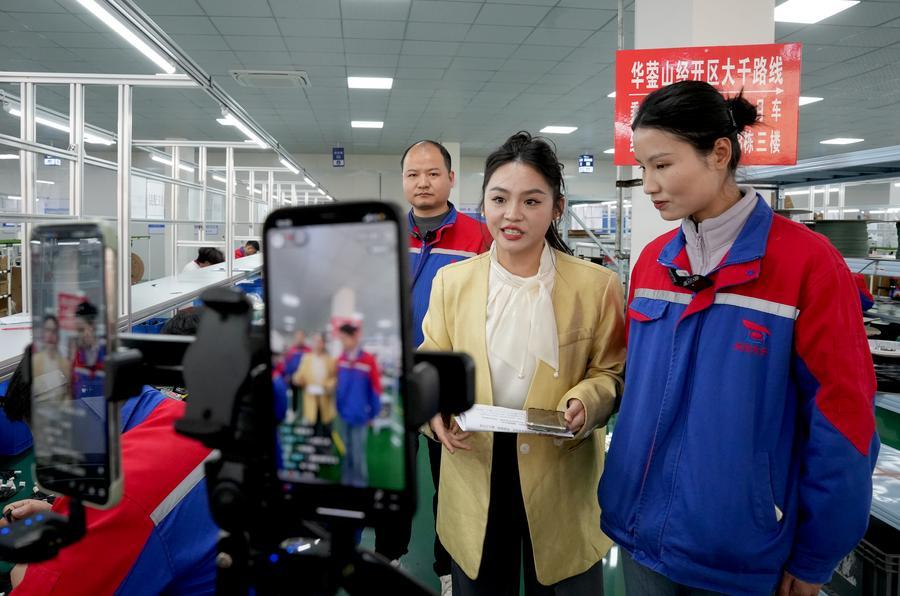
A live streamer (2nd R) introduces recruitment information via live-streaming at a company in Huaying, southwest China's Sichuan Province, Feb. 26, 2026. (Photo by Zhou Songlin/Xinhua)
Taken together, the recently introduced measures aim to synchronize industrial upgrading with employment creation, ensuring that as China's economy moves up the technology ladder, its workforce advances alongside it.
Beyond the goal of steadying this year's job numbers, China's national action plan aims to make the world's largest labor market resilient enough to absorb challenges of the AI age and turn them into opportunities.
(Video reporters: Zhao Yong, Wang Xi, Deng Nan; video editors: Hong Ling, Zhu Cong, Zhu Jianhui)
 A single purchase