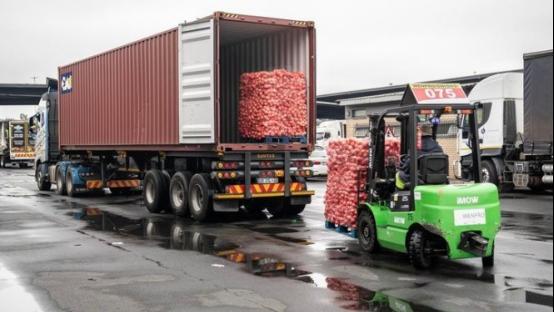



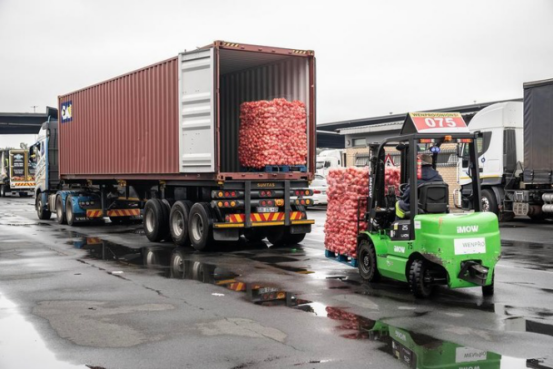
A workers drives a forklift to load boxes of fruits onto trucks at the Johannesburg Fresh Produce Market in South Africa, on Oct. 29, 2025. In recent days, South African fruit traders have been actively stocking up on fruit for export to China. (Photo by Shiraaz Mohamed/Xinhua)
Across Africa, a quiet but profound transformation is underway. The Belt and Road Initiative (BRI) has become an essential part of this shift, not as a substitute for Africa's own development plans, but as a platform that amplifies local priorities and drives regional integration. In a continent rich with potential but challenged by distance, fragmented infrastructure, and limited access to global trade networks, the BRI is playing a critical role in unlocking new markets and fostering economic collaboration.
-- Expanding market access: linking landlocked countries
One of the most visible impacts of the BRI in Africa is its role in transforming landlocked countries into trade hubs. Take Rwanda for example. Constrained by its lack of direct access to the sea, Rwanda has relied heavily on cross-border trade routes. However, through investments in dry ports and logistical infrastructure, such as the Mabuga Dry Port, Rwanda is now reducing transportation costs and increasing its competitiveness in regional and international markets.
By improving the efficiency of its Northern Corridor, which connects Rwanda to the ports of Mombasa, the BRI helps Rwanda's exports, ranging from agricultural products to manufactured goods, reach global markets more efficiently. This connectivity is not just about moving goods; it's about unlocking productivity, attracting investment, and creating jobs. The Mabuga Dry Port is emblematic of how connectivity infrastructure is redefining trade dynamics for countries like Rwanda, helping landlocked countries link not just to their neighbors, but also to international trade routes that bring new opportunities.
-- Stimulating regional integration: strengthening trade through connectivity
At the core of the BRI's vision for Africa is the creation of a more integrated continent. The initiative supports projects that link countries, regions, and markets through modern infrastructure, such as roads, railways, ports, and energy networks, enabling a seamless flow of goods and services.
This vision aligns closely with the African Continental Free Trade Area (AfCFTA), a continental agreement aimed at creating a single market for goods and services, making Africa one of the largest free trade zones in the world. The infrastructure built under the BRI to promote intra-African trade is also a major vision of the AfCFTA.
-- Enhancing competitiveness: making Africa a key player in global trade
Infrastructure projects under the BRI are helping Africa meet the demands of the modern economy. Improved logistics, enhanced digital connectivity, and energy infrastructure are all central to increasing efficiency, reducing costs, and integrating Africa into global supply chains.
For example, as connectivity improves between East Africa's major ports and inland markets, the region is witnessing a transformation in its ability to export high-value products like electronics, pharmaceuticals, and automotive parts. These changes not only enhance Africa's competitiveness, but position it as a key player in global trade.
Moreover, the focus on green energy and environmentally friendly development is ensuring that Africa's future growth is both sustainable and inclusive. Projects that integrate ecological protection into construction processes, such as Kenya's Mombasa-Nairobi Standard Gauge Railway, are setting new benchmarks for large-scale infrastructure to coexist with environmental stewardship.
-- Promoting sustainable growth: development with long-term Benefits
The ultimate strength of the BRI in Africa is its ability to promote sustainable growth. This goes beyond short-term economic gains to long-term development, with an emphasis on inclusive and environmentally responsible practices. The BRI's commitment to green infrastructure is making sure that Africa's rapid development is achieved without compromising future generations.
The growth of African infrastructure, especially in transport and logistics, serves as a blueprint for multilateral cooperation that aligns the needs of African communities with global trade objectives. It is a reflection of the continent's shift from relying on external aid to driving its own development in partnership with others.
Africa's future in the global economy will be determined by the connections being made today through road networks, railways, and digital links. The BRI is quietly but surely crafting this interconnected future, unlocking the continent's potential as a major player on the world stage.
To sum up, in achieving shared prosperity, the BRI is not merely a project to construct infrastructure; it is a project to establish the future of the global trade landscape in Africa. The BRI is assisting Africa in redefining its position in the global economy by promoting sustainability, supporting multilateral partnerships, and providing connectivity tools. The potential of Africa to transform from a passive recipient to a powerful participant in the global marketplace is increasing as regional and international trade expands.
Editor's Note: This article is written by Justine Birakoreka from Rwanda, who is now studying at Beijing Normal University. The views expressed in this article are those of the author and do not necessarily reflect the positions of the Belt and Road Portal or Beijing Normal University.
 A single purchase