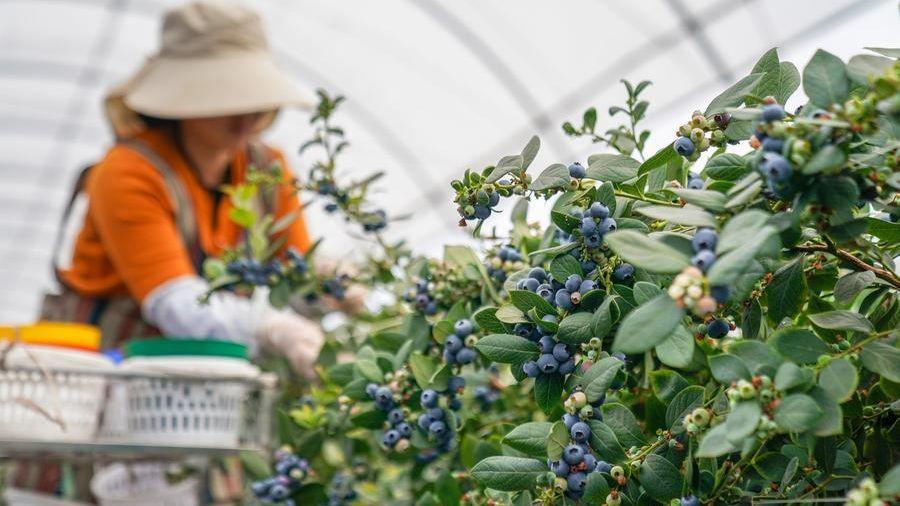



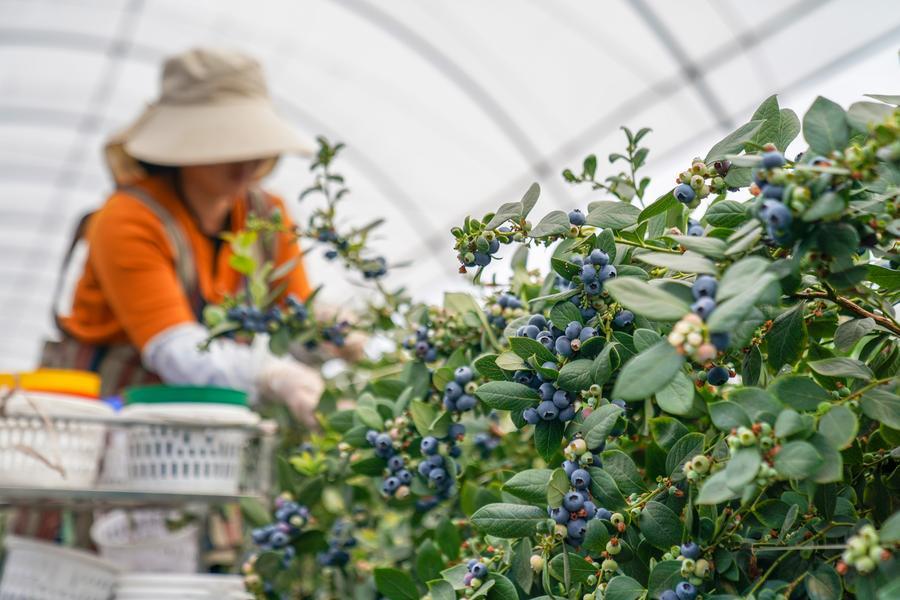
A farmer harvests blueberries at a greenhouse in Mengzi City of Honghe Hani and Yi Autonomous Prefecture, southwest China's Yunnan Province, Feb. 27, 2026. (Xinhua/Peng Yikai)
BEIJING, April 23 (Xinhua) -- Once a pricey delicacy in Chinese fruit stores, blueberries have become increasingly affordable for consumers, a phenomenon dubbed "blueberry freedom" on social media.
After becoming the world's top producer in 2020, China is pivoting its blueberry industry from simple volume expansion to a sophisticated dual-track strategy -- importing premium blueberries to ensure year-round, diversified supply while simultaneously boosting exports of homegrown berries, steering the sector toward higher-quality, more sustainable development.
DOMESTIC BOOM -- FROM "NOBLE FRUIT" TO HOUSEHOLD CHOICE
The journey to "blueberry freedom" began with a domestic production revolution. From 2020 to 2025, China's blueberry cultivation area expanded from approximately 996,000 mu (about 66,400 hectares) to 1.58 million mu, with total output surging from 347,200 tonnes to 810,000 tonnes, according to industry data.
Technological breakthroughs have been the catalyst. In major producing provinces such as Yunnan, growers have largely adopted protected greenhouse cultivation combined with soilless substrate culture. This "industrialized" model enables precise control over growing conditions, leading to higher yields, better quality, and most importantly, the ability to supply the market during the winter and early spring off-season.
This counter-seasonal advantage has made Yunnan the cornerstone of China's fresh blueberry supply. The supply calendar is now filled by a coordinated national effort. Yunnan dominates the winter-spring market; Shandong and Liaoning provinces focus on summer-autumn supplies; Guizhou has become a hub for processing; and regions like Xinjiang are entering the fray with late-season production.
This coordinated expansion has driven down prices. In Kunming, the capital of Yunnan, peak-season prices have tumbled to between 30 and 60 yuan (about 4.37 to 8.74 U.S. dollars) per kilogram, making the fruit a common supermarket sight.
"The national blueberry industry must move beyond price competition and pursue a path of high-quality development," said He Jiawei, director of the institute for alpine economic plant research at the Yunnan Academy of Agricultural Sciences.
Looking ahead, He emphasized that the path forward lies in moving up the value chain through deep processing, such as producing non-concentrated reconstituted juice.
COORDINATING IMPORT, EXPORT FOR HIGH-QUALITY DEVELOPMENT
Despite the domestic boom, China's demand for imported blueberries remains robust. In 2024, China imported 38,700 tonnes of blueberries, with Peru supplying around 90 percent of the volume.
According to Dani Geng, director of blueberry products at Joy Wing Mau Group, imports from countries such as Peru and Chile help ensure a steady supply of fresh blueberries, while providing diversified options for Chinese consumers.
Logistics are also getting a boost. "The inauguration of the Chancay Port route has reduced the shipping time from Peru to China from more than 30 days to approximately 20 days, significantly improving the freshness of imported blueberries," Geng told Xinhua. This allows consumers to enjoy fresher, crisper blueberries, effectively driving an increase in market consumption.
Meanwhile, China's blueberry exports are on an upward trajectory. From a modest 177.9 tonnes in 2022, exports skyrocketed to 2,592.29 tonnes in 2024 -- a nearly 15-fold increase, media reports showed. The export value grew even more dramatically, from 805,900 U.S. dollars to 23.14 million dollars over the same period.
The export footprint has reached 13 markets in 2024, including Singapore, Malaysia, Thailand, Indonesia and Russia, demonstrating a strong presence in Southeast Asia and neighboring regions.
This export surge is fueled by the same advancements that boosted domestic production -- improved varieties, standardized cultivation practices and enhanced post-harvest handling and cold chain logistics.
Supported by favorable policies that facilitate agricultural modernization and trade, China's blueberry industry is leveraging its massive domestic base not just to achieve self-sufficiency but also to engage dynamically with the global market, charting a course for sophisticated, high-value growth, experts observed.
 A single purchase