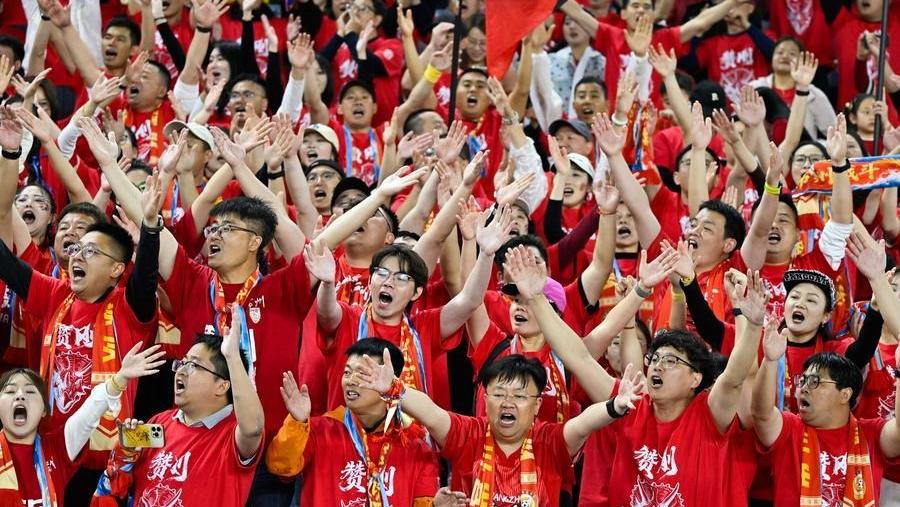



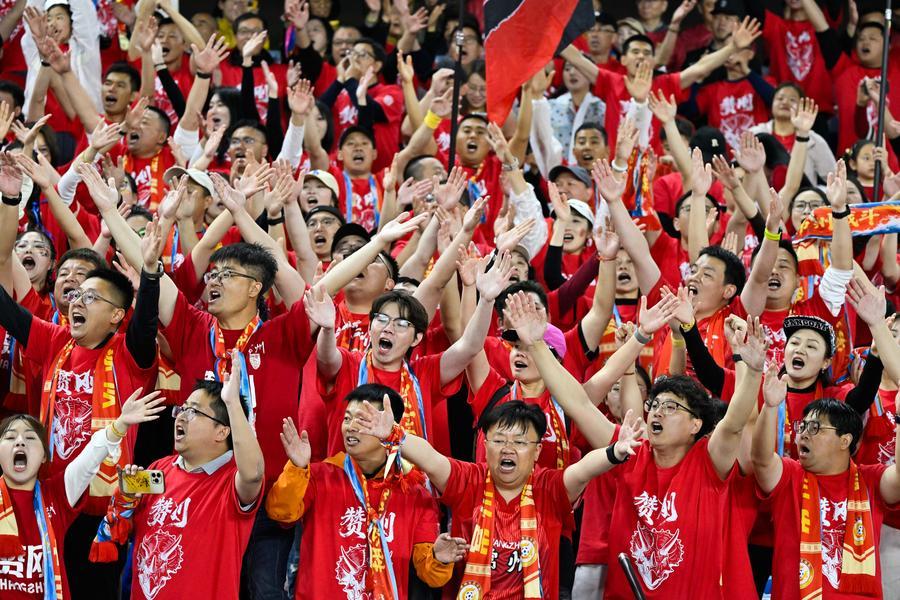
Supporters celebrate victory of Changzhou after the opening match against Nantong of the 2026 Jiangsu Football City League in Changzhou, east China's Jiangsu Province, April 11, 2026. (Xinhua/Ji Chunpeng)
China's grassroots football boom is gathering pace as the "Su Super League" returns, drawing large crowds, attracting major sponsors and turning amateur matches into citywide events. The tournament offers a vivid example of how sport can boost the economy ahead of the World Cup.
by sportswriter He Leijing
NANJING, April 13 (Xinhua) -- As the FIFA World Cup prepares to ignite global football fever this summer, China's "grassroots World Cups" are already stealing a march - stirring hometown pride, packing stadiums and fueling a surge in consumption.
The second season of the wildly popular "Su Super League", an amateur football tournament featuring 13 teams representing cities across east China's Jiangsu Province, kicked off on April 11, setting the tone for another fevered campaign.
At the opening ceremony in Changzhou, rain did little to dampen spirits. Renowned Chinese singer Zhou Shen delivered the league's theme song, while some 300 robots from local tech firms entertained the crowd with a synchronized dance performance.
More than 40,000 spectators packed the stands for the curtain-raiser, underscoring the competition's enduring appeal.
This year's season arrives a month earlier than its debut edition and will run through late October, strategically spanning China's two peak holiday periods, the May Day and National Day holidays, when travel and consumer spending traditionally surge.
Commercial capital has followed the league's meteoric ascent. The new season has already secured sponsorships from global heavyweights including Adidas and Coca-Cola, with total sponsorship revenue expected to surpass 100 million yuan (14.6 million U.S. dollars).
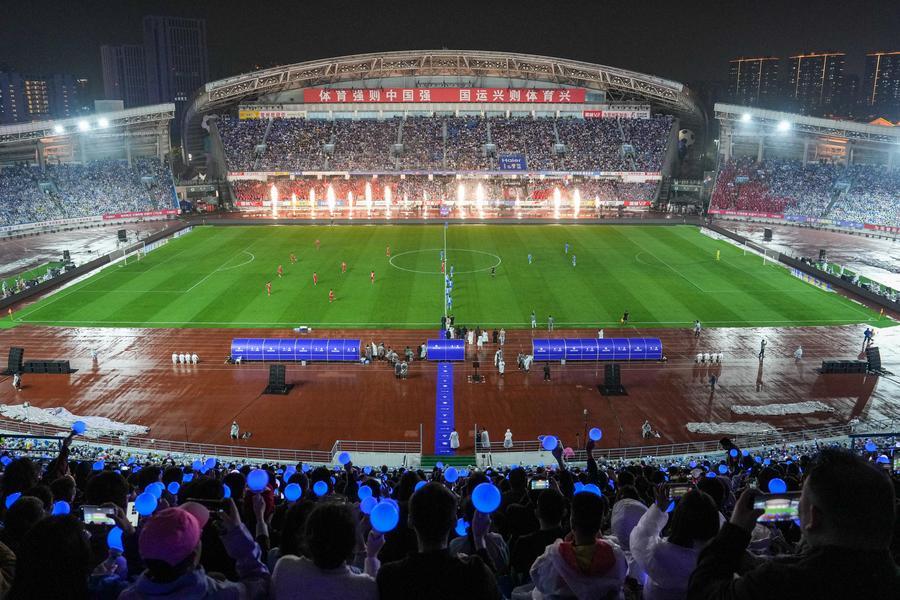
Players of Changzhou and Nantong wait for the kick-off of their opening match. (Xinhua/Li Bo)
What sets the league apart is its deeply rooted grassroots soul: a competition shaped not by professionals, but by students, teachers and office workers, whose exploits have captivated audiences more profoundly than some top-tier competitions.
The phenomenon burst onto the national stage last year. The first season saw total stadium attendance exceed 2.43 million, with average crowds topping 28,000 per match. Online, matches were streamed more than 2.2 billion times, amplifying the league's reach far beyond the terraces.
The economic ripple has been equally striking. During match periods, major retailers and supermarkets across Jiangsu recorded 11.64 billion yuan in sales, marking a 34.7 percent year-on-year increase, while foot traffic rose 31.2 percent.
A recent survey of 3,100 residents conducted by Jiangsu's statistical authorities found that 44.9 percent of respondents plan to increase spending tied to the new season, a telling sign of the league's growing pull on consumer behavior.
Cities are moving swiftly to harness that momentum. Wuxi, for example, has rolled out a "consumption map" of official viewing venues, with 66 designated sites spanning shopping districts, night markets, hotels and restaurants. Fans can gather before giant outdoor screens to cheer on their teams, then seamlessly spill into dining, shopping and nightlife - scenes typically reserved for the World Cup.
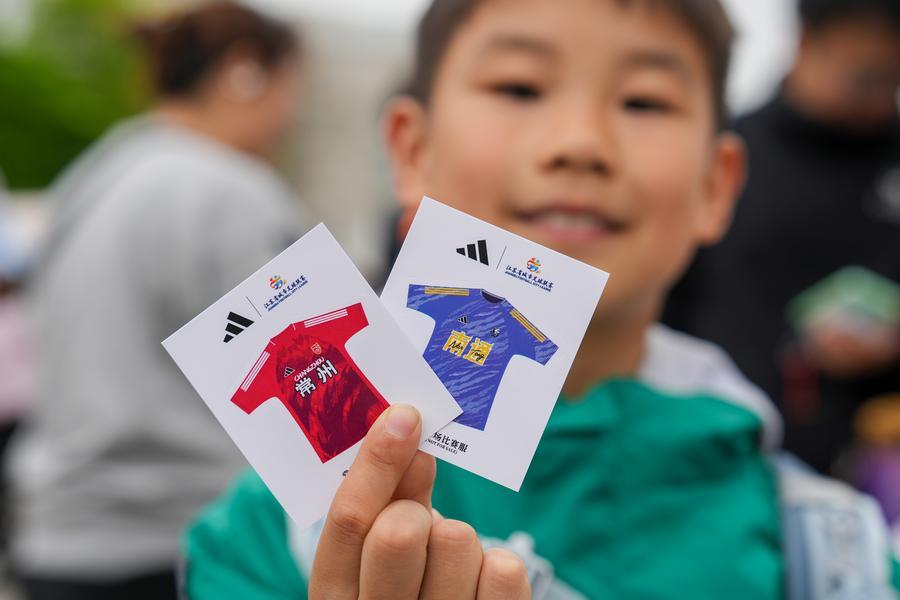
A boy shows cards of the official jersey of the two teams before the opening match. (Xinhua/Li Bo)
At the provincial level, Jiangsu plans to host around 600 food markets and establish more than 600 viewing hubs during the tournament, channeling the event's popularity into tangible consumption growth.
Authorities are also rolling out incentives such as free access to tourist attractions, consumption vouchers, and complimentary accommodation and public transport for out-of-town fans holding match tickets.
The phenomenon is not confined to Jiangsu. Across China, more than a dozen similar amateur competitions, often dubbed "city super leagues," have emerged or are in the pipeline, turning ordinary players into hometown heroes and transforming weekend fixtures into citywide festivals.
"The explosive popularity of events like the 'Su Super League' vividly demonstrates the resilience and enormous potential of China's sports industry and sports consumption," Gao Zhidan, director of the General Administration of Sport of China, said in an interview.
Official figures show China's sports industry surpassed five trillion yuan in total value in 2025, with policymakers aiming to unlock further growth and push the sector beyond seven trillion yuan by 2030.
"The development space and market potential of the sports industry are enormous," Gao said. "We will seize the momentum, advance policies for the event economy and outdoor sports, and integrate sports more deeply into the experience economy."
 A single purchase