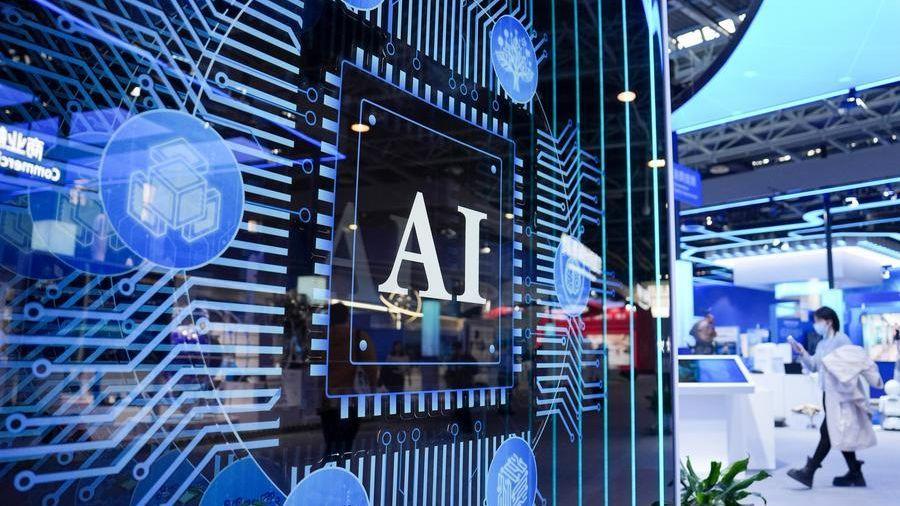



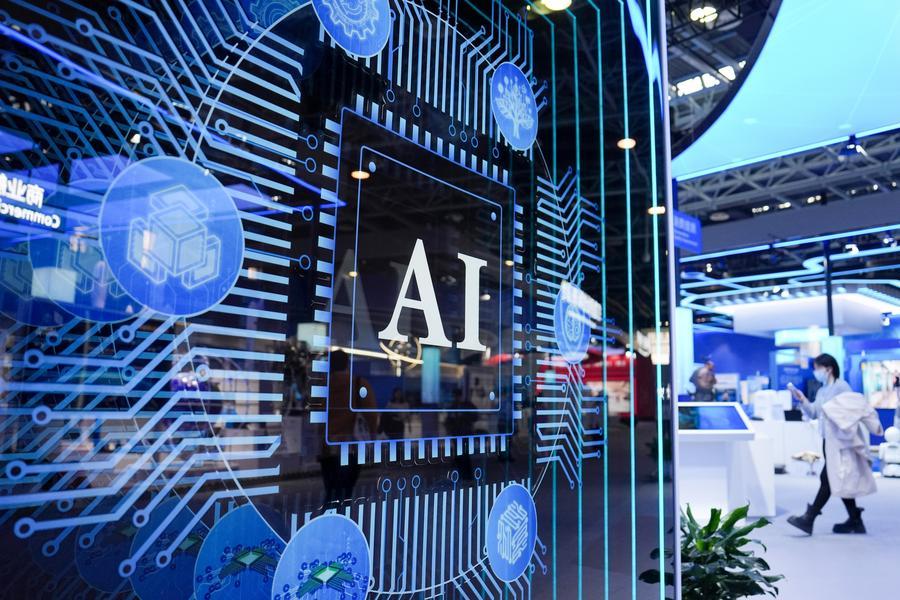
A woman visits the permanent exhibition at the Zhongguancun Exhibition Center in Beijing, capital of China, March 25, 2026. (Xinhua/Ju Huanzong)
BEIJING, March 29 (Xinhua) -- At a food bar inside the 2026 Zhongguancun Forum in Beijing, visitors are lining up not for a celebrity chef, but for a team of robot waiters.
One robot threads sugar-coated haws with mechanical precision. Another brews coffee. A third collects the order. A fourth uses both hands to combine the coffee and snack into a set meal and serves it to the customer.
No humans are involved. A central control system runs the show. Order a coffee-and-dessert set by scanning a QR code, and two minutes later, a voice prompts customers to pick it up.
According to the Beijing Academy of Artificial Intelligence, on its first day of the event, the robot counter served more than 100 orders. The robots, from different companies, are powered by a unified technology platform that handles everything from ordering to delivery.
The institute said the platform helps shift robots from working in isolation to working in concert, or from "single-machine intelligence" to "swarm intelligence."
The scene offers a glimpse into China's fast-moving AI industry, where applications are stepping out of digital screens and into the physical world, becoming a major force in high-quality economic growth.
China's government work report this year has, for the first time, stressed the need to create "new forms of smart economy" and to continue deepening and expanding the "AI plus" initiative.
The "new forms of smart economy" mark an upgrade from the digital economy, powered by deep AI integration. It signals a move from using AI as a tool to reshaping industries, business models, and how value is created.
Chen Changsheng, a member of the drafting group of the government work report, said AI is reshaping business models, production systems and daily life. The goal, he explained, is to seize opportunities arising from AI development, expand its use across industries, and open new growth opportunities.
Zhou Li'an, a professor at Peking University's Guanghua School of Management, said AI is becoming a basic building block of the economy, affecting resource allocation, industry organization and service delivery. China's advantages -- rich data, a full industrial system and vast application scenarios -- can turn technology into economic value, benefiting both China and the world.
Official data shows that in 2025, the core AI industry in China had exceeded 1.2 trillion yuan (about 174 billion U.S. dollars) in scale, while featuring more than 6,200 enterprises.
Chen said the next steps include scaling up applications, deepening open-source development, and strengthening infrastructure. That means rapid use of AI in sectors like manufacturing, agriculture, education and health care, building open-source communities, growing the intelligent agent industry, and developing large-scale computing clusters.
Zhu Songchun, director of the Beijing Institute for General Artificial Intelligence, said China's strong manufacturing base gives it an edge in robotics. He expects the "AI plus" initiative to create more scenarios and business models over the next five years, opening up new opportunities for young people.
Shen Yang, a professor at Tsinghua University, said the "new forms of smart economy" mark a shift from digital empowerment to intelligent restructuring. The strategy is not only a driver of China's productivity growth but also a new opportunity for global investors.
In the future, he said, AI will revitalize traditional industries and create new economic models, with China's AI-powered growth acting as a multiplier for the global economy.
 A single purchase