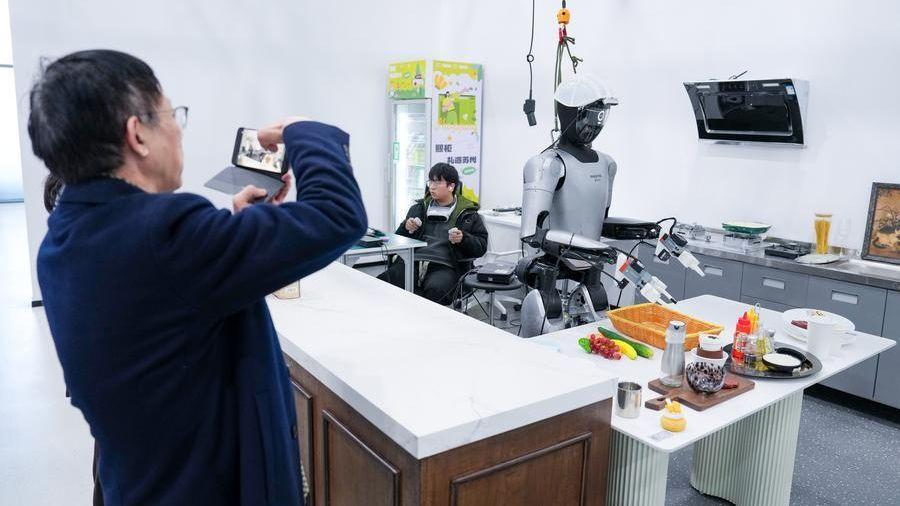



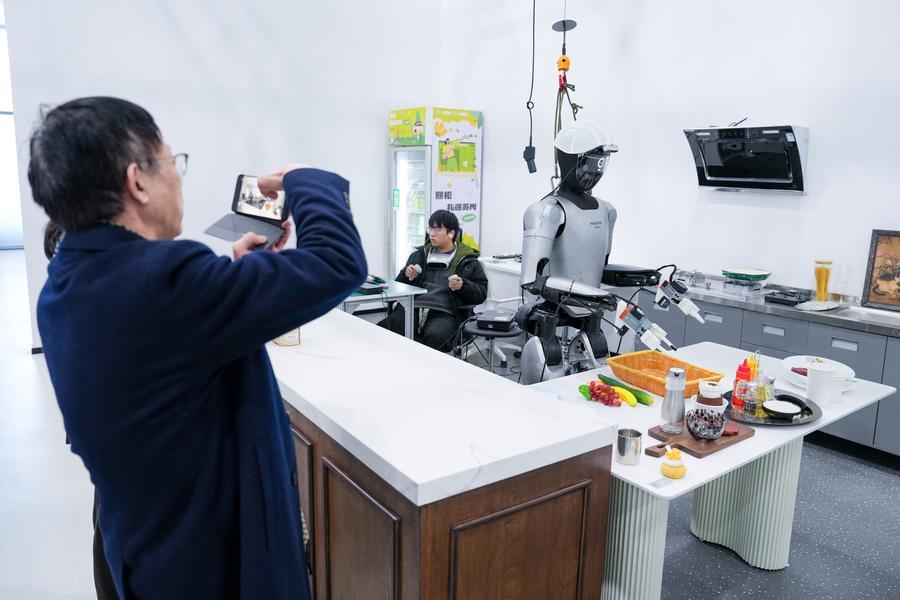
People watch a humanoid robot train in multiple training scenarios at the Suzhou Embodied Artificial Intelligence Robotics Innovation Center in Suzhou, east China's Jiangsu Province, on March 10, 2026. (Xinhua/Li Bo)
WUHAN, March 24 (Xinhua) -- Wearing a VR headset and a motion capture suit, 23-year-old Chen Wenhai raises his arm while a humanoid robot of similar height beside him mirrors the movement in sync.
Chen gently closes his hand, and the robot's five fingers curl inward. Moments later, the robot grinds coffee beans, lifts a cup and pours hot water, replicating Chen's every movement with precision. Soon, a steaming cup of Americano is ready.
Scenes like this play out daily at the Hubei Humanoid Robot Innovation Center, where Chen works as a robot trainer, a new profession born from efforts to integrate humanoid robots into everyday life and work.
The innovation center, one of China's largest humanoid robot training platforms, hosts more than 20 simulated settings, including hospitals, supermarkets, kitchens and offices. There, human trainers work one-on-one with robots, repeatedly practicing tasks such as grasping, walking and delivery.
"There's no ready-made textbook for training robots," Chen said. "We're exploring everything from scratch."
Of his eight-hour workday, only about three and a half hours yield usable training data, with the rest spent correcting movements and repeating trials. Even simple motions often require hundreds or thousands of repetitions.
Zhou Mengkun, an engineer at Hubei Optics Valley Dongzhi Embodied Intelligence Technology, the company where Chen works, said robot trainers play a key role in bridging technology and real-world applications. Their work involves teaching robots through physical demonstrations and collecting data on motion trajectories, force and tactile feedback.
Through repeated testing and adjustment, trainers help ensure robots can function reliably in real-life scenarios, from household services to factory jobs, Zhou added.
For Liu Luxi, 22, a robot trainer, the job is critical to the overall performance of robots.
"Executing a single command is relatively easy for robots, but performing a continuous sequence of actions, the way humans naturally do, is far more complex," Liu said. In kitchen training scenarios, for example, robots must adjust their grip depending on the position and orientation of knives, bowls and seasoning containers.
As the industry expands, demand for skilled talent like Chen and Liu is rising rapidly.
According to a report by recruitment platform Zhaopin, job postings in China's humanoid robot sector rose 409 percent in the first five months of 2025 compared with a year earlier, while the number of job seekers increased 396 percent.
Humanoid robots impressed audiences at this year's Chinese New Year gala with their kung fu moves and seamless performances alongside human peers, showcasing technological advances that analysts say could open the door to wider applications in the future.
The industry is now racing to turn these technological gains into practical use, with robot training centers mushrooming in provinces such as Anhui, Zhejiang and Shandong.
"The sector is at a critical stage of technological breakthroughs and an accelerating expansion of application scenarios," said Li Dezheng, general manager of Xingjie Innovation Robotics Co., Ltd. in Shandong's Binzhou City.
According to global technology market research and consulting firm Omdia, China accounted for a staggering 90 percent of global humanoid robot shipments in 2025, while Morgan Stanley projects that the country's sales in this sector will double to 28,000 units in 2026.
China has stepped up efforts to foster future industries such as embodied AI, as highlighted in the outline of the 15th Five-Year Plan (2026-2030). The goal is to cultivate new economic growth engines through technological innovation and market exploration.
For Chen, however, the goal remains simple -- to be a good teacher.
"I hope that through our work, robots can learn more steadily and operate more precisely," he said. "One day, they will enter more households."
 A single purchase