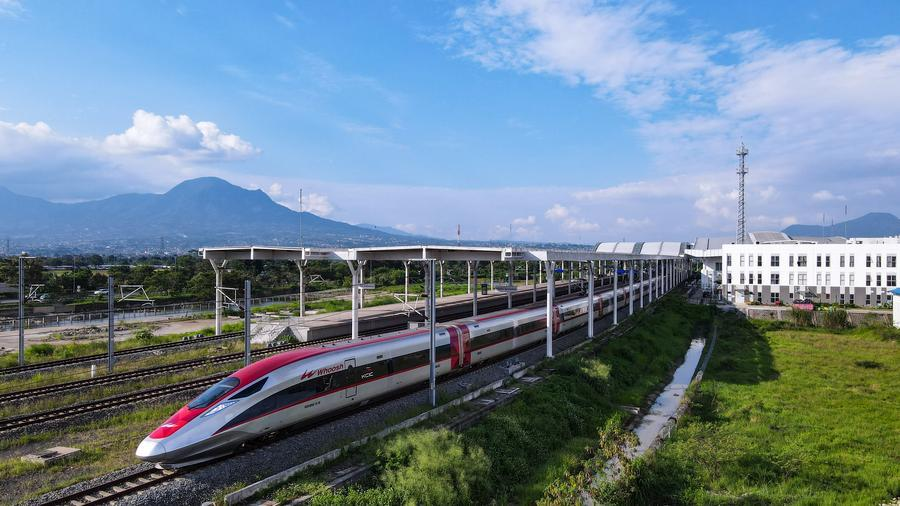



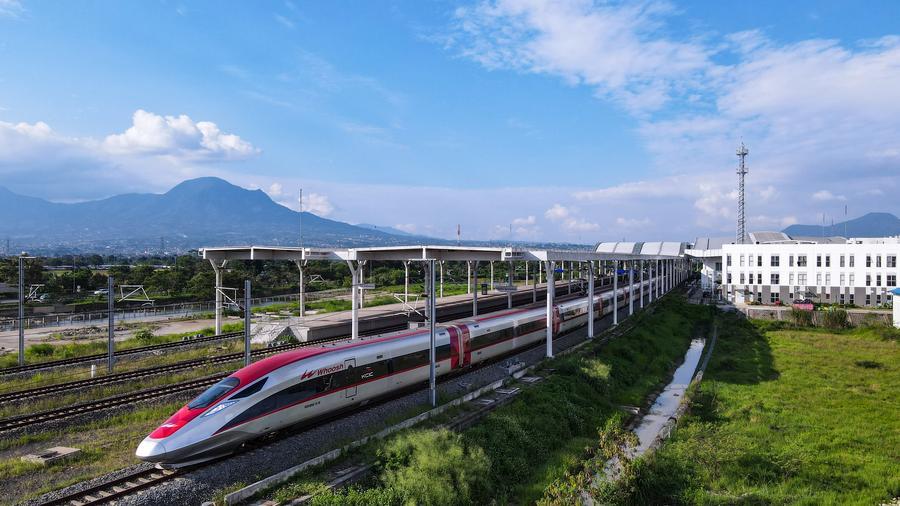
An aerial drone photo taken on May 20, 2025 shows a high-speed electrical multiple unit (EMU) train leaving Tegalluar Station of Jakarta-Bandung High-Speed Railway (HSR) in Bandung, Indonesia. (Xinhua/Xu Qin)
The "debt trap" rumors, shadowing the BRI since day one, deliberately exaggerate the debt burden of developing countries, ignore their genuine needs for financing and infrastructure development, and turn a blind eye to the socioeconomic achievements of the Belt and Road projects.
by Meng Dong
Ever since the inception of the Belt and Road Initiative (BRI), the "debt trap" rumors cooked up by the West have followed closely behind. However, any discerning observer can see that it's a politically motivated smear that does not withstand scrutiny from data or facts.
China adheres to the principle of pursuing the greater good and shared interests. The loans provided by China are primarily used to build modern infrastructure and develop industrial and agricultural sectors, with a view to helping recipient countries overcome major obstacles in their economic development.
Following the principle of extensive consultation, joint contribution and shared benefits, Belt and Road cooperation focuses on the actual development needs of host countries, and helps increase local jobs and incomes through investment in production factors. Its economic returns far exceed mere financing figures.
China's loans come with long repayment periods and low interest rates. China has never sought to turn the financial difficulties of a partner country into political bargaining chips; instead, China has actively helped these nations overcome challenges. In June 2020, China announced the cancellation of interest-free government loans owed by relevant African countries that were due to mature by the end of 2020 under the Forum on China-Africa Cooperation framework, contributing the most to the G20 Debt Service Suspension Initiative.
Statistics show that Western institutions are in fact the main creditors of developing countries. According to a 2023 World Bank estimate, low- and lower middle-income countries will need to repay a total of 940 billion U.S. dollars of principal and interest on historical debt over the next seven years, including 356.6 billion dollars to Western commercial creditors and 273 billion dollars to multilateral institutions, accounting for 67 percent of the whole amount.
Facts speak for themselves, debunking the rumors.
The "debt trap" rumors, shadowing the BRI since day one, deliberately exaggerate the debt burden of developing countries, ignore their genuine needs for financing and infrastructure development, and turn a blind eye to the socioeconomic achievements of the Belt and Road projects.
One of the signature projects of China-Indonesia high-quality Belt and Road cooperation is the Jakarta-Bandung High-Speed Railway. Its name, "Whoosh," an Indonesian acronym referring to time saving, optimal operation and reliable system, reflects the firsthand experience and sincere appreciation of the local people. The Jakarta-Bandung High-Speed Railway, the first high-speed railway in Southeast Asia with a top speed of 350 km/h, has reduced travel time between Indonesia's capital Jakarta and its fourth-largest city Bandung from over 3 hours to just over 40 minutes.
As of October 17, 2025, the railway had been in official operation for two years, carrying over 12 million passengers in total. The areas around Whoosh's stations such as Tegalluar and Halim are thriving commercially, with retail and dining businesses creating numerous jobs. Karawang Station connects local industrial parks with Jakarta's port and airport. A high-speed rail-linked economic belt is gradually taking shape, injecting new momentum into Indonesia's economy.
Facts speak louder than words and people have their own judgment.
Belt and Road cooperation has witnessed a fruitful first decade, with its substance and influence continuing to grow, truly benefiting developing countries. Meanwhile, certain countries have deliberately fragmented the global market by putting up fences and barriers, decoupling, and disrupting industrial and supply chains. These actions have led to the rise of protectionism and unilateralism, seriously undermining the stability of the global economic order. In stark contrast, rehashing the "debt trap" cliche only further exposes the absurdity and double standards of some Western media. Who is deliberately creating development traps and narrative traps? The answer is self-evident.
Editor's note: The author is an observer on international affairs.
The views expressed in this article are those of the author and do not necessarily reflect those of Xinhua News Agency.
 A single purchase