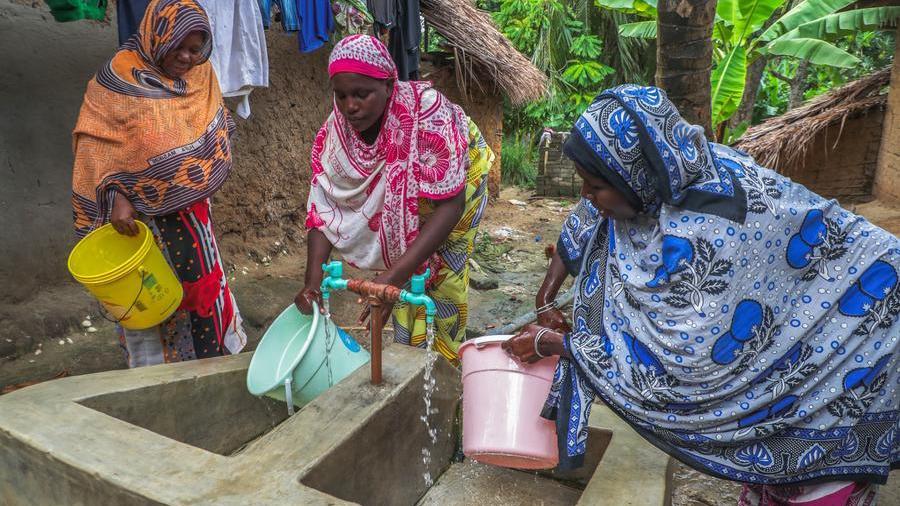



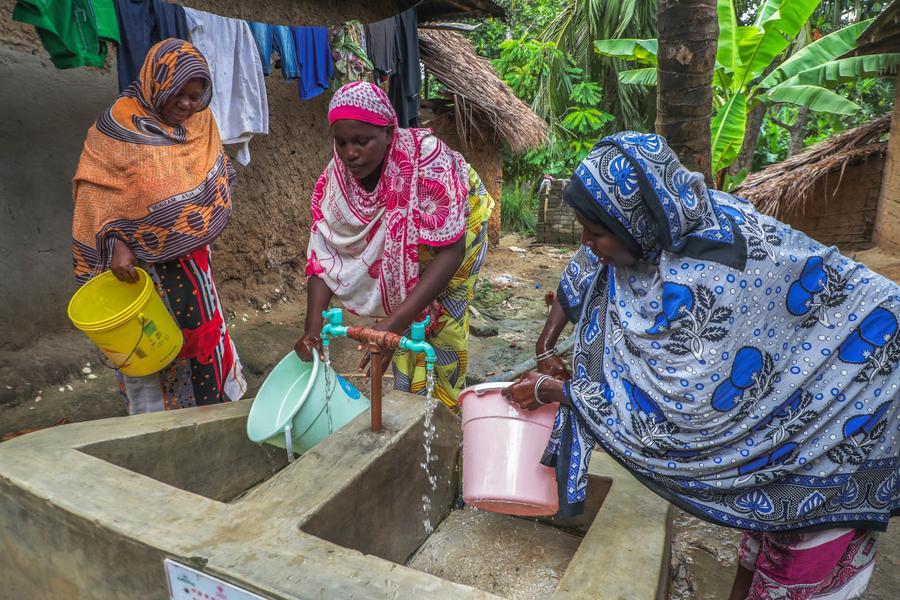
Residents get tap water on Pemba Island, Zanzibar, Tanzania, Jan. 1, 2026. (Xinhua/Emmanuel Herman)
In Chaani, a village located in Zanzibar's North Region on Unguja Island, clean water now flows morning, noon, and night, a simple change that has transformed daily life and helped curb one of the region's most persistent diseases, schistosomiasis.
by Xinhua writers Hua Hongli, Lin Guangyao, Lucas Liganga
ZANZIBAR, Tanzania, Jan. 3 (Xinhua)--With a gentle turn of the tap, clean water gushes out -- a sight that villagers in Chaani had long thought impossible.
Located in Zanzibar's North Region on Unguja Island, Chaani struggled for decades with unsafe water sources. That reality began to change in 2025.
"For many years, water was our biggest problem," said 53-year-old Haji Makame Omari, a father of eight and residentofChaani.
"We fetched water from rivers, and that is where we got infected with schistosomiasis. Now we no longer go there. We feel safe," he said, crediting a China-aided schistosomiasis control project jointly implemented with the World Health Organization (WHO) and the Zanzibar government in Tanzania.

Chinese experts carry out snail control operations at a pond on Pemba Island, Zanzibar, Tanzania, Jan. 1, 2026. (Xinhua/Emmanuel Herman)
In Chaani, one of the project's beneficiaries, clean water now flows morning, noon, and night, a simple change that has transformed daily life and helped curb one of the region's most persistent diseases, schistosomiasis.
By combining safe water supply systems with disease treatment, snail control and health education, the project has significantly reduced infection rates while improving livelihoods.
Schistosomiasis, a waterborne parasitic disease, has long burdened Zanzibar, particularly rural areas, where residents relied on rivers and unsafe wells, exposing themselves to infection. Mothers like 30-year-old Mwanaisha Abdallah, also a Chaani villager, recall frequent hospital visits for their children due to water-related illnesses.
For women, who bore much of the burden of fetching water and caring for children, the change has been transformative."Before, we struggled a lot," Abdallah said. "Now I just take my bucket, walk a short distance, and come back. I can grow vegetables, keep chickens,andwash clothes easily. Happiness in my family has increased."
Behind the visible changes lies a decade-long cooperation effort.
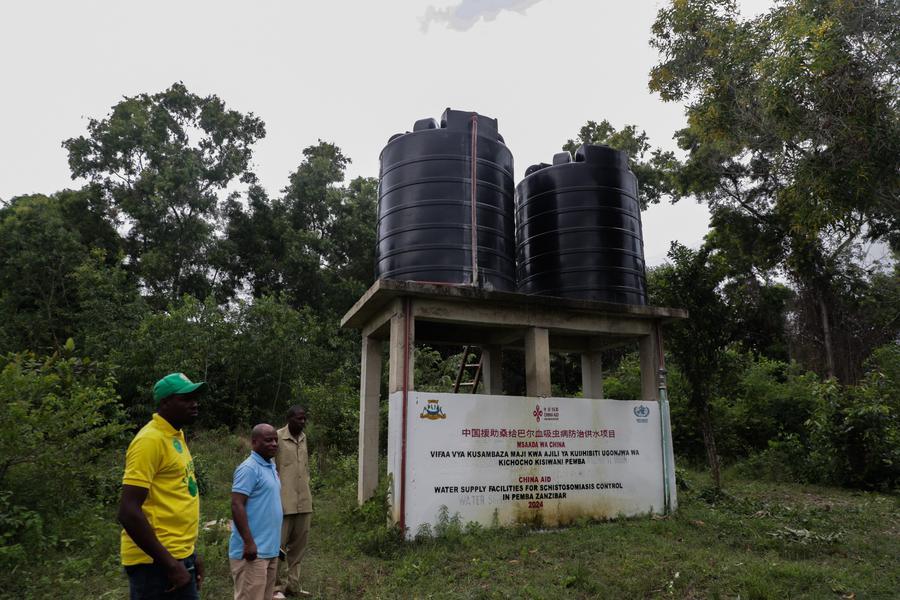
Photo taken on Jan. 1, 2026, shows a China-aided water supply facility standing in a community on Pemba Island, Zanzibar, Tanzania. (Xinhua/Emmanuel Herman)
According to Wang Wei, team leader of the 5-member Chinese expert group and a professor at China's Jiangsu Institute of Parasitic Diseases, the cooperation began after Zanzibar sought international assistance in 2014, when schistosomiasis prevalence remained high despite earlier control efforts.
"China's experience in schistosomiasis control had already proven effective and scalable," Wang said. "Based on shared commitment, China,theWHO, and the Zanzibar government signed a memorandum of understanding, and the project was officially launched in 2016."
According to project data,Phase I of the project, implemented on Pemba Island from 2017 to 2020, reduced infection rates in demonstration areas from 8.92 percent to0.64 percent, meeting WHO standards for eliminating schistosomiasis as a public health problem. Phase II, launched in 2023, expanded coverage to Unguja Island.
The results have been striking. Baseline surveys showed an infection rate of about 1.23 percent. After two and a half years, the latest data indicate a drop to just 0.15 percent, well below the WHO threshold of 1 percent.

Wang Wei, leader of the Chinese experts team, explains schistosomiasis prevention to residents on Pemba Island, Zanzibar, Tanzania, Jan. 1, 2026. (Xinhua/Emmanuel Herman)
A key innovation in Phase II has been the construction of safe water supply systems. Five projects -- four in Pemba Island and one in Unguja Island -- now serve about 30,000 people in total.
In Unguja alone, 18,000 residents benefit from clean, accessible water, cutting off disease transmission at its source while also reducing other water-related illnesses such as intestinal infections and cholera.
"This is a genuine livelihood project," Wang said. "It not only controls disease but also improves daily life."
Rashid Kassim Juma, project coordinator from Zanzibar's Ministry of Water, Energy, and Minerals, described the initiative as "a big help from China."
"Before, people fetched water from ponds and unsafe wells," Juma said. "Now they have fresh water. We are very thankful to China and hope to see more projects like this."

A resident drinks clean water directly from a public tap in Chaani village on Unguja Island, Zanzibar, Tanzania, Dec. 31, 2025. (Xinhua/Emmanuel Herman)
Beyond infrastructure, the project has focused on sustainability. Community hospitals and volunteers were trained, health education bases and demonstration schools were established, and monitoring was gradually integrated into Zanzibar's health information systems.
The next milestone is set for January 2026, when a fully digital schistosomiasis surveillance and response system goes live. Once cases are detected atthecommunity level, reports can be sent instantly via computer or mobile phone, triggeringrapid responses and preventing outbreaks.
"This will beone ofthefirstschistosomiasis information systems in Africa," Wang said. "It has the potential to be replicated in other Belt and Road partner countries."
BackinChaani, the impact is already visible. Small vegetable gardens have sprung up around homes, made possible by nearby water sources.The small square where the water tap stands has become one of the liveliest areas in the village.
"We are truly grateful," Omari said. "This water has protected our health and changed our lives."
 A single purchase