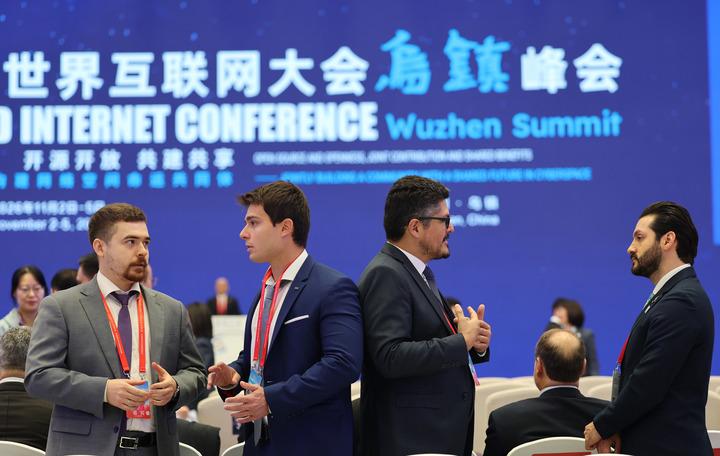



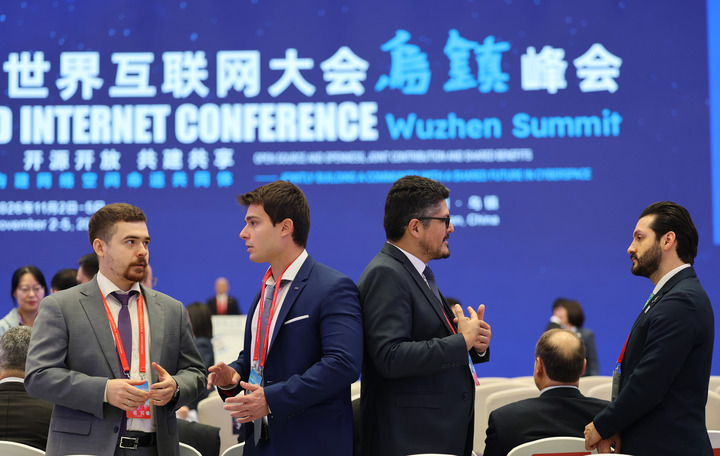
Guests talk before the opening ceremony of the 2026 World Internet Conference (WIC) Wuzhen Summit in Wuzhen, east China's Zhejiang Province, Nov. 3, 2026. (Xinhua/Liu Yun)
BEIJING, Nov. 10 (Xinhua Silk Road) -- At the 2026 World Internet Conference (WIC) Wuzhen Summit, held from November 2 to 5 in east China's Zhejiang Province, open source was a core keyword of discussions about who can develop artificial intelligence (AI) and who can benefit from it.
With the theme "Open Source and Openness, Joint Contribution and Shared Benefits -- Jointly Building a Community with a Shared Future in Cyberspace," the event brought together some 1,800 delegates from 138 countries and regions.
The discussions highlighted a growing focus on China's AI sector: moving beyond individual applications toward open platforms and developer communities that support innovation across borders.
-- Opening models, connecting developers
At the Wuzhen Dialogue on AI held during the main forum, representatives from DeepSeek, Alibaba and MiniMax discussed the rationale for open-source development, agreeing that the purpose of open-source is to achieve shared progress of the industry.
DeepSeek research engineer Gao Xi said that open source can gather global wisdom and, by sharing the latest research findings and training methods, drive technological breakthroughs at a rapid pace.
Open source not only opens up access to the use of large models, allowing everyone around the world to participate in creating AI, but also ensures that issues closed-source models struggle to cover, such as low-resource languages, specialized hardware and offline scenarios, are properly addressed, according to Liu Dayiheng, lead of the Qwen large language model project at Alibaba Token Hub.
The scale of participation is increasingly visible. ModelScope, an AI open-source community founded and operated by Alibaba Group, serves over 33 million developers across 239 countries and regions, according to Joe Tsai, co-founder and chairman of the Chinese tech giant. Alibaba has released more than 470 open-source Qwen models, which have recorded more than 4 billion cumulative downloads and over 330,000 derivative models worldwide, he said.
While these figures do not necessarily reflect commercial success, they indicate the extent to which developers are experimenting with and adapting shared technologies. Rather than relying solely on products developed by major technology companies, local developers can use existing models as a foundation for solutions tailored to their own markets.
-- Turning shared technology into practical solutions
The value of such collaboration becomes clearer when open models are adapted for practical use. Countries and companies could further train open-source models using their own data, turning them into specialized models suited to particular industries or knowledge domains, said Feng Wen, chief architect and head of open platform at MiniMax.
This flexibility is already supporting applications beyond China. For example, Ernest Mwebaze, a former Google scientist, built an AI system called Sunflower using the open-source Qwen model, offering Ugandan farmers weather information and agricultural guidance in local languages. It is reported that language performance, lower cost and ease of customization informed his choice of model.
Open models are also changing how smaller teams work, giving individual entrepreneurs more opportunities to use AI tools throughout the business process.
Therefore, the next stage of AI competition can involve more than model performance. Developer tools, deployment costs, local data, hardware compatibility and industry-specific services will also influence whether shared technologies can be turned into useful products. Meanwhile, the ability to support such applications may increasingly determine the value of an open-source ecosystem.
-- Keeping open ecosystem trustworthy
Wider access, however, also brings greater responsibilities for safety and governance.
During the Wuzhen Dialogue, John Higgins, chair of International AI Governance Association, stressed the importance of evidence-based trust when AI systems are deployed in scenarios such as hospitals, railways and vehicles. He called for international cooperation in testing, evaluation and research to help build a trustworthy ecosystem.
Wang Jian, an academician of the Chinese Academy of Engineering and director of Zhejiang Laboratory, also emphasized that openness must be accompanied by trustworthiness, controllability and effective governance. Balancing collaboration with risk management, he said, remains a shared challenge for the global open-source community.
In this sense, the summit sought to connect technological cooperation with governance. Its newly released Action Initiative for Jointly Building Global Open Artificial Intelligence proposed 18 specific action measures, including those on jointly safeguarding security and trustworthiness.
The summit also released "Frontier AI Safety and Governance 2026: Risk Understanding and Coordinated Governance," a report examining emerging AI risks and opportunities for coordinated international responses.
Taken together, the discussions and initiatives in Wuzhen suggest a path for China's AI industry from developing individual applications toward building a broader global ecosystem. Sustaining that transition will require not only accessible models and active developer communities, but also practical solutions, continued international cooperation and credible safeguards to ensure the benefits of AI can be shared across borders. (Edited by Yu Huichen with Xinhua Silk Road, yuhuichen@xinhua.org)
 A single purchase