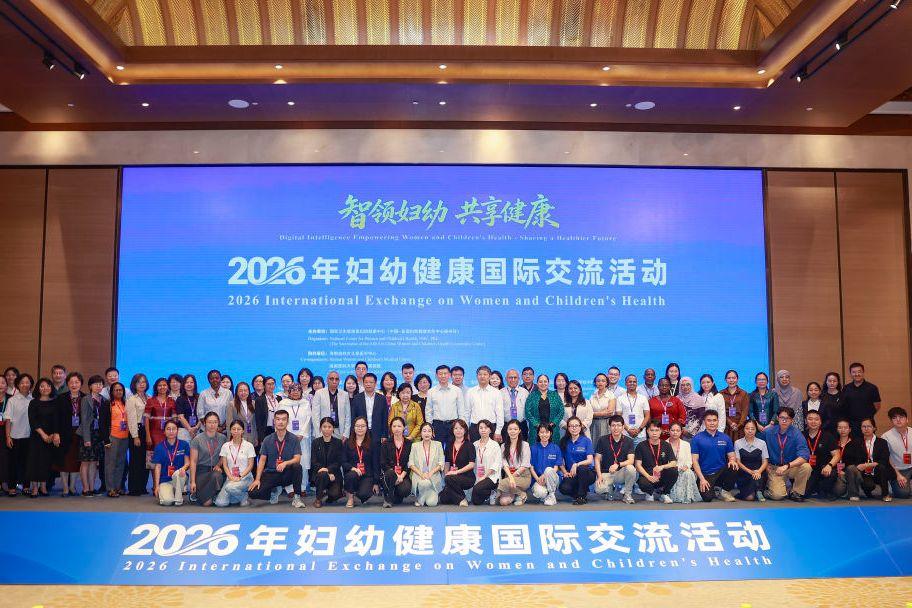



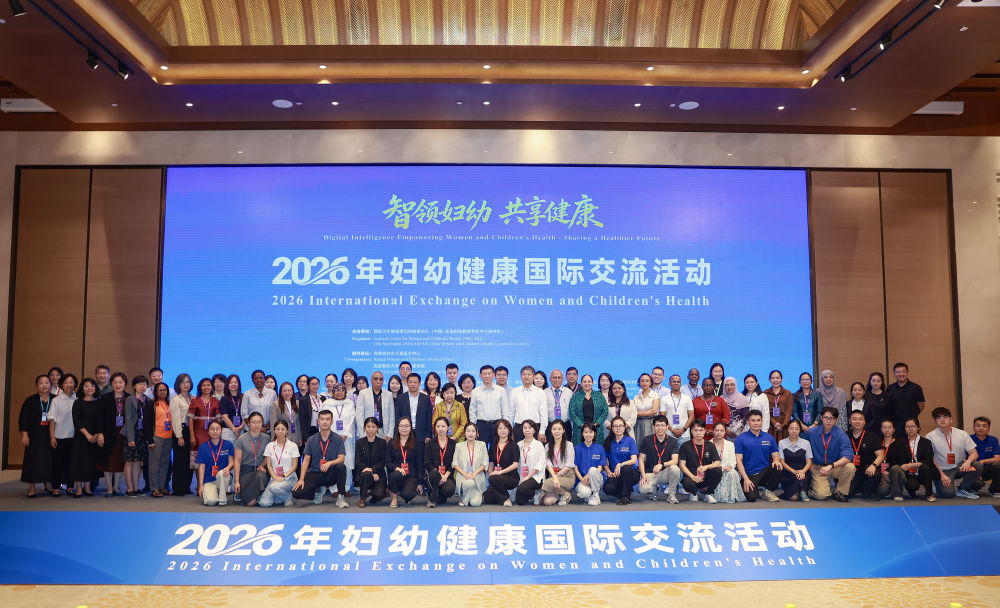
Participants pose for a group photo at the 2026 International Exchange on Women and Children's Health. (Photo provided by the event organizer)
BEIJING, Oct. 26 (Xinhua Silk Road) -- The 2026 International Exchange on Women and Children's Health was held in Boao, south China's Hainan Province, on October 23-26, attracting over 170 representatives from government health departments, international organizations and the health sector across Asia and Africa.
At the event, themed "Digital Intelligence Empowering Women and Children's Health -- Sharing a Healthier Future", participants exchanged views on deepening South-South cooperation, strengthening China-ASEAN and China-Africa exchanges and mutual learning on women and children's health, and advancing women and children's health-related goals under the United Nations 2030 Agenda for Sustainable Development.
The event also provided a platform for women and children's health insiders from China and abroad to engage in dialogue and explore opportunities for cooperation.
Gao Xinpu, deputy director of the Hainan Provincial Health Commission, said that Hainan, leveraging its free trade port's strategic position and opening-up advantages, will actively serve as a bridge for practical cooperation between China and other countries and regions in women and children's health.
Xu Zongyu, director of the National Center for Women and Children's Health under the National Health Commission (NHC), said that women and children's health is an important indicator of social development. He called for deeper South-South cooperation, exchange and mutual learning, and the full use of the event's open and collaborative platform to integrate resources and share China's practical experience and appropriate technologies with the Global South.
China has continued to strengthen its foundations of health services for women and children, establishing a service system covering both urban and rural areas and introducing digital technologies into clinical practice.
According to the NHC statistics, China's average life expectancy reached 79.25 years in 2025, while the maternal mortality ratio fell to 13.4 deaths per 100,000 live births and the infant mortality rate declined to 3.8 per 1,000 live births. These indicators have already met the corresponding targets set under the UN 2030 Agenda for Sustainable Development.
Nadia Rasheed, representative of the United Nations Population Fund to China, cited UN statistics as saying that approximately 260,000 women worldwide died from complications related to pregnancy and childbirth in 2023. Such health risks can be further exacerbated by conflicts and weak health systems. She called for sustained investment in health services to improve maternal and child health outcomes.
Li Nan, an expert in women and children's health at the UNICEF Office in China, said China had developed replicable practices in areas such as early newborn care, which could serve as useful references for other countries.
Representatives from several Asian and African countries expressed strong interest in practical cooperation tailored to their respective needs.
Kruy Leang Sim, undersecretary of state of Cambodia's Ministry of Health, said the country's maternal and child health had improved, but gaps in medical services remained in remote areas. Cambodia hoped to learn from international experience to address these challenges, he added.
Muna Abdullah Ali, a health system specialist with the UNFPA East and Southern Africa Regional Office, said that the African region continued to face a substantial burden of maternal illness with a lack of proper medical equipment and professional training. She expected that affordable, practical technologies related to maternal and child health could be introduced into Africa while deepening cooperation in staff training.
San Lwin, deputy secretary-general of ASEAN for ASEAN Socio-Cultural Community, said in a video address that women and children's health had long been a priority of China-ASEAN health cooperation. He expected to advance practical collaboration in knowledge sharing, capacity building and other areas.
Xu Zongyu said that China would organize joint training programs for ASEAN countries and African nations and launch a number of cooperation projects in maternal and child health.
Xu said that China is planning to train at least 1,000 maternal and child health professionals from ASEAN countries over the next three years, while promoting the coordinated sharing of technologies, products and practical experience.
An exhibition of maternal and child health technologies and products was also held during the event. A guest from Tanzania's Ministry of Health said she was impressed by innovative achievements showcased at the exhibition, particularly artificial intelligence-powered cervical cancer screening technology, which she hopes to bring back to Tanzania.
The 2026 International Exchange on Women and Children's Health was organized by the National Center for Women and Children's Health of the NHC. (Edited by Li Xueqing with Xinhua Silk Road, lixueqing@xinhua.org)
 A single purchase