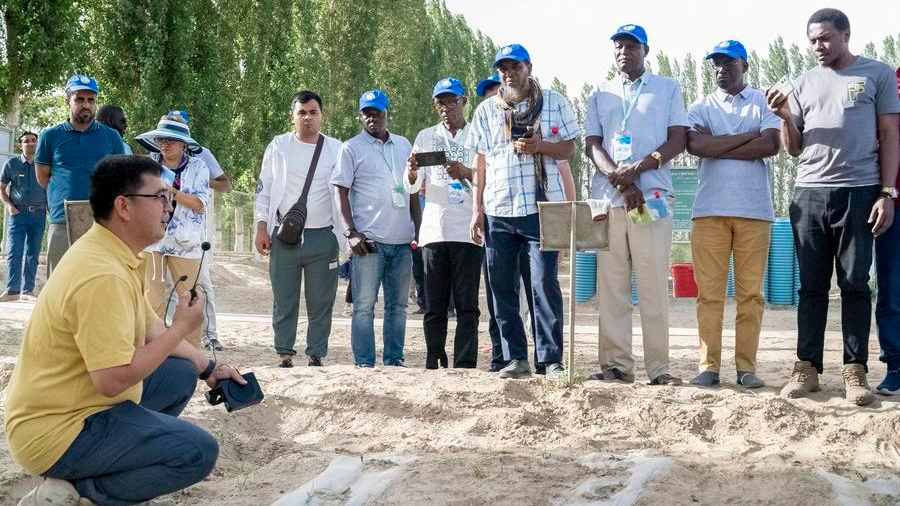




A Chinese expert introduces desert plants to people from central Asian countries at a desert research station in northwest China's Xinjiang Uygur Autonomous Region, June 13, 2023. (Xinhua/Zhou Shengbin)
BELGRADE, Aug. 25 (Xinhua) -- The global governance system can draw inspiration from China's major global initiatives in a multipolar world, a former senior UN official told Xinhua in a recent interview.
"China's four initiatives give together a very important set of values and principles that, in my opinion, ought to be applied to the current system that we have in order to transform it," said Vuk Jeremic, who served as president of the UN General Assembly (2012-2013) and foreign minister of Serbia (2007-2012).
Jeremic currently leads the Center for International Relations and Sustainable Development, a global public policy think tank based in Belgrade.
He was referring to a series of major global initiatives proposed by China: the Global Development Initiative, the Global Security Initiative, the Global Civilization Initiative and the Global Governance Initiative.
Reviewing the evolution of the international landscape, Jeremic said the world is no longer unipolar. "There is no single center of power that dominates all others," he said. The world has moved toward multipolarity, he noted, but a new multipolar world order has yet to be fully established.
Jeremic said the emergence of a multipolar world does not mean a more cooperative international system.
He outlined three possible forms of multipolarity: competitive, managed and cooperative. Competitive multipolarity would see major powers compete fiercely without recognizing each other's legitimacy, increasing the risk of conflict. Managed multipolarity would involve competition within agreed rules and red lines to prevent misunderstandings and escalation.
Cooperative multipolarity, meanwhile, would see major powers recognize each other's existence, legitimacy and rights and work together to address common challenges such as climate change and the regulation of advanced technologies, including artificial intelligence.
"This third multipolar version, cooperative multipolarity, is something that we should all hope for," he said.
Jeremic also spoke highly of China's development over recent decades, describing it as "the most successful exercise in the history of human development."
He cited lifting hundreds of millions of people out of poverty and increasing opportunities to participate in economic and social development as major achievements. He also highlighted China's technological achievements, noting that the country has become a leading tech power.
It is in this broader context, Jeremic said, that China's four global initiatives have particular significance.
He identified the four initiatives as important components of China's approach to global challenges, stressing how the Global Governance Initiative is people-centered and action-oriented.
Global governance, he said, should be "not just for governments around the world, not just for certain blocs, but for the people."
"For somebody who comes from a very small country, this respect for international law and the sovereign equality of nations that is deeply embedded in the Global Governance Initiative is something very appealing," he said.
In his view, these principles are particularly relevant, given that the existing multilateral system faces significant challenges and that international institutions fail to better reflect today's realities.
"We do have a multilateral system that is not terribly functional these days," he said. "We need to change it, we need to reform it."
Though transforming the international system would be a lengthy process, Jeremic said China's global initiatives provide principles for countries worldwide to explore a more cooperative multipolarity.
 A single purchase