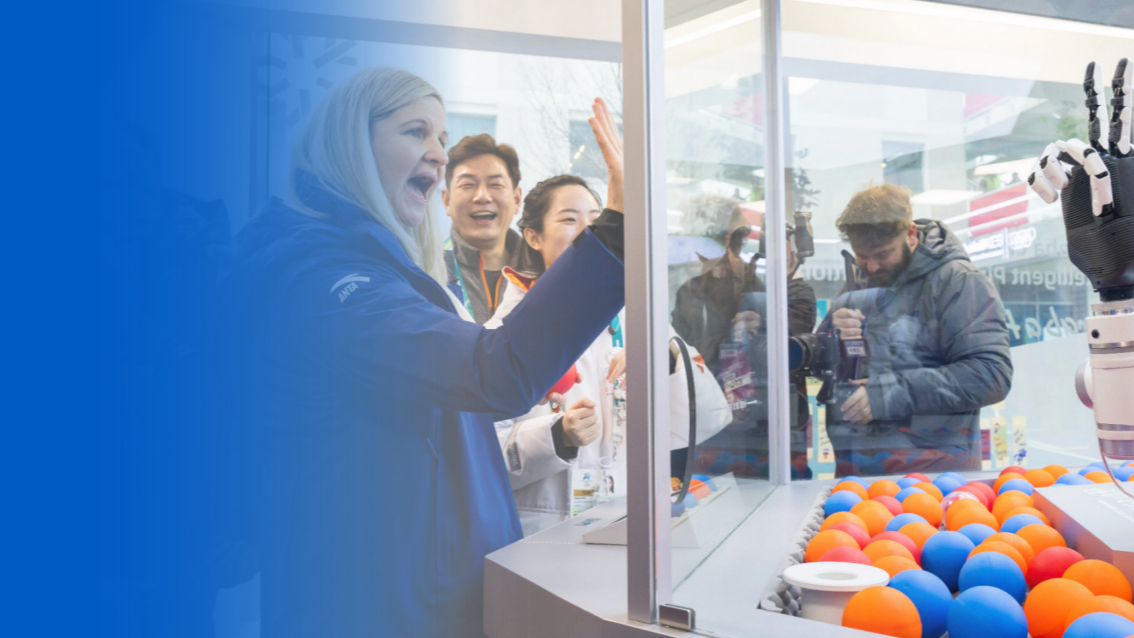



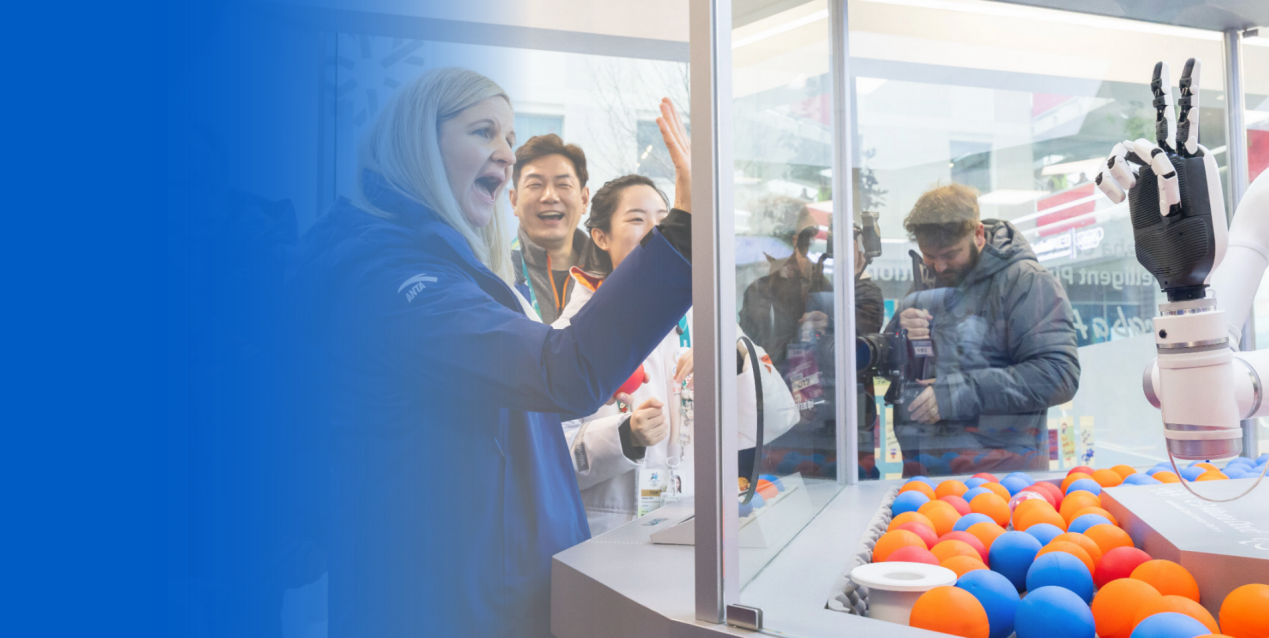
IOC President Kirsty Coventry tries out AI-powered pin trading.
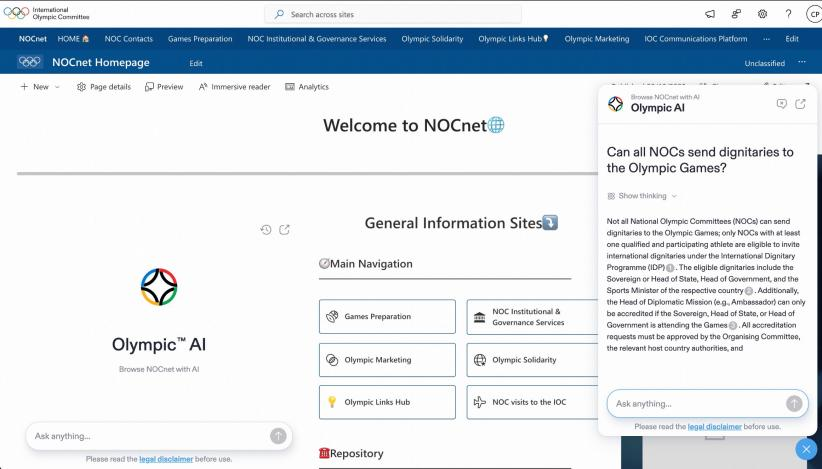
The National Olympic Committee AI Assistant.
High in the Alps, a freestyle skier launches into the air and performs complex aerial spins. In the meantime, across the venue's giant screens and the global broadcast feed, a time-slice motion trail effect freezes the skier's entire set of motion onto a single frame, allowing viewers to clearly see split-second details that the naked eye could not capture.
This is not computer-generated imagery from a science-fiction film, but a real scene from the Milan-Cortina 2026 Olympic Winter Games. Behind this centenary sporting gala of the Olympic Movement, a profound, AI-driven transformation is quietly unfolding. As a Worldwide Olympic Partner, Chinese company Alibaba Cloud equipped the Winter Games with a "smart brain" and ushered in a new era of intelligent Olympics through its AI-powered global cloud-computing network.
Making the Olympics Smarter: The Debut of the First Official Olympic Large Language Model
A staff member of Brazil's Olympic delegation traveled to Italy for the first time for the Winter Games. Confronted with competition venues scattered across multiple cities, a complicated event schedule and numerous official documents in foreign languages, he initially found himself completely overwhelmed.
"Our delegation needs to apply for additional training venues. What's the procedure?" he asked, posing the question in Portuguese to the AI assistant on his computer. Within seconds, the screen displayed not only the complete application procedure, but also a download link for the relevant forms and the deadline.
This was a scene that genuinely played out at the Milan-Cortina 2026 Olympic Winter Games. On February 5, 2026, International Olympic Committee (IOC) President Kirsty Coventry announced that built on the Qwen Large Language Model, the IOC had created the first official large model in Olympic history, and deployed it simultaneously across both professional Games operations and public services.
On the professional operations side, the National Olympic Committee AI Assistant was made available to staff from National Olympic Committees around the world. Drawing on the Qwen model's multilingual comprehension, the assistant has not only "read" its way through millions of words of official handbooks, rule documents and event guides, but also supported real-time interaction in 119 languages. It dramatically boosted the efficiency of global delegations in coordinating their preparations for the Games, and made "Chinese standard" a preferred solution for tackling the management challenges of major international events.
For providing public services, the official Olympic website (Olympics.com) simultaneously launched the "Olympic AI Assitant," providing audiences worldwide with real-time, precise answers to all sorts of questions, from competition rules to Olympic history.
"Thanks to the technology of Qwen, the Milan-Cortina 2026 Olympic Winter Games will deliver smarter operations, deeper engagement and new possibilities for the Olympic Movement," Coventry said.
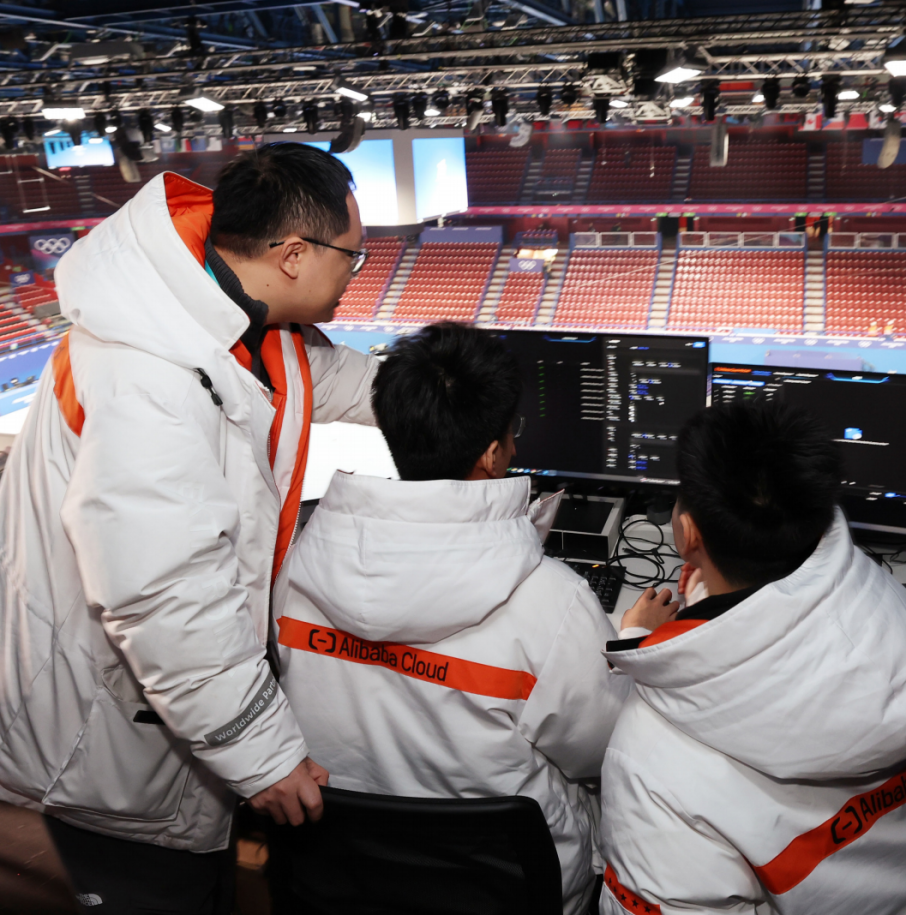
Alibaba Cloud engineers work in a stadium during the Milan-Cortina 2026 Olympic Winter Games.

The athlete's motion trajectory picture processed by AI algorithms.
Bringing the Brilliance to Light: Winter Olympic Broadcasting Redefined by AI
Throughout Olympic history, prohibitive broadcasting costs and high technological barriers have made it difficult for many countries to fully capture and share the brilliance of the Olympics. AI technology is breaking down that barrier, and Qwen model is deeply empowering the live broadcasting and content production at the Milan-Cortina 2026 Olympic Winter Games.
Through the OBS Live Cloud platform, Olympic Broadcasting Services (OBS) supported 42 rights-holding broadcasters worldwide and delivered 442 live video feeds, while its Content+ platform released more than 5,000 highlight clips to global audiences, bringing the excitement of the Winter Olympics to countless households.
This model of inclusive coverage did not come at the cost of compromised technical standards. On the contrary, the team spared no effort to improve video quality across the board through a range of technological approaches. Faced with challenges unique to the Winter Games, such as severe glare off the snow, the extreme speed of the athletes and the short duration of each event, the team chose to start from the core physical characteristics of motion to build their models and run their tests in innovative ways.
To simulate high-speed events like skeleton and luge, the team improvised by replacing professional gear with the most ordinary push cart, filmed the motion while a colleague pushed the cart, and then used post-processing to recreate the high-speed downhill scenes. For major events such as freestyle skiing big air, the team traveled to the ski slopes to conduct field tests of various combinations of movements and overlaid visual effects. After continuous refinement, the team developed a new-generation recognition model to handle the extreme conditions of ice and snow. During the Winter Games, the system ran with zero failures, generating a total of 23,176 replay clips, of which more than 3,000 were picked up by the OBS main feed and television networks around the world.
At the same time, in pursuit of more stunning visuals, the team built an entirely new real-time 360-degree replay system. On one hand, it achieved the world's first fusion of time slice and free viewpoint, letting the key moments of an athlete's takeoff, flight, rotation and tuck unfold across three-dimensional space like the petals of a flower. On the other hand, the team turned the invisible laws of physics into a visible language, showing key metrics such as jump height, hang time, and speed in real time on screen, making complex, highly technical maneuvers easy to grasp.
Thanks to cloud-based computing power, the kind of visual magic that once required huge budgets was made readily available to rights-holding broadcasters, allowing audiences around the world to see the beauty of winter sports in detail as if they were there.

Your Epic Vibe, the first AIGC digital artwork in Olympic history and the opening film for the Milan-Cortina 2026 Olympic Winter Games.
Engaging the Entire World: AI Bringing the Olympics Closer to Billions of Fans
Before the opening of the Winter Games, the first official Olympic fan engagement initiative in the world — Alibaba Cloud AIGC Championship @ Milan-Cortina 2026 Olympic Winter Games — was launched, opening up an opportunity for the world's 8 billion people to take part in the Games creatively.
The competition drew users from nearly 130 countries and regions. Using Tongyi Wan video generation model, participants needed only to enter a natural-language description to generate short Winter Olympic videos on themes such as figure skating, short track speed skating, alpine skiing, and snowboarding. Works brimming with creative flair poured in, with some clips featuring the Great Wall, the Terracotta Warriors, and even a skiing Monkey King. In the end, selected highlights from nearly 15,000 submissions were woven together into the Winter Games' opening film "Your Epic Vibe," the first AIGC digital artwork in Olympic history and now part of the permanent collection of the Olympic Museum.
Ilario Corna, IOC's Chief Information Technology Officer, said: "The Milan-Cortina 2026 Olympic Winter Games marks a defining moment in the integration of AI into the Olympic Movement. Chinese enterprises have deployed cutting-edge technologies across a wide range of practical application scenarios — not only enhancing the everyday interactive experience for global fans through the Olympic AI, but also building intelligent systems such as Sports AI that will preserve historic Olympic moments for generations to come."
Every edition of the Olympics leaves behind a distinctive legacy. The legacy of the Milan-Cortina 2026 Olympic Winter Games may well be intelligence. AI technologies and capabilities from China have raised the technological bar of the Olympics, and have also written an open, inclusive, universally beneficial, and jointly shared Chinese solution to the questions of global digital economy cooperation and the advancement of intelligent society. (Gao Jingyan)
 A single purchase