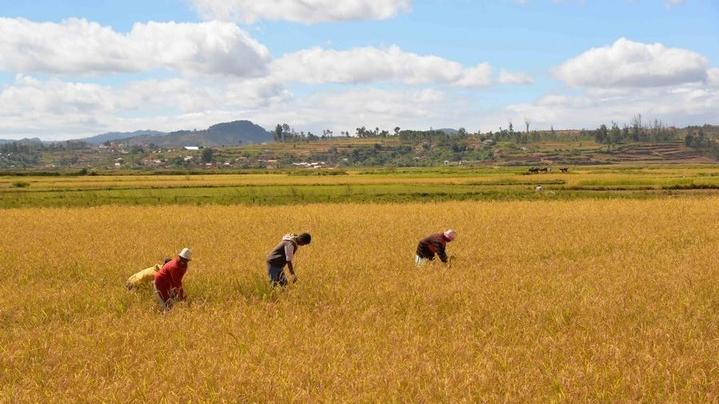



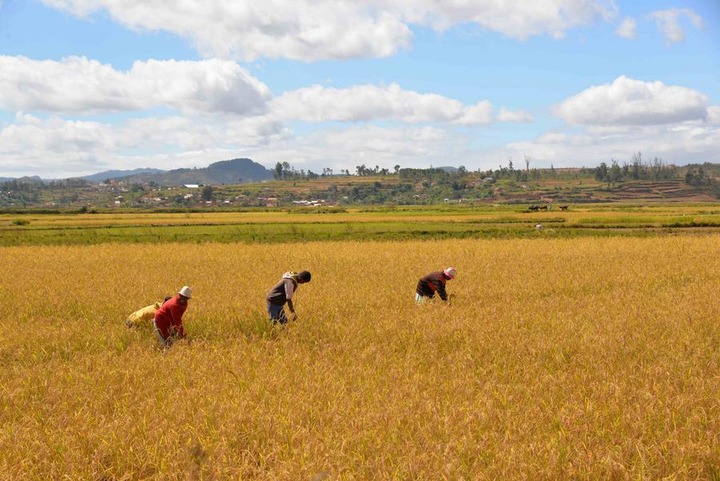
Local farmers harvest rice at a high-yield hybrid rice demonstration field in Mahitsy, Madagascar, on May 8, 2024. To help more African countries reduce food shortages, the China National Hybrid Rice Research and Development Center inaugurated its Africa sub-center in Madagascar in May 2019. The average yield of hybrid rice produced in Madagascar with Chinese technologies is two to three times more than that of local ones. (Photo by Sitraka Rajaonarison/Xinhua)
Before coming to China, I knew nothing about the Belt and Road Initiative (BRI). I first saw it mentioned in the Beijing Normal University information brochure, not knowing it was an initiative that has been bringing development to struggling and underdeveloped countries like Liberia. As a student in China, my journey has not only allowed me to earn a degree but also to gain an in-depth understanding of BRI.
My experience in China has helped me better understand the broader vision behind the BRI. Over the years, BRI has contributed significantly to the development of many developing and underdeveloped countries. China's approach to cooperation shows that it is not only an economic partner but also a committed one, especially in infrastructure and human development.
Through BRI, I have come to understand the importance of connectivity in three major ways. The first is hardware: physical infrastructure such as roads, railways, and transportation systems that connect people and markets. These developments are visible and impactful, making movement and trade easier and more efficient. The second is software: policies, development strategies, and cooperation frameworks that support long-term growth and mutual understanding. The third is people-to-people exchange, which brings cultures together. These three layers work together; roads alone are not enough without the policies to support them and the people who use them every day.
In Liberia, the BRI has begun to make its presence felt. Infrastructure projects supported by Chinese cooperation have contributed to road rehabilitation and energy improvements. Right now in Monrovia, the Tubman Boulevard two-way overpass bridge is under construction, a small but visible example of this cooperation taking shape. While Liberia is still developing, the partnership offers hope for stronger connectivity with both China and neighboring countries. For a nation that endured years of civil war, any support for rebuilding is meaningful. BRI, from my perspective, is not about domination but about partnership. I have seen how my countrymen welcome Chinese businesses and workers, and I believe this mutual respect is the foundation of lasting cooperation.
Life out of my comfort zone
Living in China has shown me the deeper meaning of the BRI. To the world, it may represent infrastructure, trade, and development, but to me, it represents opportunity and transformation. Through roads, railways, policies, and people-to-people exchanges, China has built connections that go beyond economics. From my perspective, the BRI gives me a chance to change uncertainty into purpose.
Here, I am learning more than business theories. I am learning discipline from a culture that values order and harmony. I am learning patience from living in a society different from my own. I am learning and understanding from engaging with people whose history, beliefs, and systems are unlike those I grew up with in Liberia. Even the smallest daily experiences have become lessons. Learning to use chopsticks, for example, was not easy at first. My early attempts tested both my patience and my coordination. Although spoons are available in China, I chose to challenge myself by practicing with chopsticks to embrace the culture. With time and persistence, what once felt awkward has become enjoyable, and I now use them with confidence and even a smile. This simple experience reminds me that growth often begins with small, uncomfortable steps.
Beyond chopsticks, everyday interactions have taught me just as much. In the classroom, my Chinese professor has been patient and encouraging, always finding small ways to make me want to learn more, a kind word after a mistake, an extra explanation when I struggle with a tone. That encouragement matters. At the campus cafeteria, I once asked the staff for soup to go with my rice, the way we eat back home. They laughed, not unkindly, just surprised. At first, I felt embarrassed, but then I laughed too. In Liberia, we enjoy rice with a rich soup, often with meat or fish, so every spoonful is flavorful. Now I appreciate both ways. These small moments: a professor's patience, a shared laugh over soup, and the discovery of a different plate of rice, remind me that connection does not require grand gestures. It lives in the ordinary, in the repeated, in the patient act of showing up and trying again.
When I return to Liberia, I hope to use what I have learned here, not just the business theories, but the discipline, patience, and open-mindedness. I want to contribute to my country's development and the friendship between Liberia and China. Looking back, I realize that my journey is not only about personal success. It is about what becomes possible when opportunity meets perseverance. The BRI not only connects nations but also reaches me at a moment when I need a new direction. That is why this story matters to me, and why I hope to carry it home to Liberia.
Editor's Note: This article is written by Dorothy P. Brown from Liberia, who is now studying at the Belt and Road School of Beijing Normal University. The views expressed in this article are those of the author and do not necessarily reflect the positions of the Belt and Road Portal or Beijing Normal University.
 A single purchase