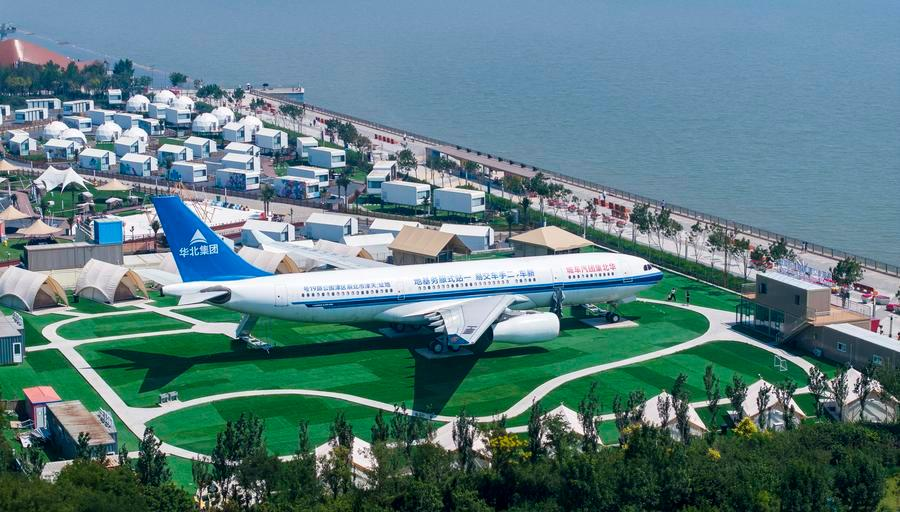



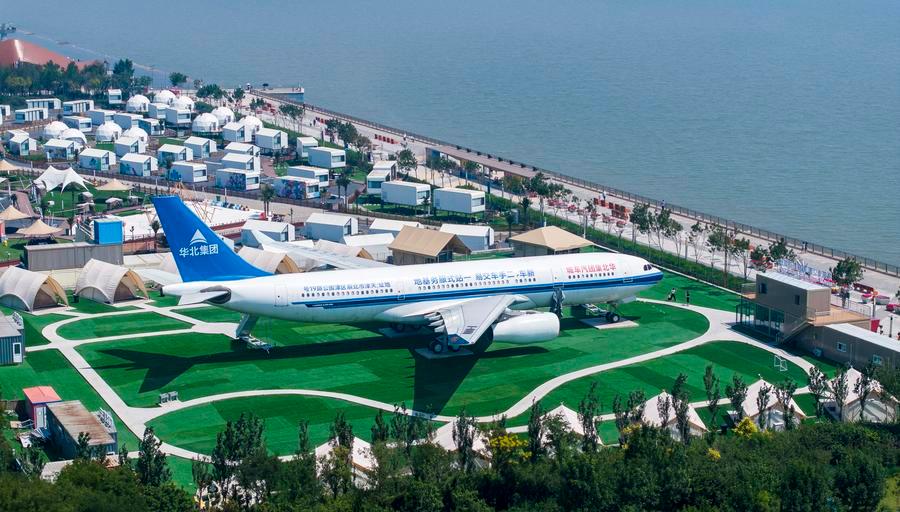
A drone photo taken on June 21, 2025 shows a camping base at a seaside park in Binhai New Area in north China's Tianjin. (Xinhua/Zhao Zishuo)
TIANJIN, May 26 (Xinhua) -- Early morning at a science park in north China's Tianjin Municipality, groups of young people streamed into the shared office space, booted up their laptops, and kicked off their workday. Among them is Wang Haoquan, an entrepreneur in his 20s and founder of a cultural technology company.
His company is a typical One-Person Company (OPC). Empowered by artificial intelligence (AI) tools, Wang handles the entire business chain from video creativity, editing and production to online promotion single-handedly, providing digital marketing services for local merchants.
"Not long after its establishment, the company has already secured clients and achieved preliminary profitability," he said.
In recent years, youth entrepreneurship in China has taken on new characteristics of "light asset and high intelligence." Represented by OPCs, the lightweight entrepreneurship model has emerged in large numbers, becoming a key window into China's innovation vitality.
Different from the traditional solo startup model, OPC refers to a business form where individuals can complete the full closed commercial loop from product R&D to market launch with the support of AI tools. AI agents help individual entrepreneurs complete multiple work processes that previously required team collaboration. Their joint efforts greatly reduce the barriers to entrepreneurship, allowing more young people to participate.
Since the end of 2025, more than 20 new OPCs have been registered in the Huayuan science park in Tianjin Binhai High-tech Industrial Development Area, covering fields including cross-border e-commerce, software development, and AI content production.
Though run by individual founders, these companies form a collaborative network in the shared space, where individuals from different backgrounds can exchange technologies and creative ideas in real time to complement each other's resources.
"I majored in art and lack accumulation in programming and other technical fields, but the OPC founder at the opposite desk is a senior programming expert. When encountering tricky technical problems, we can just look up and communicate face to face," Wang said, noting the vibrant entrepreneurial atmosphere in the community.
"This model retains the flexibility of individual entrepreneurship while possessing certain collaborative advantages," said Sun Lei, head of the park operator. The platform has formed a service system from initial incubation to enterprise acceleration, providing support for enterprises at different stages of development.
This new trend has caught the attention of local governments across China, with Shenzhen, Shanghai, Nanjing and other cities rolling out targeted supporting policies. The Longgang District of Shenzhen in south China has issued a policy consultation document for OPC development, with "zero-cost startup" as the core highlight, attracting global AI agent developers and OPC entrepreneurs.
Tianjin Binhai High-tech Industrial Development Area has introduced policies including office space subsidies and computing power cost support, providing a maximum annual subsidy of 300,000 yuan (around 43,912 U.S. dollars) for OPCs to offset the high computing cost.
"The development of AI is reshaping the entrepreneurial landscape, and we must seize this new track," said Chang Xinyue, director of the new economy bureau of Tianjin Binhai High-tech Industrial Development Area.
The "high intelligence" feature of Chinese youth entrepreneurship is becoming more prominent as a result of technological advancements. In the industrial system of Tianjin Haihe Laboratory of Brain-Computer Interaction and Human-Machine Integration, enterprises are developing cutting-edge technologies such as brain-computer interface, combining neuroscience and AI for application in medical health and other fields.
Industry insiders pointed out that the new generation of entrepreneurs relies more on knowledge and technological innovation. The technical content and growth potential of the enterprises are substantial, despite their modest size. This innovation-centered entrepreneurship model is becoming a driving force in industrial upgrading.
 A single purchase