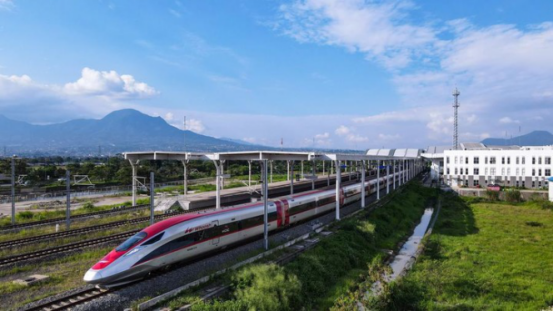



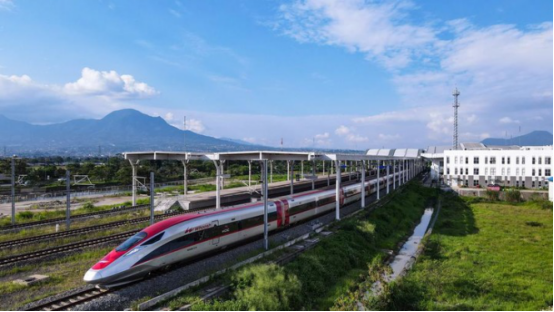
An aerial drone photo taken on May 20, 2025 shows a high-speed electrical multiple unit (EMU) train leaving Tegalluar Station of Jakarta-Bandung High-Speed Railway (HSR) in Bandung, Indonesia. (Xinhua/Xu Qin)
Before coming to China, my understanding of the Belt and Road Initiative (BRI) was limited. I had heard the phrase, but it felt formal, technical, and far removed from my own experience as a young Indonesian professional.
I never imagined it would become something I would think about so personally. Yet living and studying in Beijing gradually changed that.
At first, I assumed the BRI was mostly a conversation for officials, economists, and policymakers. I did not connect it to the lives of ordinary Indonesians, including people my age. It seemed significant, but distant.
I knew the name, but not its real meaning. I had not yet understood how closely it could relate to roads, railways, jobs, industrial development, and the wider question of Indonesia's future growth.
-- A shift in perspective
Living in China gave me more than a new place to study. It gave me distance, and sometimes distance helps you see home more clearly.
From here, I began noticing how often China appeared in conversations about Indonesia's investment, transport, industrial upgrading, and technology. What once felt abstract started to feel practical.
I realized this was not only about diplomacy. It was also about what gets built, how cooperation works on the ground, and how countries like Indonesia prepare themselves for the next stage of development.
-- When the numbers spoke
What changed my view most was the scale of the relationship. During 2021-2025, Chinese investment in Indonesia reached:
Total investment of 34.4 billion U.S. dollars,
Average annual growth of 37 percent,
Absorption of 732,599 local workers.
Source: Indonesia Investment Coordinating Board (BKPM)
When I saw these figures, the relationship stopped feeling symbolic. It started to feel like a real and expanding economic presence.
For me, these numbers made it easier to understand that this cooperation is already part of Indonesia's development story, not something distant from it.
-- Not only capital, but opportunity
The investment figures mattered to me not only because they were large, but because they pointed to something more meaningful. Growth of that scale suggests continuity, confidence, and long-term commitment.
The local employment figure also made a strong impression on me. It reminded me that investment is not only about capital entering a country. Chinese investment is always about space for jobs, skill development and broader participation. That was the moment I began to see Chinese investment in more human terms.
-- Whoosh made it feel real
For me, the Jakarta-Bandung High-speed Railway, known locally as Whoosh, is one of the clearest examples of why this cooperation feels real. It is not just something people hear about in speeches or headlines. It is something people can actually see, use, and experience. That matters because it turns international cooperation into something visible in daily life. Projects like this shape how people imagine progress. They make modernization feel concrete. For many Indonesians, including me, Whoosh helped make the idea of China-Indonesia cooperation easier to understand.
What makes this story meaningful to me is not only the physical infrastructure, but also the growing capability behind it.
When cooperation results in more advanced systems, better trained people, and more confidence in what Indonesians can operate and manage, it feels deeper than a single project. It feels like capacity building. That is what stayed with me.
I started to think infrastructure about less as a symbol and more as a way to strengthen Indonesia's own readiness for a more modern and connected future.
-- Seeing EVs and industry in a new way
Another turning point for me was thinking about electric vehicles (EVs) and downstream industry. Indonesia has long been known for its natural resources, but the bigger question has always been whether those resources can support higher-value industries at home.
That is why the EV ecosystem feels important. It represents more than a new product category. It represents the possibility of industrial upgrading.
The more I reflected on it, the more I saw Chinese investment not only as money, but as something that could support Indonesia's move into more advanced manufacturing.
I also came to realize that this relationship is not only about railways, factories, or industrial zones. It is also about digital systems, connectivity, and the wider digital economy.
That part matters to me because the future will not be built only with concrete and steel. It will also be shaped by platforms, information flow, technological capability, and how well countries adapt to digital transformation.
Once I saw that, the story felt even broader. It was no longer just about visible projects, but about the systems that support a more modern economy.
-- I began to see finance on a larger scale
Having worked in fintech and, more recently, banking, I was already familiar with finance in a practical sense.
But living in China helped me see it from a wider perspective. I began to understand more clearly that finance is not only about serving markets or customers. It also helps make large-scale development possible through investment, coordination, and long-term planning.
In that sense, instruments and channels such as local-currency cooperation, panda bonds, or offshore RMB funding channels like dim sum bonds made me appreciate more deeply how financial cooperation can support long-term development. That realization made this topic even more relevant to me, both professionally and personally.
As a young Indonesian professional, I do not think investment should only be measured by how much money enters the country. The more important question is what kind of future it helps create.
Does it improve connectivity?
Does it support higher-value industries?
Does it help strengthen skills and technological capability over time?
These questions feel personal to me because my generation will live with the long-term outcome. We are not only watching these changes from a distance. We are the ones who will inherit the economy they help shape.
-- What stayed with me most
Before coming to China, the BRI felt distant for me. But now my perspective is different. At its best, Chinese investment is not just about capital entering Indonesia. It can support modern infrastructure, stronger industrial capacity, digital development, and a more future-ready path for the country.
What changed most is not only my opinion, but my sense of relevance. I no longer see this as someone else's conversation. I see it as part of Indonesia's own story, and part of the future my generation hopes to build.
Editor's Note: This article is written by Satria Fajar Ardianto from Indonesia, who is now studying at Beijing Normal University. The views expressed in this article are those of the author and do not necessarily reflect the positions of the Belt and Road Portal or Beijing Normal University.
 A single purchase