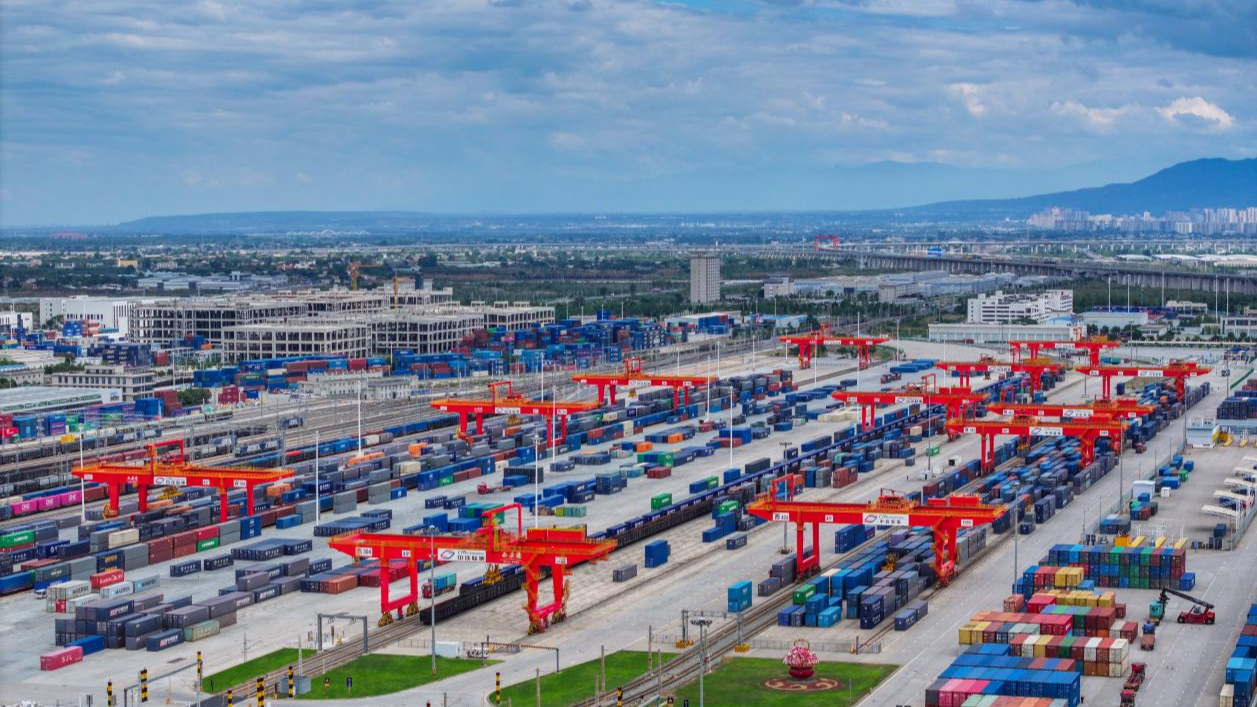



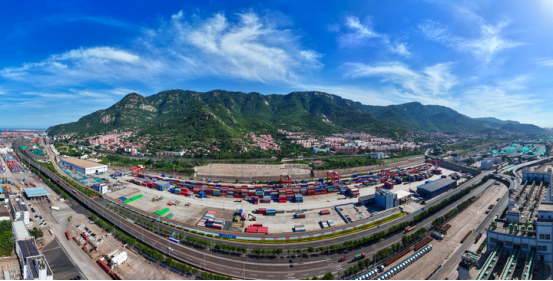
An aerial drone photo taken on June 26, 2024 shows a view of the China-Kazakhstan (Lianyungang) Logistics Cooperation Base in Lianyungang, east China's Jiangsu Province. (Xinhua)
The wheels of China Railway Express (CRE) trains always roll forward, and resounding whistles blare from time to time.
Building on the 14 CRE hubs established across different regions in China, the CRE's operation model is shifting from "point-to-point" to "hub-to-hub," and an efficient collection and distribution system that features trunk-and-branch integration and hub-centric distribution is rapidly taking shape.
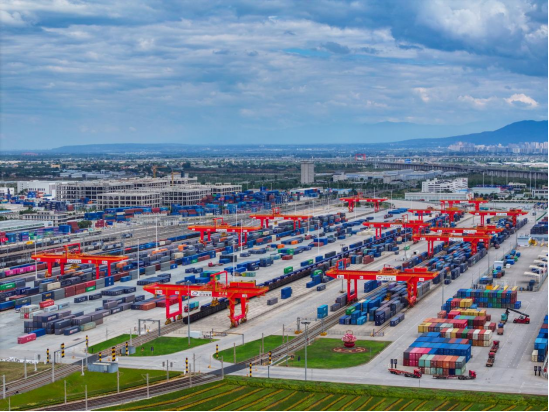
An aerial view of Xi'an International Port. (Administrative Committee of Xi'an Chanba International Port)
Transformation: From a Small Station to an International Gateway
If you visit the Xi'an hub of the CRE at Xi'an International Port Station, you will immediately be greeted by a busy scene of gantry cranes constantly lifting and lowering as cargo trucks stream in and out.
Twelve years ago, the first CRE train via Xi'an departed from right here. It was also one of China's first CRE trains launched after the Belt and Road Initiative was proposed. The previously obscure small station -- Xinzhu Station -- completed a dramatic transformation amid this era of change, becoming a crucial node connecting East and West today.
Now, a logistics network spanning Eurasia has been constructed here: 18 international main routes stretch out like vital arteries, covering major sourcing areas; 26 domestic assembly lines support the structure for inland assembly and global distribution. "A train enters or leaves the port every 80 minutes, an interval that is 20 minutes shorter than last year," said Yuan Xiaojun, general manager of Xi'an International Port Group Co., Ltd. According to data from China State Railway Group, core indicators for the CRE via Xi'an, such as the number of train trips, freight volume and heavy container rate, have ranked first in the country for seven consecutive years.
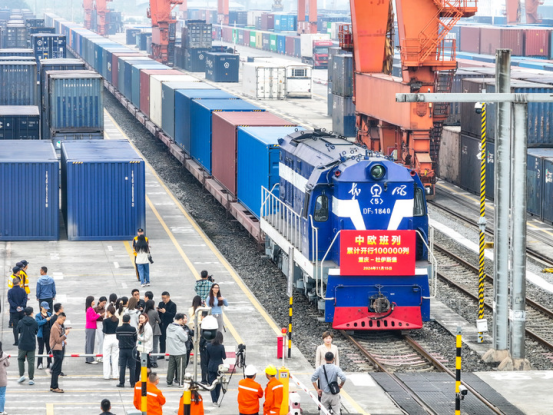
The 100,000th CRE train, coded X8083, waits for departing at the Tuanjiecun Station in Chongqing, southwest China, Nov. 15, 2024. (Xinhua)
Chongqing's Tuanjiecun Station underwent a similar transformation over more than a decade, evolving from a small station surrounded by farmland into a transportation hub connecting all directions and reaching the entire world. The operation of the CRE has created a new space for opening up of this inland region in southwest China, which is neither along the border nor near the sea.
Connectivity: From "Point-to-Point" to "Hub-to-Hub"
Recognizing the increasingly prominent assembly efficiency of the CRE, many countries along the routes have proactively sought to push forward practical cooperation.
In Duisburg, Germany, local authorities are actively pushing for the modernization and upgrading of infrastructure, which has in turn bolstered the rapid development of associated industries.
In June 2025, the China Xi'an Kazakhstan Terminal in Almaty was officially completed and put into operation. Just over a year earlier, the Kazakhstan Xi'an Terminal, jointly built by China and Kazakhstan, began operations in Xi'an. The two terminals have turned the blueprint for a "dual-hub" connection for the CRE into a reality, completely opening up the artery for loaded containers both ways. This ensures that trade flows in an endless cycle.
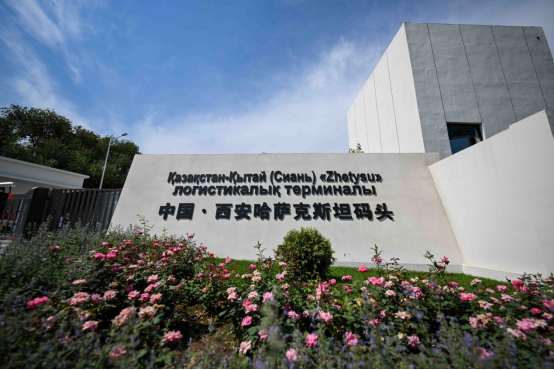
This photo taken on Aug. 1, 2025 shows the sign of Xi'an Kazakhstan Terminal in Almaty, Kazakhstan. (Xinhua)
"We set up a company in Xi'an, gather goods from various regions of China to Xi'an, and then load them on the CRE trains from Xi'an to various regions in Europe, Russia and Central Asia," said Ozas Alibekov, deputy general manager of the China branch of KTX Express. "With this terminal, Kazakh goods assembled in Xi'an can also go south to Guangxi and enter Southeast Asian countries like Vietnam and Thailand. This gives us another vital economic and trade channel."
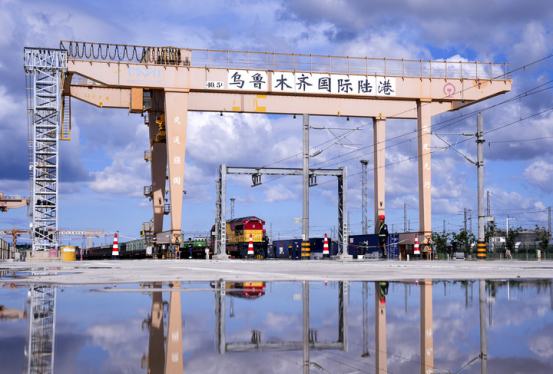
A CRE train loaded with goods departs the Urumqi International Land Port Area in northwest China's Xinjiang Uygur Autonomous Region, May 27, 2024. (Xinhua)
Prosperity: From a "Corridor Economy" to a "Hub Economy"
As the route layout becomes more diverse, its radiation capacity continues to rise, and the content of the trains constantly expands, the CRE has become a crucial engine driving the accelerated shift from a corridor economy to an industrial economy and a hub economy.
In the intelligent production workshop of Shaanxi Konka Smart Home Appliance Co., Ltd., a dishwasher is assembled every 20 seconds on average. This production base of Konka began operations in November 2022, and the distance from the base to the Xi'an hub is less than 1 kilometer. Leveraging this advantage, products can be packaged, transferred and shipped via the CRE within one day of production.
"Our channels, business scope and product categories are inseparable from the CRE. More than 60% of our products are exported via this route," said Chen Zhao, the company's general manager. As of September 2025, Konka had shipped 239,600 white goods via 47 special trains and 153 containers through the CRE.
The stable operation of the CRE hubs has not only reshaped the logistics map but also connected global industrial chains covering smart manufacturing, modern agriculture and high-end equipment, giving the market a major boost in confidence.
"The CRE's transit time is getting shorter and more stable with each optimization, allowing us to provide clients with better, steadier and more environmentally friendly supply chain solutions," said Li Na, general manager of Beijing Trans Eurasia International Logistics Co., Ltd.
Opportunities blossom wherever the railway extends. To the sound of the whistle, more CRE trains are fully prepared to set off. The journey is long, and new stories are just beginning. (By Shi Chunjiao and Lei Xiaoxiao)
 A single purchase